What Is the TEAS
The TEAS (Test of Essential Academic Skills) is a standardized test that is developed by ATI and administered by health science programs throughout the United States. It assesses skills in Reading, Mathematics, Science, and English and Language Usage, not on knowledge of nursing. Programs include it as one of the standardized data points in addition to GPA and prerequisite courses.
Who should take the TEAS?
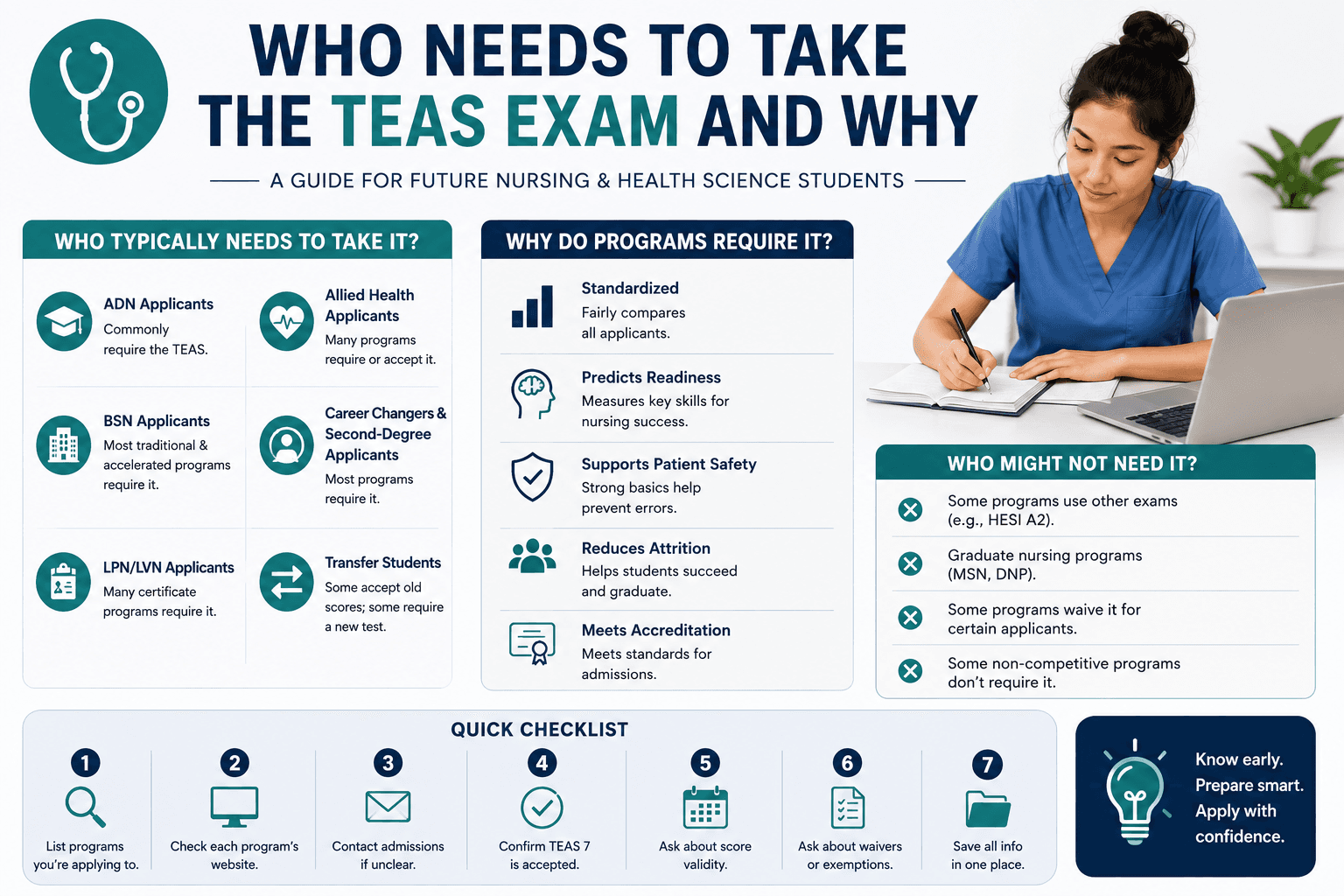
For the most part, if you're applying to most or many allied health programs, or nursing programs in the U.S., you will very likely need to take it. These are the most consistent users of the TEAS — including community colleges and technical schools that offer ADN programs, who are applying the test to provide a consistent method for comparing applicants with a diverse academic background. It's required for both 4-year programs and accelerated/second degree programs for BSN applicants. Score requirements for accelerated programs can be higher, and therefore competitive. LPN/LVN Applicants — There are many certificate and diploma programs that require the TEAS but the requirements are more varied than for RN-track programs. Applicants for allied health programs — such as radiologic technology, respiratory therapy, health information management, surgical technology, and some paramedic/EMS advancement programs — may be required to take the TEAS or accept it as one of a number of approved entrance exams. If you're not sure if your program is in this category, double check instead of taking a chance. Don't assume an existing degree in a subject you don't need for your career is accepted by a college for a degree in a different field.Don't presume that an existing degree in a subject that has nothing to do with your career will be accepted for a second degree in a different discipline. Many accelerated and second-degree programs still require the TEAS, as they wish to have a standardized and up-to-date measure of readiness for a rigorous science and math-based program. Transfer students — Requirements can be quite different. Some programs require a retake even if you've earned a TEAS score that is valid for them, while others may require it, even if you have passed elsewhere.
Who might NOT need to take it?
Some programs have other tests, such as the HESI A2, in addition to or instead of the TEAS — ask directly. For the most part, it is not required for graduate-level nursing programs (MSN/DNP for already-licensed RNs). A few programs do not require applicants to have specific criteria (high GPA, relevant coursework, or prior license). Don't make assumptions about waiver, unless it's written. Some LPN/LVN certificate programs will have no standardized entrance exam, and some programs will accept rolling admissions or non-competitive admission.
Why is it required for Programs?
It provides a common, comparable measure. The range of grades that are given is vast from one school to another and one teacher to another — 90% at one school does not always imply a 90% at another school. The TEAS is administered to all applicants in the same conditions. It forecasts ability to engage in a challenging curriculum. Nursing courses require a lot of content from the sciences, lots of clinical calculations based on math, a lot of reading, and a lot of written communication, all at once. Programs employ the TEAS since basic skills in the areas were strongly predictive of success in this type of course load. It helps to ensure patient safety. This is the one thing that counts the most. A future nurse who has difficulty with math, may miscalculate a dosage; a future nurse who has difficulty with reading may misread a patient's chart. Academic weakness in this area could have an impact on patient outcomes, so programs seek objective evidence in addition to grades. It helps reduce attrition. Nursing programs can be costly and rigorous to the student and the school. When students are under-prepared, they are at risk of failing or dropping out, which is an expensive course of action for everyone. The TEAS is used to increase admissions of students who are more likely to succeed in completing courses. It is compliant with accreditation requirements. Many programs have accreditation requirement that they require objective, standardized admissions measures, and a validated exam such as the TEAS can help in this demonstration.
Some of the most frequently encountered issues and resolutions.
- I wonder whether or not my program needs the TEAS. Check the official admissions page, or call/email the admissions office directly. Don't assume or use forums to determine what is going on in other schools.
- Multiple programs have different requirements and I am applying to several. Create a basic comparison chart showing requirement, minimum score, accepted version and valid period for each program.
- Do I need to complete this, as I already have a Bachelor's Degree? Yes, in most cases, if your program requires it (even if you don't have a degree). Make sure that you check if the student is exempted before assuming they are.
- I am a transfer student; will my previous score be transferred? Your new program will have two questions: Do they accept test scores from outside the program, and is your score within the allowed validity period (usually one to two years).
- How can I determine whether my program is one in which it is not needed? If you assume a waiver, confirm it with a letter from the admissions office.
- Why is this important if I am doing well on my coursework? The TEAS is complementary to your grades and not in place of them — it is used because grades are not comparable across schools and grading systems.
A Step-by-Step Checklist
- Go to each program's admissions webpage, and type in "TEAS," "entrance exam," or "admissions testing.
- If you are not sure, call the admissions office directly and make it clear if they require the TEAS and what score you must meet.
- Write the accepted version (TEAS 7 is current).
- Inquire about scoring window.
- Inquire about waivers or exemptions and criteria.
- Keep all the information in a single place; a simple spreadsheet is good.
- This can avoid two of the most expensive errors: studying for an exam when you don't need it, or finding out that you need it and not preparing at an appropriate time.
So what happens if you do not do it when you should?
In most programs, it is considered that a TEAS is required and if left blank or an unqualifying score is received, that the application is incomplete, regardless of all other materials. Other programs may have a grace period, but this is not a reliable option as deadlines are typically hard in competitive programs. Just let them know in advance and register early in order to receive score in time.
Conclusion
The key is whether the TEAS applies to you, it is not based on your background or what others have told you. The best thing to do isn't more general research — it's a direct conversation with your program's admissions office. After determining for certain if it applies, what score is required and when, you can develop a realistic, targeted plan rather than a plan based on guesswork.