Why there is not a Simple Answer to This Comparison
Difficulty is subjective, and the two exams are different enough that a student’s academic background will play a large role in which one seems more manageable. Most nursing students find that their own strengths in particular subjects dictate which exam is more approachable, rather than one exam being objectively easier across the board.
Structural Differences First Worth Knowing
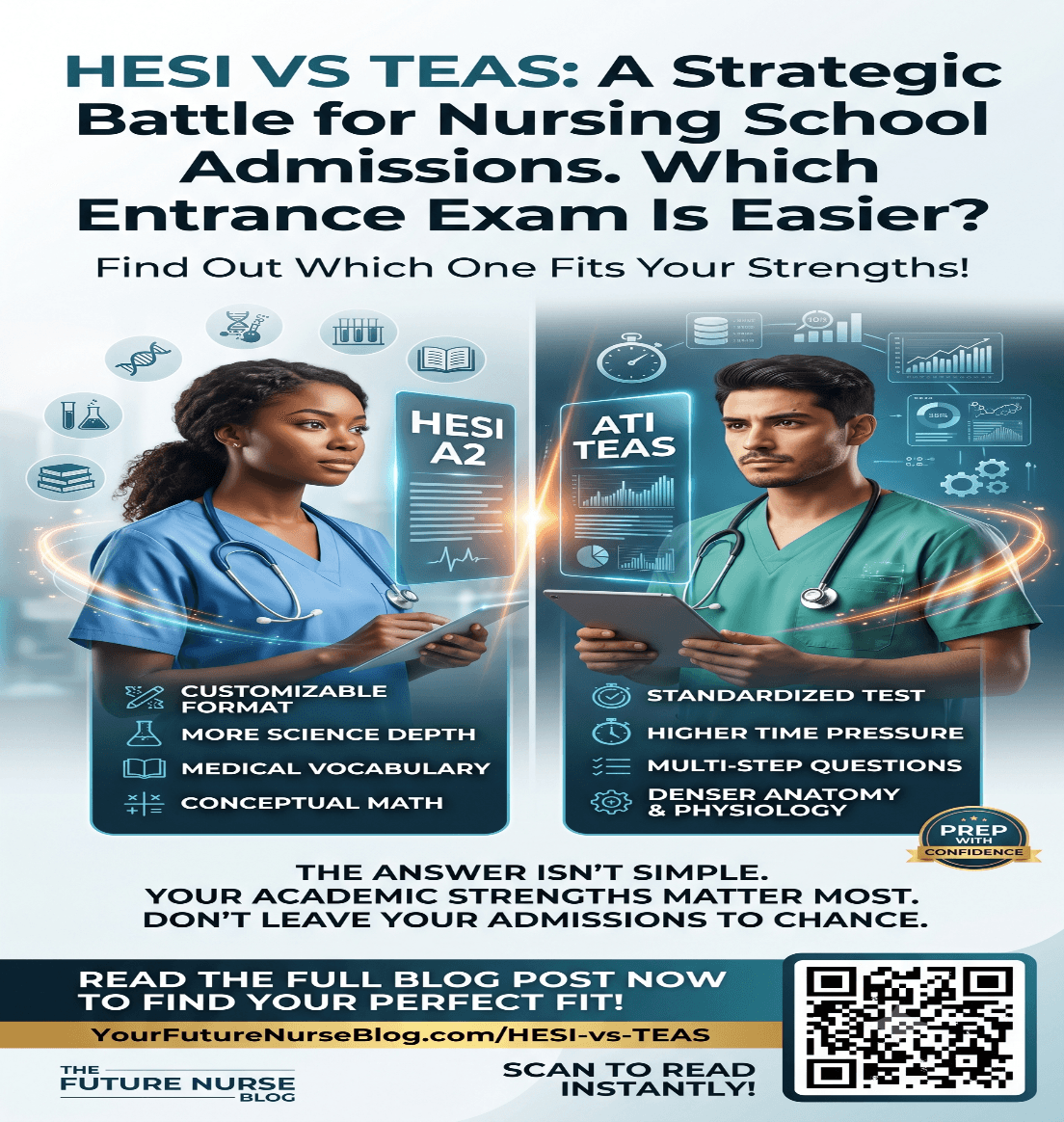
It is helpful to understand a major structural difference between the two exams before comparing difficulty. The TEAS is a standardized, fixed format test. All students will complete the same sections in the same order, regardless of the school they are applying to. Each nursing program, however, can customize the HESI A2, so the specific sections you have to take can vary a lot depending on your school. This means that two students applying to two different programs could take meaningfully different versions of the HESI A2. All TEAS test-takers take a consistent, predictable structure.
Where the HESI A2 Can Be More Difficult
Some common themes come out when comparing the HESI A2 is more challenging.
- More science material – The HESI A2 tends to get into more detail in chemistry and biology, which can be especially difficult for students who have not taken these classes in a while.
- Medical vocabulary depth — questions about vocabulary on the HESI are often going to use health-specific terminology that general test-takers may not see in their everyday reading.
- Physics, if required – some programs require a HESI A2 physics portion, which is not part of the TEAS at all and can be a surprise to students who do not anticipate it.
- Overall breadth of content – The HESI A2 can have more individual sections than the TEAS, so if students have trouble covering broad content, they sometimes find this exam more difficult than one that is more narrowly focused.
Where the TEAS Typically Feels Harder
Meanwhile, there are varieties of reasons that make the TEAS harder for other students. The TEAS also has more complex question formats than the HESI A2, which is more traditional multiple choice. Time pressure – the TEAS does tend to get faster and have more multi-step questions, which can be a challenge for students who need more time to work through complex reasoning. The science section of the TEAS is denser and covers a variety of topics in one section including anatomy, physiology and general scientific reasoning that some students find more difficult than the separated science modules on the HESI.
Comparison of Math Sections
Both tests test similar basic math skills, including fractions, decimals, ratios, percentages and basic measurement conversions. Neither test requires calculus or trigonometry. Both typically allow use of an on-screen calculator. Students may find that the math on the HESI is conceptual, but the calculator support makes it feel more manageable in practice. If you are comfortable doing dosage-style calculations, you are probably in good shape for the math section of either test.
How to Decide Which One Matters More to You
The more helpful question to ask is usually which one is easier overall, but you normally do not have a choice between the two (your nursing program will tell you which one you have to take). Therefore, the more helpful question to ask is “which one does my target school require?
- First - confirm your program's specific requirement, as this determines which exam you will actually need to prepare for.
- If you are applying to multiple schools, each requiring different exams, consider your own academic strengths. If you have a strong science background, then the HESI A2 may feel more manageable. If you have strong general reading and reasoning skills, then the TEAS may feel more approachable.
- If your program has HESI sections such as chemistry or physics, just know that these topics do not appear at all on the TEAS so do not assume that experience with one exam fully prepares you for the other.
Tips for Practical Prep on Any Exam You Take
Take a diagnostic practice test for whichever exam you are taking. This will help you identify your own personal strengths and weaknesses, rather than the general reputation for difficulty.HESI and TEAS study guides are designed to focus on the particular format and content emphasis of each test, so use test-specific prep materials.
Spend some more time on the subjects you are weaker on, whether it is chemistry and vocabulary for the HESI or complex reading and science reasoning for the TEAS. Getting comfortable with pacing is rewarded on both exams, but the TEAS in particular tends to be more brisk. Practice with timed conditions.
Conclusion
Which is easier, the HESI A2 or the TEAS? Unfortunately, there is no clear-cut answer to this question. It really depends on your academic strengths in areas like science, vocabulary, and complex reasoning under time constraints. The most helpful thing to do is not to decide based on overall reputation, but instead to verify which specific exam your desired nursing program requires and then study for the particular content and style of that exam. It does not matter which exam you take; focused, exam-specific preparation will make far more of a difference than which test has a general reputation for being harder or easier.