What the Composite Score Means
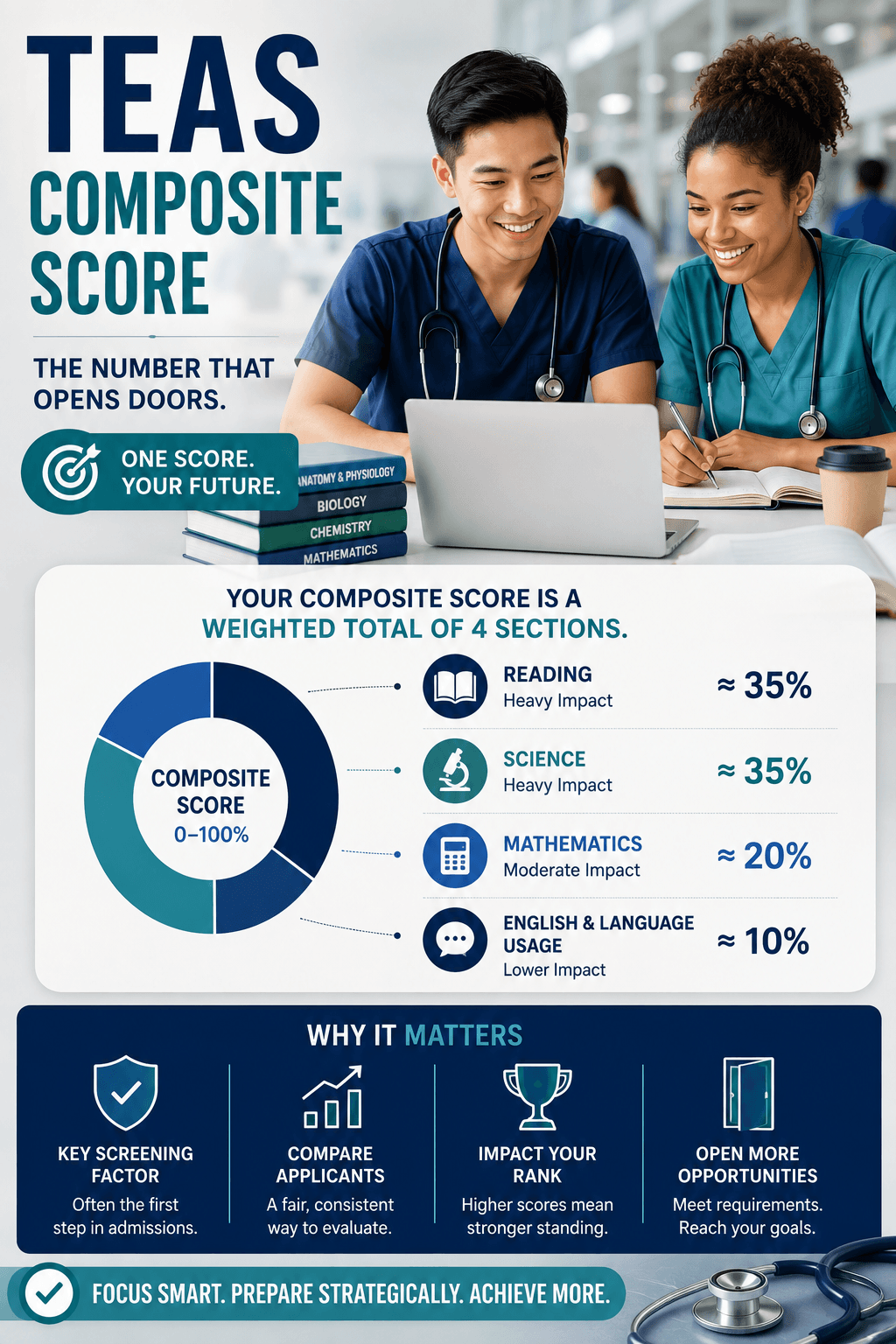
Your composite score, or your Total Score, is a single percentage that represents your success on all four TEAS curriculum areas – Reading, Mathematics, Science, and English and Language Usage. That is the number most often listed as a minimum TEAS requirement by a nursing program and typically the first number admissions personnel will see when assessing applications.
Importantly, this composite isn’t just the average of your four sector percentages. It's a weighted calculation, and knowing that weighting is one of the most practical things you can do as you walk into your prep.
Why the Composite is Not a Simple Average
Each TEAS segment contains a varied number of scored questions and each section contributes to your composite roughly in proportion to the number of scored questions in that area. In the current version of the exam, the Science and Reading sections have the most scored questions, and consequently will have the biggest impact on your composite score. Mathematics has a moderate number of scored questions. English and Language Usage, the section with the fewest scored questions, impacts your score the least.
This means that a strong performance in science or reading will help your composite more than an equal number of points gained in English and Language Usage . Similarly, a poor science or reading section would hurt your composite more than a poor performance in the smaller parts. Many applicants assume that all four areas are equally weighted and study the same way, distributing their effort across. But this is not always the best use of your study time, in reality; you may have an even better case for spending more time on Science and Reading, especially if a practice diagnostic test shows you need to improve in either area.
The organization that administers the exam also applies a statistical technique known as equating to your raw scores . This is a method that adjusts your scores to account for small changes in difficulty across different forms of the exam. Note that. This means that two test-takers who answered the same number of questions correctly on different forms of the exam could have slightly different composite scores, as equating accounts for form difficulty. This is why third party score calculators that estimate your composite based on raw section percentages are always estimates – the only source that is 100% accurate is your official score report, produced by the testing company itself.
Proficiency levels and what they mean
More than just a raw percentage, your composite score is typically linked to a proficiency category ranging from lower bands that indicate substantial gaps in preparation to higher bands that demonstrate great readiness for health sciences curriculum. These categories allow you and admissions committees to quickly see how your overall performance compares to a larger population of test takers, beyond the raw number alone.
Remember that these proficiency bands are broad criteria, not admissions judgments. Nursing programs independently establish their own specific composite requirements. A score in a strong overall proficiency band may still fall short of a highly competitive program’s specific cutoff. A more modest composite might comfortably clear the bar at a less competitive program.
Why the Composite is so critical in the admissions
- This is the main screening number. Many programs use the composite score as an initial cut before taking a deep look at other application materials therefore it can be the difference between the rest of the application getting a detailed evaluation or dismissed outright.
- This offers a common basis for comparing applications. GPA varies greatly by school, major, and grading standards. The composite score offers a common baseline for admissions officers to compare students from very various academic environments .
- It is commonly used in point based ranking systems. At programs where they translate application components into a composite admissions score, your TEAS composite will often account for a large portion of the total points available. So even a few percentage points of improvement can make a major difference in your standing in a ranked applicant pool.
- It can determine eligibility for some sorts of programs. Requirements can vary significantly across regular BSN, Associate Degree Nursing (ADN) and Accelerated BSN programs, with accelerated and more competitive programs often requiring a much higher composite than open-enrollment community college programs.
How to Use This Information Effectively
Don’t simply ask for your composite score. Ask for your subsection breakdown. Your score report provides performance data for each section and often for sub-content areas inside sections. When you look at this breakdown, you can see exactly which sections are bringing your composite down, which is far more actionable than just looking at the composite.
If time is tight, give Reading and Science more weight in your study time. With these two areas likely to carry such a heavy weight in your composite, significant improvement in any of these sections can bump up your overall score more than comparable gains in English and Language Usage, particularly if you're working with a tight prep schedule.
Don't depend only on third-party composite calculators for critical judgments. These tools are handy for general estimates and for study preparation, but they aren't an exact substitute for your actual score report in making decisions about applying, retaking or accepting an admissions conclusion because of the equating procedure used for official scores.
Compare your composite to your target schools, not averages. A composite score that appears impressive on paper might not clear a certain program's declared hurdle, so always check your target schools' exact criteria instead of national averages.
The Bottom Line
The composite score from the TEAS is not just an average, but it’s a weighted, equated number that gives more importance to your performance on the Reading and Science sections. For most nursing programs, the composite score is the first way they’ll start evaluating your readiness. Knowing how it’s put together helps you plan more strategically, concentrate your limited study time where it will do the best, and evaluate your results with reasonable expectations when your official score report arrives.