There Is No Universal Passing Score
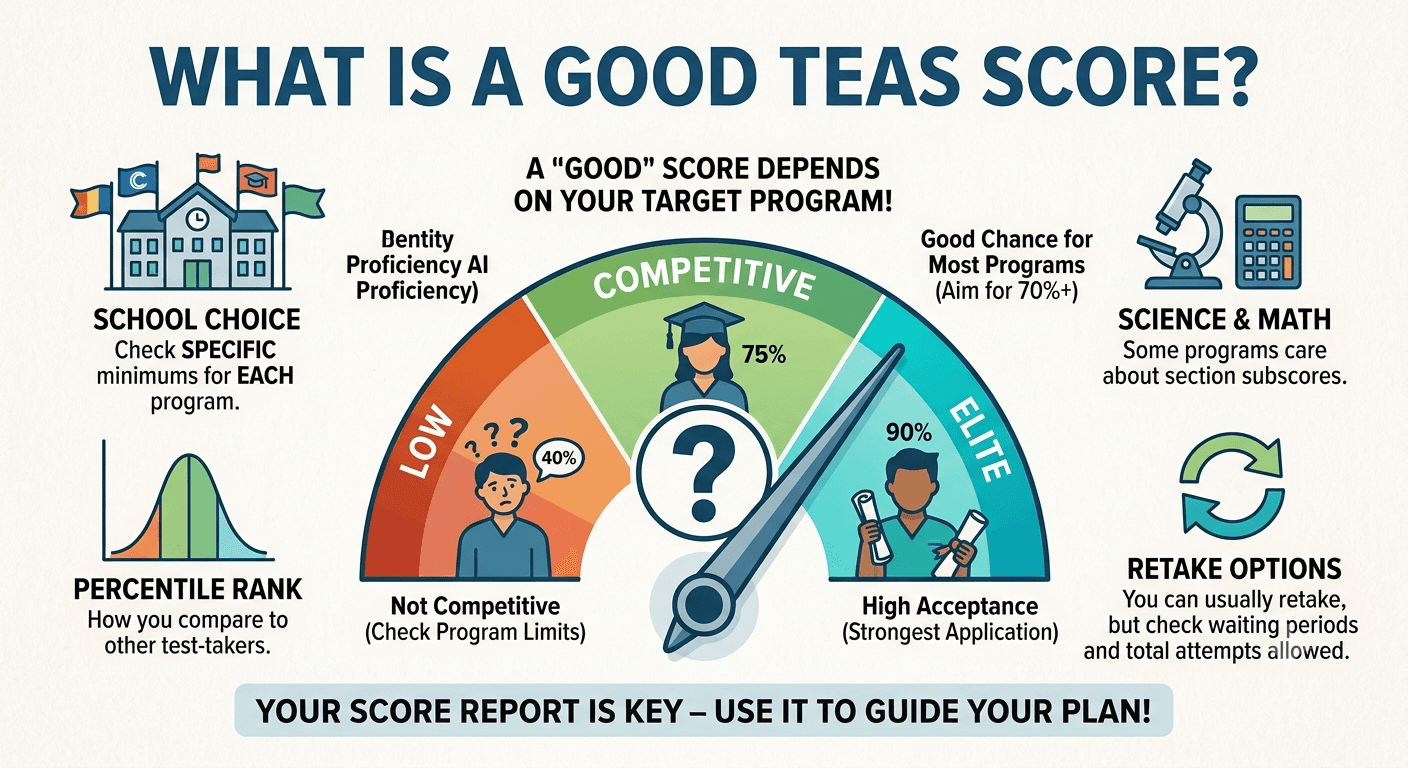
There is one fundamental rule to know before anything else: ATI does not have a passing score. The minimum composite score requirement is determined by each nursing or health science program, and can differ significantly by the type of program and its competitiveness. What might be a "good" grade in a community college ADN program may be "average" at a competitive BSN program across town.
ATI Classifications of Scores
ATI is divided into 5 proficiency levels:
- Exemplary: 92–100%
- Advanced: 80–91.3%
- Proficient: 58.7–79.3%
- Basic: 40.7–58%
- Developmental: Below 40.7%
The national median composite score is about 65% (about the 50th percentile); the majority of test takers are in the Proficient range.
What Different Program Types Typically Require
Although the standards vary from school to school, there are general trends in standards by program type:
- ADN programs: usually have a 55-65% minimum composite, but competitive candidates may score a 70% or better.
- Traditional BSN programs: admit students with a 65–80% GPAs, and their mean GPAs are generally much higher than the published minimum.
- Accelerated/second degree BSN: These are among the most competitive, and are usually 70-85%.
Elite programs or top-ranked programs: 90% or more, as the number of applicants is very high in comparison to the number of seats available.
The point: don't simply meet the cutoffs for the 80th percentile or above (about an 80% composite), and you'll sit well in programs that take a holistic approach to applicant selection, not just meeting the minimum.
Composite Score vs. Section Scores
The composite score is an average of all 4 sections, but a few programs do have minimum scores in each section, typically in the science section, which is the largest and is considered the best indicator of readiness for anatomy-based coursework. Even with a great composite score, you may not be admitted if your Science sub score is not high enough for that program, so see if your chosen school considers each section or your overall number.
The Other Piece of Context: Percentile Rank
Your score report also provides you with a percentile ranking which indicates how your score relates to others who took the test across the country. The programs don't usually give out exact percentile goals, but there is a general trend that usually prevails:
- Percentiles below may be eligible but not competitive
- The middle range of the percentile scores are likely to represent a good, viable applicant.
- Higher percentiles are associated with admission to competitive, limited seat programs
A score falling at or above the minimum does not guarantee acceptance into a program: it only makes your application eligible for full consideration.
Here are some of the issues that applicants might encounter
Problem: "I'm not sure what my score is - is it competitive or is it just passing?
Solution: Don't focus on the stated minimum of your program. If your program reports score ranges for admitted students, check them, or contact admissions directly to inquire about the range of scores for recent competitive applicants; the actual cut-off for competitiveness is frequently higher than the published score range.
Problem: "My composite score is fine, but I don't know if my score in Science is a problem.
Solution: If it is a specific program, find out if it has minimum section scores or a minimum composite score. If Science is a standalone course, a low Science sub score may restrict choices.
Problem: "I am in the 'Proficient' range but I'm not sure if that is good enough.
Solution: There is a large range between "Proficient" (about 59-79%) and solution is a matter of where you are within the range. Be careful not to assume that just because both scores are in the "Proficient" range, that they each represent a similar competitive position; a 60% can be just as competitive as a 78% depending on the program's exact requirements.
Problem: You didn't score your target, and don't know whether it is worth retaking!
Solution: Narrow your review to targeted areas on your Individual Performance Profile where you lost the most points in order to minimize re-studying. A small composite score gain can make a significant difference in percentile rank. Before taking the test again, check your program's retake policy — in some cases, you can only retake once, or the retakes will not count as a benefit.
Problem: "I don't know how many times I can retake the exam. The problem: "I don't know how many times I can retake the exam.
Solution: ATI will typically provide three attempts per year, and a waiting period (usually about 30 days) between attempts. Check your particular program's policy as well, as a few put a limit on their attempts or just accept the latest score.
How to determine what your real goal is
- Use published minimums for your specific program; do not just use general minimums.
- Find out what is required for each section, particularly the Science section.
- Research admitted-student score ranges, if available, to gauge true competitiveness beyond the minimum. Ensure that there is a retake policy for the program before considering retaking it.
- Understand exactly where you are on a percentile and sub-topic basis from your score report, and know where you need to improve.
Final Thoughts
In the end, a ‘good' TEAS score is subjective and will depend on the number of points that will allow you to meet the program's requirements and give you room to be competitive with the other students applying. A composite in the 70s is generally a suitable anchor – anything 80% or higher makes your file stronger almost anywhere. However, the only number that matters is the one your target program has decided — so check with them first, understand how your section scores will influence your chances of admission, and don't follow a national average.