Why You Should Review Your HESI Results
The score you earn on the HESI Exit Exam is more than pass or fail; it is a detailed diagnostic snapshot of your performance in major areas of nursing content at a point in time. Since this exam is meant to reflect NCLEX content and NCLEX reasoning, this snapshot gives a very valuable look at where to start your NCLEX preparation.
You will want to begin with your HESI results so you can make a more targeted and efficient plan from the start, rather than creating your NCLEX study plan from the ground up.
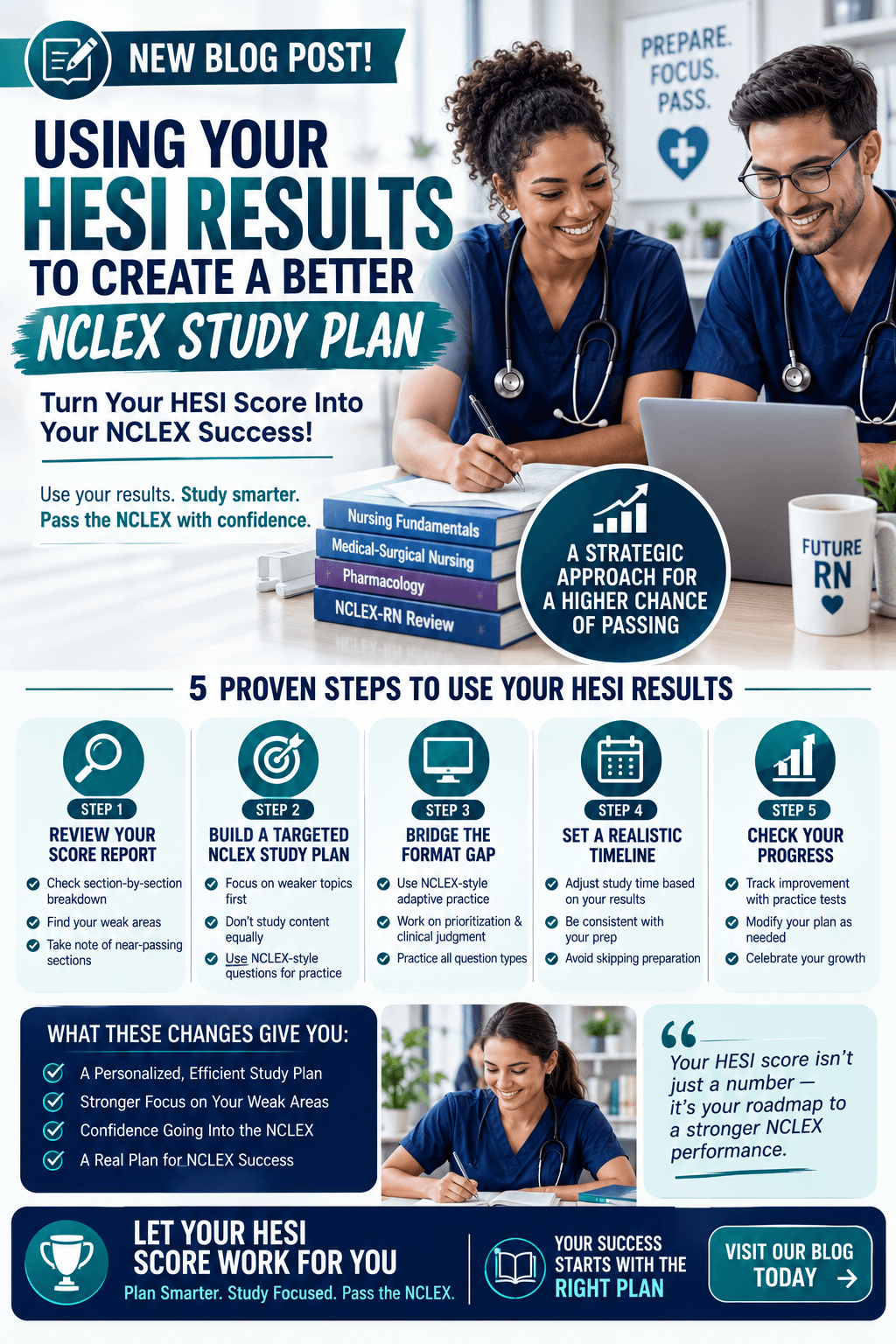
Step 1: Look over your section-by-section breakdown
- Rather than relying on your overall result, pull out your detailed HESI score report to start.
- Pinpoint your weaker content areas, such as pharmacology, medical-surgical nursing, or mental health nursing.
- If you came close to the passing threshold, note those areas that may need reinforcement even if you technically met the requirement.
- Do not assume that all subjects will require the same amount of focus going forward – compare your relative strengths and weaknesses.
Step 2: Apply These Results to Your NCLEX Study Plan
- Be aware of your weaknesses and plan your NCLEX study accordingly. If you know exactly where you stand on the HESI, study those areas first.
- Rather than studying each subject equally, spend more study time on the topics in the HESI that you know the least about.
- Focus on specific topics in those weak areas and use NCLEX-style practice questions to reinforce the underlying concepts.
- That said; do not completely ignore your stronger areas. Some reinforcement is still good to make sure content does not fade away before your NCLEX date.
Step 3: Bridging the Format Divide
The NCLEX is a Computerized Adaptive Testing exam and the HESI Exit Exam is a fixed-length exam, so it is vital to supplement your HESI-based content review with NCLEX-specific practice.
Get used to a format that your HESI Exit Exam does not fully replicate by using NCLEX-style adaptive practice question banks.
Practice various types of questions (select all that apply and other question types commonly used on the NCLEX).
Especially clinical judgment and prioritization type questions. These are a big part of what is on the NCLEX now.
Step 4: Set a Realistic Timeline Based on Your Findings
Your HESI score will also help you figure out how much total preparation time you should expect to take before your NCLEX date. A good HESI predictive score could mean less time spent studying for the NCLEX, focusing on keeping up knowledge rather than relearning it. Lower predictive scores may necessitate a longer and more intensive NCLEX study timeline, with particular attention to your weak areas. In either case, do not skip preparation entirely, as the retention of content naturally drops over time between the two exams.
Step 5: Check Your Progress As You Go
- Your HESI results provided you some great diagnostic data, now continue with that same approach for your NCLEX prep.
- Use NCLEX practice test results to track progress over time and compare your results to your original HESI weak areas.
- If you find new weaknesses, modify your study plan. Do not stick to your original study plan like glue.
- Celebrate the improvements in areas that were previously weak. Use this as motivation and as confirmation that your targeted approach is working.
In conclusion
Your HESI Exit Exam results are so much more than a pass/fail checkpoint. They are a truly valuable diagnostic tool that can have a huge impact on your NCLEX preparation. Reviewing your detailed score breakdown, targeting your weaknesses, closing the format gap with practice that is specific to the NCLEX, and monitoring your progress along the way will all contribute to the development of a study plan that is efficient and personalized to you. Do not start from scratch; let your HESI scores give you a strong, informed start on NCLEX prep.