What the Adjusted Individual Total Score Means
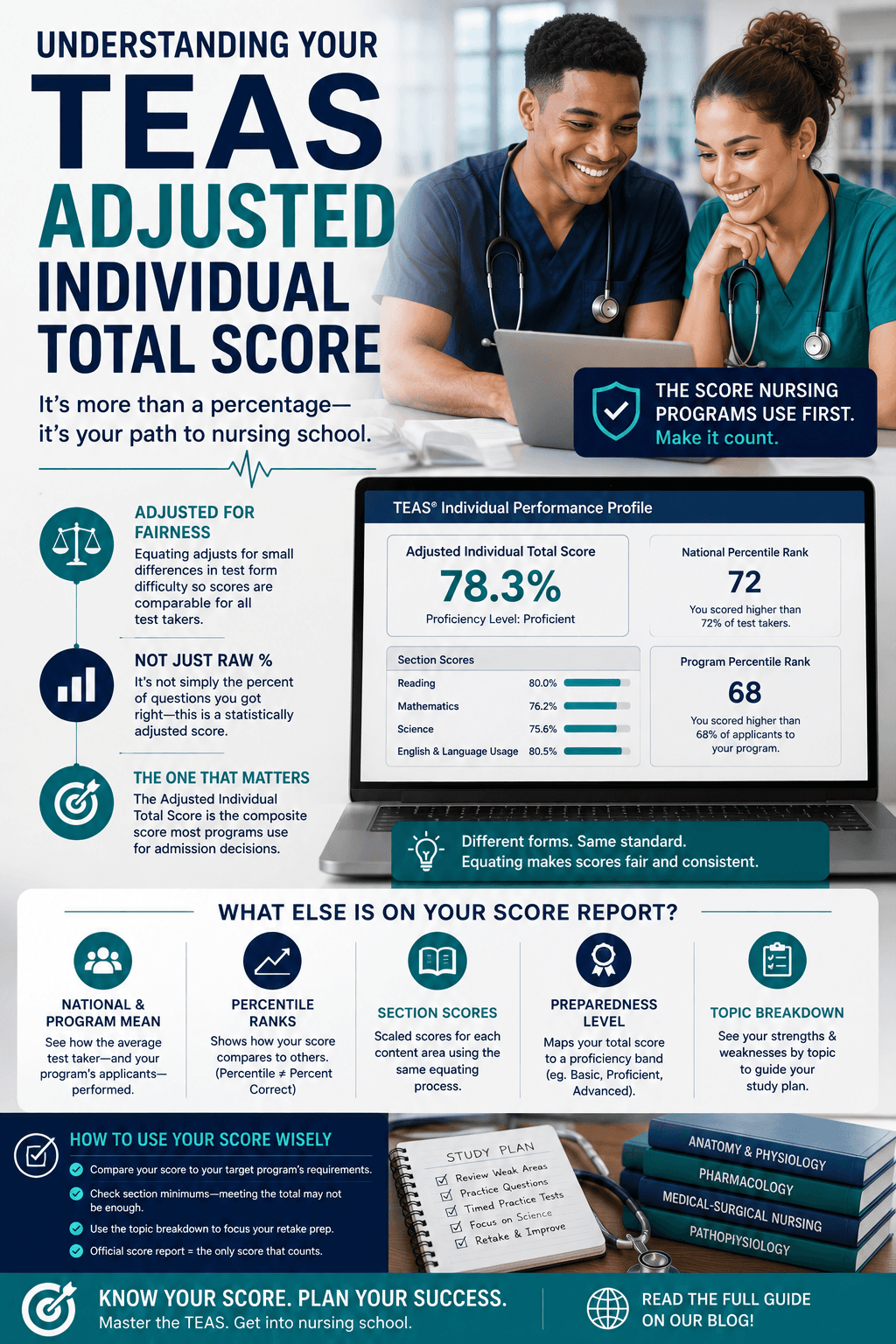
The Adjusted Individual Total Score is the main composite score shown on your official TEAS Individual Performance Profile and is reported as a percentage. This is the score you hear most often when a nursing program says something like “a minimum Adjusted Individual Total Score of 62% is required.” This is usually the first score admissions officials will look at when assessing your file.
The operative word: “adjusted”. This is not simply the proportion of scored questions that you got right; it is statistically adjusted to account for small differences in difficulty among the many test forms that are taken from the exam’s wider question bank. Because no two test-takers are necessarily given the same set of questions, and some forms may, by chance, be slightly more or less difficult than others, this process of adjustment (called equating) calibrates results so that a particular score means approximately the same thing regardless of which specific form you happened to receive.
This means that two test takers who get the same number of questions right on different test forms could have slightly different Adjusted Individual Total Scores since the underlying difficulty of their specific forms was different. This is also why unofficial score calculators (which normally merely average your raw section %s) can never quite match your real official score – only the testing organization’s internal equating process gives you the real adjusted score.
What Sets It Apart From Other Numbers On Your Credit Report
There are a number of additional numbers in your score report, and they’re easy to mix up if you’re not paying close attention.
- National Mean and Program Mean tell you how the average test-taker did nationally on the exam and how the average test-taker in your specific target program’s applicant pool did on the exam. These are points of reference for context, not your own score.
- National Percentile Rank and Program Percentile Rank indicate how your score compares to other test-takers. They use a percentile rather than a percentage. For example, a percentile rank of 70 suggests you did better than 70% of the comparison group, which is a quite different number from your percentage-correct composite.
- Reading , Mathematics , Science , and English and Language Usage . These content area (section) scores are also scaled separately, using the same equating logic that was used to score your total score. This accounts for the fact that some of the individual questions in each section based on your particular form may have been more difficult than others .
- Preparedness Level maps your Adjusted Individual Total Score into a broad band of proficiency, providing you with a quick qualitative interpretation (like “Proficient” or “Advanced”) and the raw number.
- The figure that brings all of this together into the single composite that most programs really utilize for admission decisions is the Adjusted Individual Total Score, and that is why it merits greater attention than the surrounding background figures.
Why Programs Use This Particular Number
Not an unadjusted raw score, but the Adjusted Individual Total Score is consistently referenced in published admissions requirements for nursing programs. The reason is simple: it’s the most standardized, comparable number across all applicants regardless of which specific test form they happened to receive on their test date. Once form difficulty is taken into account, a program can establish a single, consistent minimal threshold and apply it fairly to every applicant's file, without concern that some candidates were disadvantaged by a little harder form than others.
This is also why you often see programs specify not only an overall Adjusted Individual Total Score minimum, but sometimes individual section minimums as well, because some programs want to ensure baseline competency in every content area, not just a strong overall average that could mask a weak individual section.
How to Effectively Use This Number
- Don't compare it to a general benchmark, compare it to the published requirement of your target program. Each program sets their own criteria individually. So always check your specific schools stated minimum Adjusted Individual Total Score. Do not assume a "good" score in the abstract would clear every program's bar.
- Don't confuse this with your raw % correct. If you look at your results and try to mentally calculate a percentage based on the number of questions you think you answered correctly, remember that number will not be exactly the same as your official Adjusted Individual Total Score because of the equating process. The official number on your report is the one that matters for admissions.
- Also check whether your target programs have section minimums. Even if you meet the overall adjusted individual total score requirement for a program, you may not be eligible for admission if you do not meet the minimum score requirement for one of the individual content areas (because the program has set minimum standards for each area). So, before you assume you have met all of the requirements, be sure to check both the overall and individual area scores on your score report.
- Use it to help you decide on retakes. If your Adjusted Individual Total Score is below your target program’s minimum, the content breakdown in your score report (which often includes specific topics to review) provides a data-driven starting point for a retake, rather than guessing what to study based on how the test felt at the time.
Summary
The most important composite score that nursing programs consider is the Adjusted Individual Total Score, which has been statistically normalized. It is “adjusted” to factor in the fact that some forms of the TEAS are more difficult than others, which is why it doesn’t always correlate with a simple raw percentage calculation. Use that number as your primary point of reference for comparing your results to the program’s published requirements and use the thorough topic breakdown that accompanies it to help guide focused preparation should you need to retake the exam.