Why This Market Is Genuinely Hard to Navigate
Many self-published TEAS prep books with remarkably similar titles, cover designs, and marketing copy can be found with a quick search ("1,000+ practice questions," "comprehensive review," "pass on your first attempt"). Many of these books were released or updated during the same recent printing cycle. This doesn't necessarily mean that any particular book is bad, but it does indicate that star ratings and review counts by themselves aren't trustworthy quality indicators in this category because some listings can quickly garner positive reviews without independent confirmation of their actual content accuracy or alignment with the current exam.
The practical implication is to assess guidelines using precise, verifiable standards rather than merely total scores.
Factors That Really Count
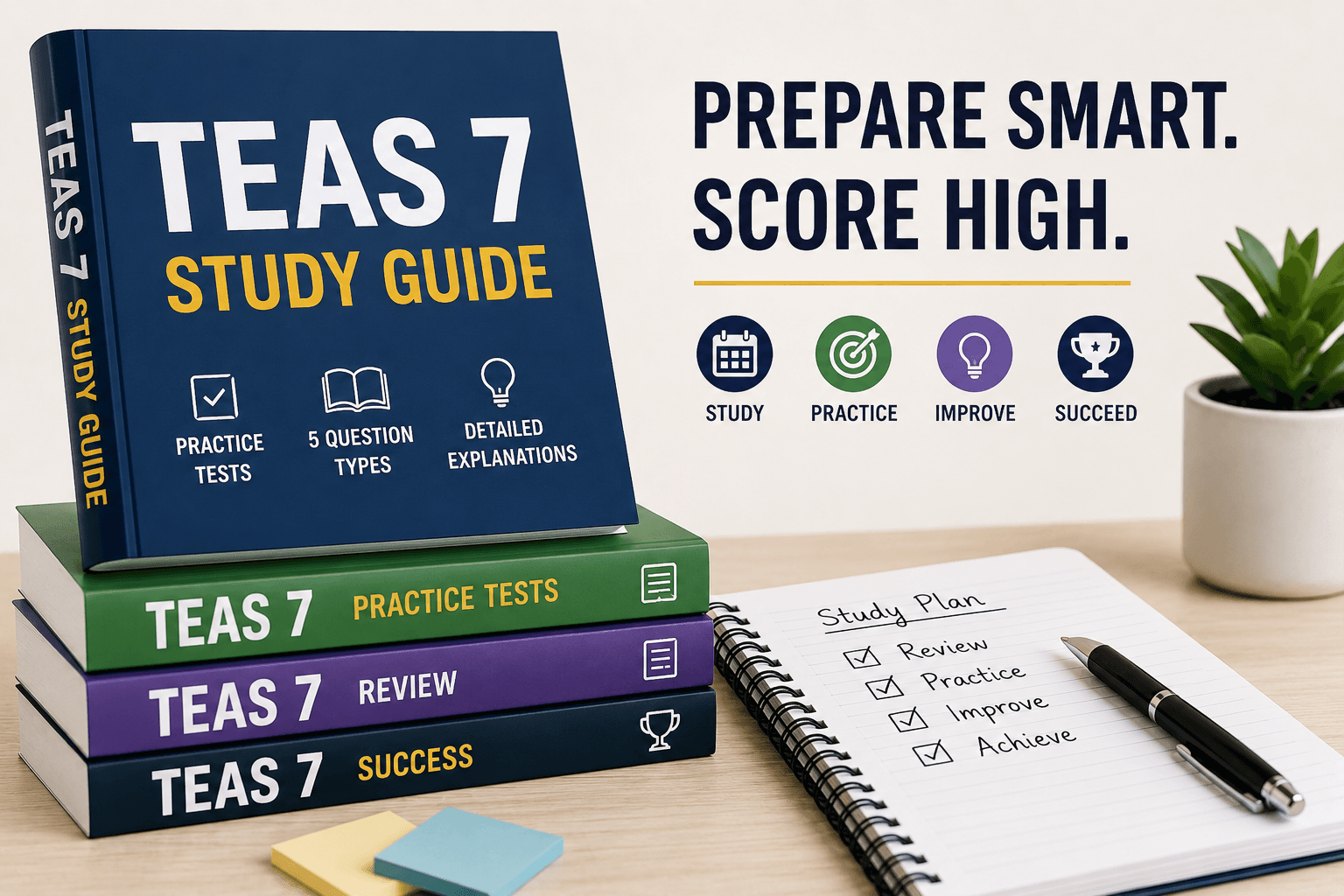
- Recent Publication and Explicit TEAS 7 Labeling. This cannot be negotiated. Any guide should ideally include a recent publication or modification date and clearly specify that it covers TEAS 7, not an earlier version. An out-of-date guide will actively misdirect your study time given how much has changed between TEAS 6 and TEAS 7, including the addition of discrete chemistry and biology subcategories, new alternate question kinds, and enlarged English content.
- All Five Question Types Are Covered. Multiple choice, multiple choose, fill-in-the-blank, hot spot, and ordered response styles are all included in the current exam. Regardless of how much subject study is included, a book that solely provides conventional four-option multiple-choice practice questions isn't preparing you for the actual test style.
- A Placement or Diagnostic Exam. Before committing to a full read-through, guides that begin with a diagnostic evaluation allow you to pinpoint your areas of weakness. This is significantly more efficient than going through each chapter in the same order regardless of your current strengths.
- Comprehensive Practice Exams Rather Than Just Single Questions. Full-length, timed practice exams are what truly develop pacing skills and endurance for the final 209-minute exam, but isolated practice questions aid with topic review. Seek out resources that provide at least a few comprehensive practice exams rather than merely a big collection of unrelated questions.
- Provide Explanations for Your Answers, Not Just Answer Keys. If a guide gives you the right answer but doesn't explain why, you won't be able to pinpoint the gap in thinking that led to your error. For real score improvement, thorough explanations for both right and wrong response options are considerably more beneficial.
- Categories of Resources Worth Considering Official ATI documents. Official ATI study materials (available directly through ATI) are assured to accurately match the current exam pattern because ATI creates and administers the exam itself. If funds permit, this is the safest place to start because there is no doubt that the content will pass the actual test.
- Reputable publications for test preparation. Companies that have been in the standardized test-prep industry for a long time (as opposed to recently established single-title publishers) typically have more uniform editorial quality control throughout editions. When assessing a publisher, be sure they have a proven track record of publishing preparation materials for a variety of standardized tests rather than seeming to specialize in a small number of extremely similar, recently released items.
- Other resources that are inexpensive and free. Free practice questions and brief review materials can be a useful addition to a primary study guide, especially when it comes to strengthening particular weak subtopics found in your diagnostic test. However, because the quality of free sources varies, they shouldn't be your only source of preparation. Prep courses and platforms. Beyond books, some students benefit from structured online courses offering video instruction, adaptive practice, and progress tracking. These tend to cost more but can provide more accountability and structure for students who struggle with self-directed study.
Typical Issues Students Face
- Problem: "I can't distinguish which of these very identical books is genuinely good." Solution: Ignore the star rating and look immediately at the book's description or a sample preview, which includes TEAS 7 labeling, all five question types, lengthy practice exams, and thorough explanation of the answers.
- Problem: "I bought a guide and it doesn't reflect what I've read about the current exam structure." Solution: Verify the copyright or revision date and contrast the question kinds with the five formats that were previously discussed in this guide. It might be out-of-date or lacking if it completely lacks multiple-select, fill-in-the-blank, hot spot, or ordered-response practice.
- Problem: "I don't sure if I need one complete guide or multiple tailored resources." Solution: Do a diagnostic test first. One thorough guide is perhaps more effective if you're weak in all four areas. Targeted resources for just those weak areas could be more beneficial and less expensive if you are strong in most areas but have one or two specific deficiencies.
- Problem: "I don't want to spend money on a guide that turns out to be bad quality." Solution: Before making a purchase, look for a sample chapter or preview, paying particular attention to how thorough the explanations are. You may learn a lot about a guide's overall quality by how it answers one sample question.
- Problem: "I'm overwhelmed by how many options are presented as '#1' or 'best seller.'". The answer is to ignore marketing superlatives. Put all of your attention on the specific requirements, such as the most recent edition, comprehensive question-type coverage, lengthy timed tests, and well-explained answers, rather than any listing's badges or ranks.
Conclusion
The amount of TEAS preparation materials available on the market indicates that you need a filter, not that they are scarce. Examine any guide using clear, verifiable standards, such as full-length timed practice exams, comprehensive answer explanations, coverage of all five question categories, and current TEAS 7 alignment. Regardless of its star rating or marketing claims, a guide that meets all four standards will be beneficial to you; one that lacks some of them is not worth your research.