Why So Many Test-Takers Fall Down on Vocabulary
The TEAS is not a spelling bee; thus it doesn’t measure vocabulary in isolation. Instead, it embeds vocabulary in reading passages, context-clue questions, and health-related situations. That means a typical and costly mistake is to learn a list of words without knowing how words work in context. Students come in after cramming hundreds of flashcards only to freeze up when a familiar term is used in a new clinical or academic phrase.
The problem, then, is not exposure to vocabulary. It’s a lack of applied vocabulary exercise. This demands a transition from passive memorizing to active, contextual learning.
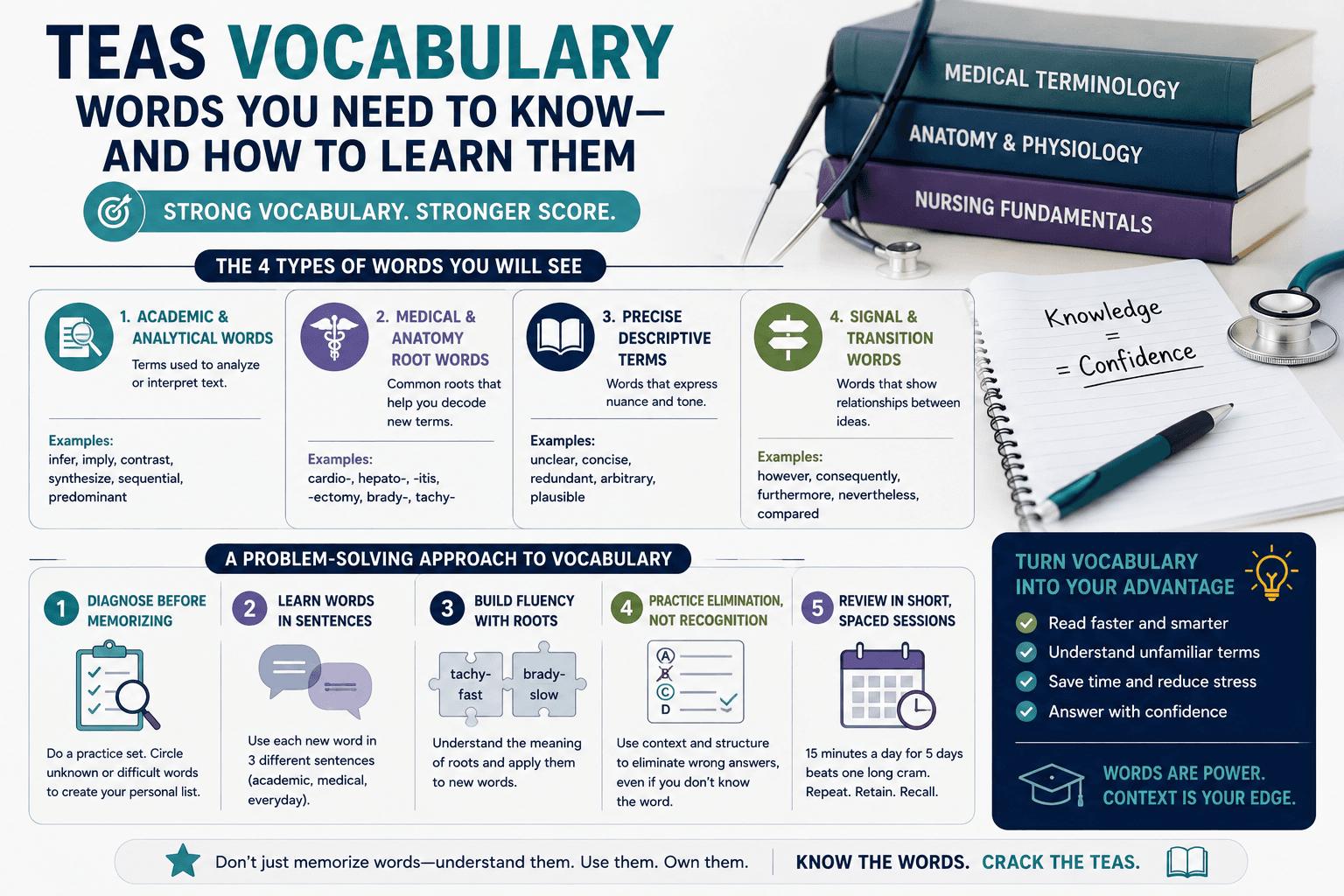
The Four Types of Words You Will See
TEAS vocabulary falls into 4 predictable categories based on the structure of the exam. This approach of organizing your studies makes review far more efficient than working through a randomized list.
1. Academic and Analysis Words These are generic terms used to indicate how an author constructs an argument or arranges information—terms include infer, imply, contrast, synthesize, sequential, and predominant. They are continually appearing in reading comprehension questions inquiring about core idea, author’s purpose, or text structure.
2. Medical and Anatomy Root Words Although TEAS Reading is not a science test; passages often draw from health-related topics. Knowing common roots – cardio-, hepatic-, -itis, -ectopy, Brady-, techy- – enables you to understand novel terminology on the go, rather than needing to have memorized every potential word.
3. Precise Descriptive Terms Questions that ask you to analyze an author’s word choice or tone will include words like unclear, concise, redundant, arbitrary, and plausible. These words matter because nuance is typically tested on the TEAS – the difference between two answer choices sometimes comes down to a single well-chosen term.
4. Signal and transition words like however, consequently, furthermore, nevertheless and compared show the logic relationship between thoughts. Failing to notice these might enable a test-taker to misread whether an author agrees, contradicts, or develops a previous position – a common mistake that could have been avoided.
Vocabulary Prep, A Problem-Solving Approach
Think of it as a comprehension skill instead than memorizing language. Here’s a practical framework:
Step 1: Diagnose before memorizing. First, do a timed practice set of reading. Circle any word that slowed you down, even if you eventually figured it out. That provides you a personalized list, not a generic one – tackling the true problem of wasting study time on words you already know.
Step 2: Learn words in sentences, not alone. For each new word, create or locate three phrases that use the word in diverse settings (academic, medical, everyday). This is how the TEAS really teaches language and trains your brain to pick up meaning from context clues—the very skill the test awards.
Step 3: Build fluency in root words, not word-for-word recall. Rather than learning “tachycardia” and “bradycardia” as two words that have nothing to do with each other, understand that tachy- means fast and brady- means slow, and then apply the same logic to tachypnea and bradypnea. This one method can reveal dozens of unknown words on test day.
Step 4: Practice elimination not recognition. When you don’t know a word, the TEAS still expects you to use context and structure to remove false answers. Make it an explicit practice: cover up the vocabulary word in a practice question and see if you can still get the answer right, using only the rest of the phrase.
Step 5: Review in brief, spaced out sessions. If you don't repeat the words, your ability to remember them falls drastically. Fifteen minutes of review over five days’ trumps one 75-minute cram session. Use spaced repetition tools or simple flashcards, but always in combination with the manner of sentences above.
Turning Vocabulary into a Competitive Edge
Strong vocabulary skills on the TEAS are not so much about sounding clever as they are about accuracy under time pressure. A test-taker who is able to rapidly comprehend an unknown medical root or properly understand a transition term gains crucial seconds and confidence throughout the exam. Because the Reading and English parts require a lot of comprehension and precision, it usually pays a disproportionately high return relative to the time spent on vocabulary training.
Ultimately, the kids that do the best use language not as a checklist for memorizing, but as a lens for reading comprehension itself. By concentrating study time on the four major areas listed above and practicing with context-driven strategies, test-takers can walk into the TEAS not only knowing the words, but with the ability to confidently reason through them – the very talent the exam is intended to assess.