Why ABSN Programs Put So Much Weight on the TEAS
Traditional BSN applicants usually earn their nursing prerequisites over multiple semesters while simultaneously completing general education requirements, providing admissions committees an extensive academic history to assess. Conversely, ABSN applicants generally complete prerequisites in an accelerated timeline, sometimes completing science courses just months before to applying. That shorter runway means committees have less longitudinal data to consider, making the TEAS a more crucial real-time signal of whether a candidate is ready for an intensive, fast-paced program.
There’s also a practical aspect of timing: ABSN cohorts go through subject fast, sometimes covering in one accelerated semester what a regular program stretches over a full year, so schools want solid evidence that prospective students can assimilate material efficiently from day one. Students with strong TEAS scores, especially in the science and math areas, are less likely to need extensive remediation when the accelerated pace begins.
TEAS Average Score Requirements for ABSN Programs
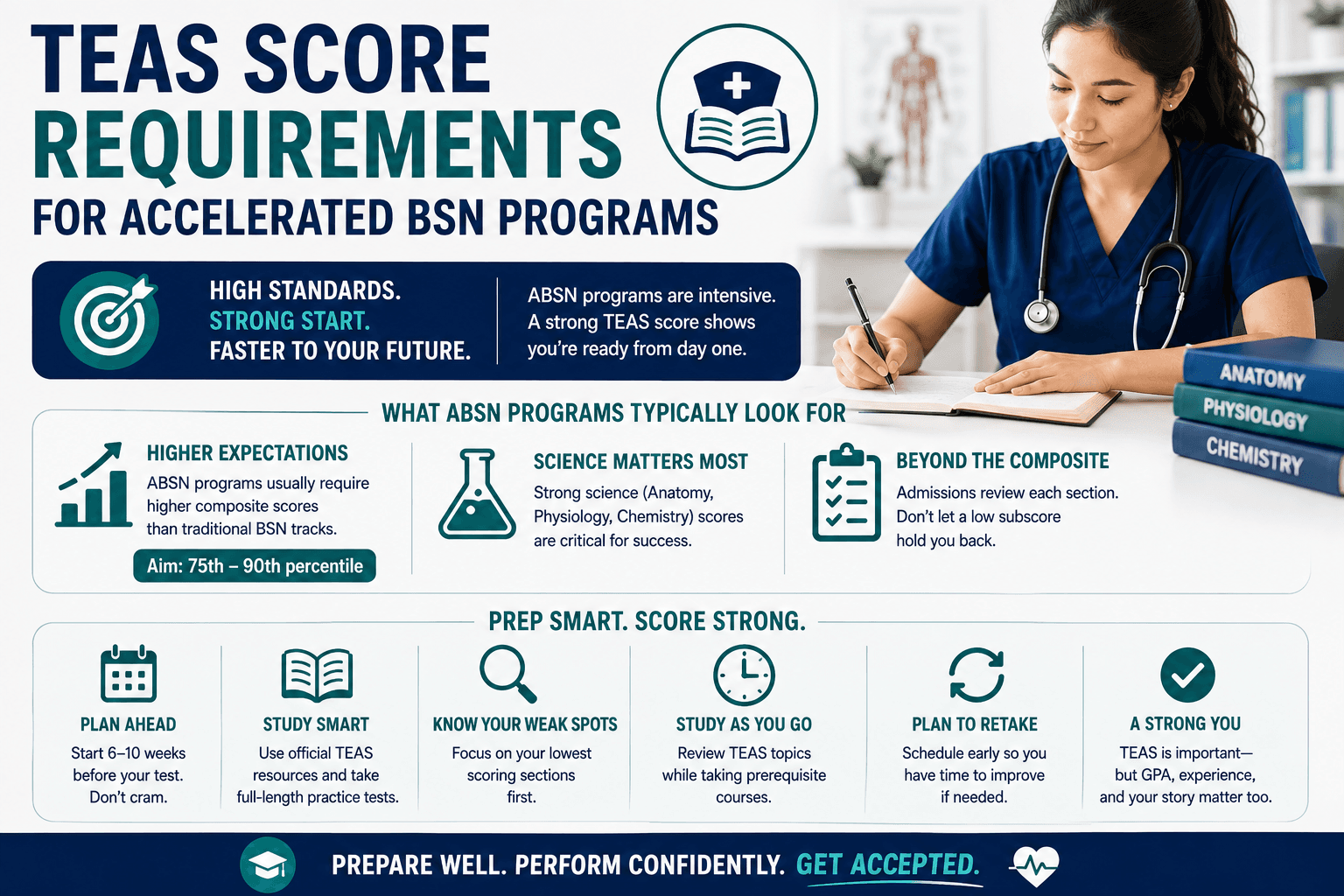
Though the standards vary from school to school, generally the minimum TEAS requirements for ABSN programs are higher than that of traditional BSN programs at the same school. It is not uncommon for traditional programs to accept composite scores in the “proficient” range whereas ABSN tracks at the same institution need “advanced” or “exemplary” composite scores, generally in the 75th to 90th percentile range nationally.
The most accurate way to determine this is to visit the current admissions page of each specific ABSN program you are applying to. Published ranges change from year to year and are very variable by institution, so don’t rely on broad benchmarks. Many programs additionally disclose the average TEAS score of their most recent cohort. This is a more useful aim than the bare minimum as competitive institutions often admit over the posted floor.
Section-by-Section Analysis
In addition to the composite score, admissions committees for ABSN programs review the subsection scores, and science is often a focus. Most ABSN applicants have backgrounds in non-nursing academic disciplines (psychology, business, communications, etc.) and committees are looking for assurance that science literacy is strong, especially in anatomy, physiology, and basic chemistry concepts, even with an undergraduate degree in a non-science field.
Math and reading sections matter too, because accelerated courses requires fast, accurate dose calculations and dense reading comprehension under time pressure. A composite score that appears good, but masks a bad science or math part, may raise eyebrows during review, so it’s worth asking for your comprehensive score breakdown and resolving any uneven findings before you submit.
Common Issues for ABSN Candidates
Prerequisite courses missing or rusted. Many ABSN applicants took general biology or chemistry years ago, if at all, as part of their original degree. That leaves a substantial subject vacuum coming into the TEAS science section, which evaluates topics some applicants haven’t seen since high school.
Compressed readiness schedules. Most of our ABSN applicants are busy working and taking their prerequisites so they don't have a lot of committed time to study for the TEAS itself. “Test prep work often gets squeezed into whatever time is left over from coursework, which can hurt performance on sections that rely on memorized content, like science.
Not knowing the format of standardized testing. Some applicants from areas with too few standardized tests, or who haven’t taken a timed, multiple-choice test in years, do poorly not because they lack the underlying information, but because they are not accustomed with pacing or question type.
How to Meet TEAS Requirements for ABSN
Don’t do the prerequisite coursework and then the TEAS; do them simultaneously. Rather of finishing all required courses and then commencing TEAS preparation, weave TEAS material review into your prerequisite coursework as you go. For example, when reviewing anatomy and physiology topics, remembering the TEAS science part covers the same material twice and lowers the need to cram separately later.
Put your weakest subpart (depending on findings of diagnostics) above assumptions. Take the full-length practice exam early. Check out the breakdown of the subsections, not just the composite result. When a diagnostic shows science or reading comprehension to be the larger gap, applicants generally believe math to be their weak spot.
Allow yourself more prep time than you think you need. With the short schedules of ABSN programs, it’s tempting to think of TEAS prep as a quick last step. Most ABSN programs have higher expectations for scores, so six to ten weeks of structured review, even in brief daily sessions, tends to produce better results than a rushed one- or two-week cram.
Use official or vendor-aligned prep material. Because the majority of ABSN programs use the same testing vendor's official study guide and practice examinations, it's important to focus on specific resources rather than generic third-party ones to get as near as possible to the style and difficulty level of the test questions.
Plan for a probable retake before you apply, not after a bad first effort. Because ABSN admissions are competitive, it is a good idea to plan your first attempt of the TEAS far enough in advance that you can repeat it if necessary and still meet your application deadline.
The TEAS Compared to Other ABSN Requirements
The TEAS is important, but it’s rarely the only reason. Most ABSN schools additionally consider undergraduate GPA (especially in prerequisite science classes), letters of recommendation, experience working in a healthcare-related field and sometimes an interview or personal statement. A high TEAS score with a low requirement GPA, or vice versa, can still get you into programs that use holistic review, so it’s a good idea to invest in your entire application rather than considering the TEAS to be the only element that matters.
Summary
ABSN programs have higher expectations from TEAS as the rapid structure allows for minimal academic catch-up once the program starts. Applicants who see the TEAS as a natural extension of the preparatory course work, rather than as a hurdle to overcome at the end, tend to do better and be more prepared for their programs. Learn the live score requirements for each ABSN program you are applying to, learn your weak areas early, give yourself ample time to prepare completely – the investment is worth it in acceptance and the rigorous training that follows.