The True Meaning of Super scoring
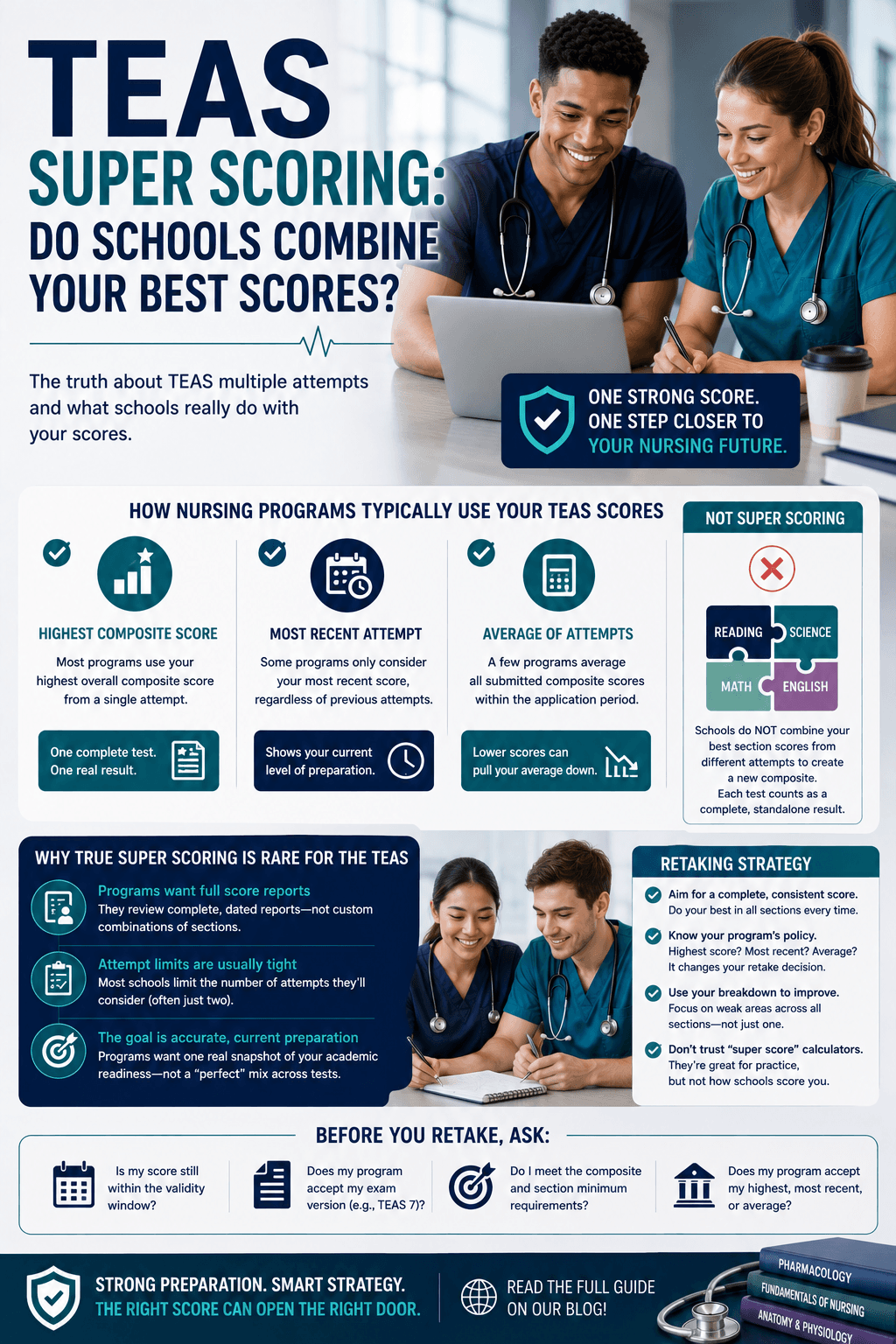
The true definition of super scoring is a certain way of doing things: then pick out your best score from each separate area over a few distinct test dates, and then combine these finest individual scores to create one perfect composite, even if you never achieved that identical combination in one single sitting. Let's say you did your best on Reading on your first attempt and your best on Science on your second attempt. Super scoring would combine those two best scores together, even if you never actually earned both of those scores on one test.
Many institutions do this for tests like the SAT, but it is not a standard for the TEAS.
What Programs Really Do Instead
Instead of using your best individual section scores from separate attempts to create a new hybrid composite, nursing programs commonly deal with multiple attempts on the TEAS in one of three more simple ways:
- Biggest composite single effort. Most systems just accept your highest overall composite score from one of your efforts and use the complete score report, sections and all, as your official result. This is different from super scoring in that it requires one full, real sitting rather than mixing and matching pieces from multiple occasions.
- Latest effort. Certain programs will request your most recent score, because it is thot to best reflect your current level of preparation, and they will discard previous tries, even if an earlier try was higher in a given portion.
- Averaged across numerous tries. It’s actually worse for you if you did considerably better on a retake because other programs tend to average your composite scores over all tries submitted within an application period, so a strong second try gets diluted by a weaker first effort.
- Because these three methods produce very different results, and because super scoring by section is not generally practiced in the wild, the real-world fact of the matter is that doing well in every section at the same time in a full, independent sitting is more important for the TEAS than it usually is for the tests that do super score.
Why True Super scoring Is Rare for the TEAS
- Most programs want the entire score report, not aggregate data. You get a score report after each TEAS sitting, which is a complete performance profile from that single exam administration.
- Most programs’ verification processes are designed to analyze a specific, dated report rather than create a custom hybrid score from numerous different papers.
- The limitations on attempts are often tight. And because programs often impose limits on the number of TEAS attempts they’ll consider in an application cycle, sometimes as few as two, there’s less institutional infrastructure built around comparing and blending scores across many attempts the way super scoring at more open-ended standardized tests sometimes presumes.
- The basic objective is a little different from that of college-entrance tests. The TEAS is intended to assess current academic preparation for health sciences coursework, and most programs would prefer to see one unified picture of performance rather than an artificially optimized hybrid score that was never really obtained in one sitting.
How Should This Affect Your Retake Strategy?
- Treat each effort as a whole performance, not as a piece you are ‘banking’. Most programs will not give you credit for a strong individual portion from a previous attempt if your subsequent effort underperforms in that specific area, so do not enter a retake with the mindset that you can cruise thru a subject you previously excelled in. Aim for a consistent, well-rounded performance on all portions on the attempt you plan to submit.
- Check your program policy to determine if and when retesting is appropriate. Some programs take your highest overall attempt, some take your most recent, and some average your scores. Which is the smartest retake decision for you relies totally on which policy applies to you. For example, if your program averages tries, retesting when your existing score already meets the minimum could potentially penalize you if the fresh try comes in lower.
- Prepare comprehensively not selectively using your sub-scale breakdown. You want to duplicate or beat your best full performance, rather than mixing and matching results. So , go thru the detailed section and sub-content breakdown from your prior attempts , and shore up every weak area before retesting , rather than assuming you can neglect a section you did reasonably well on previously .
- Don’t rely on unofficial “super score calculators” to determine admissions policy. Some third-party test-prep websites provide features that will calculate a super scored result for you, combining your best section scores from across tries. They can be beneficial as a personal diagnostic exercise to see what your theoretical ceiling is, but they are not how any nursing program would actually score your official submitted score report, so do not base real decisions on them for your application approach.
The Bottom-line
Nursing programs do not usually super score the TEAS in the conventional sense that some standardized entrance examinations are super scored. However, systems generally choose your greatest composite entire attempt, your most recent try, or an average across attempts, all of which consider each session as a complete, standalone result rather than a source of distinct pieces to blend together. So the best way to approach any TEAS attempt, first or repeat, is to do your best to do well across the board in all sections in that one sitting, and to find out your target program’s multiple-try policy before deciding if and when a retake makes sense.