Why Study Groups Can Be Really Useful
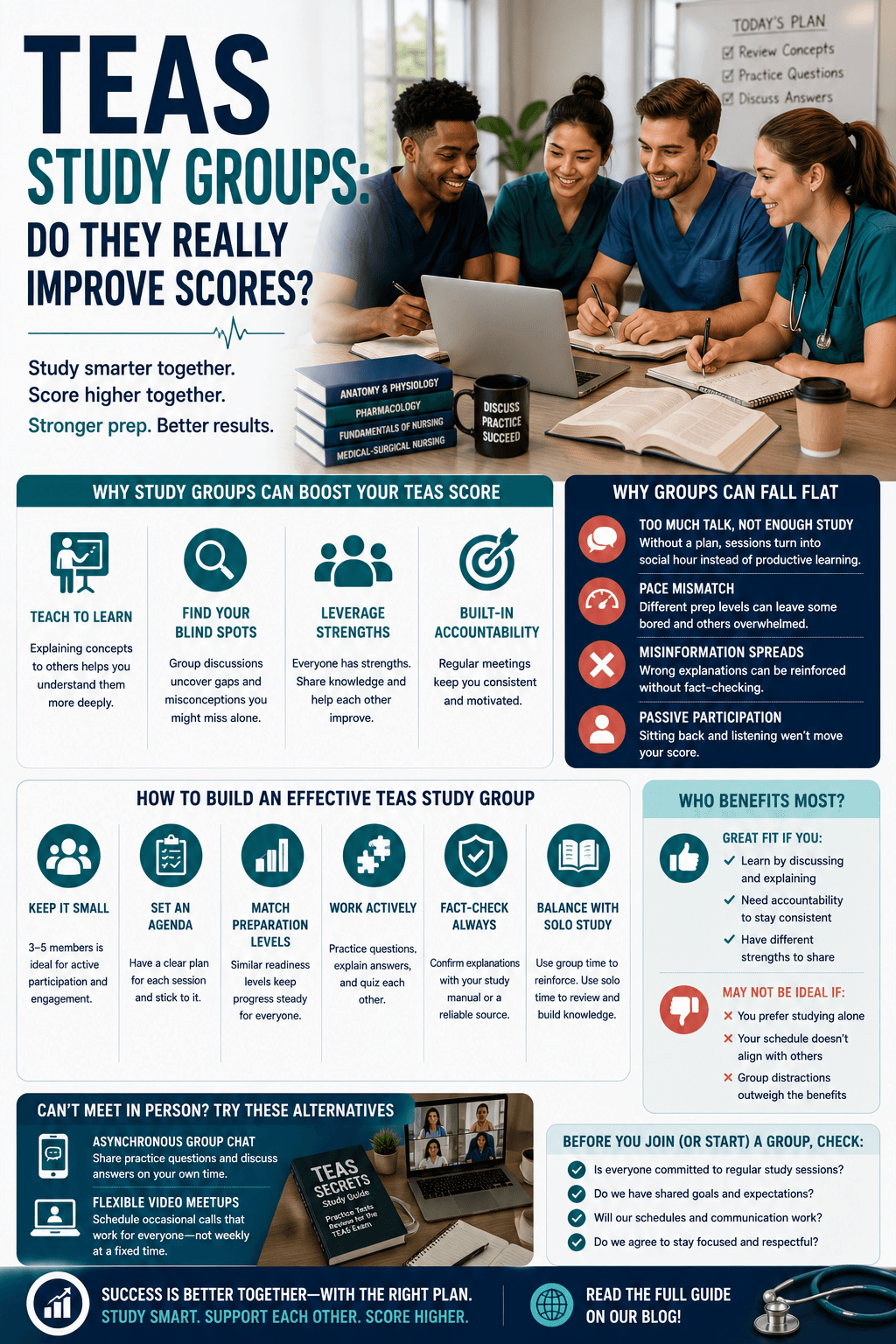
- Teaching it to someone else will make it stick for you. Educational research has repeatedly shown that teaching or explaining a concept to someone else requires you to organize your information more clearly than passive review. The “protégé effect” is that you may already comprehend a topic but if you explain it to a struggling group member it will help you understand it better.
- Groups expose blind spots you didn't know you have. When you study on your own, you may feel confident about a topic merely because the content looks familiar when you read it again. Going over practice questions with others can often surface small misconceptions or gaps that you’d miss on your own, because someone else’s approach or question can disclose an assumption you didn’t know you were making.
- Different people have different strengths. The TEAS is divided into four different curriculum areas, therefore it is common for group members to have different strengths, one person good in math and another person great in science. If the group is run successfully, this can be leveraged such that everyone gets free, informal instruction on their weak areas.
- Accountability is consistency. One of the biggest risks to any self-directed study approach is just not following thru consistently. Scheduling a group session creates an external accountability that’s easier to stick to than a solo study block, especially when a hectic week means you’re not feeling motivated.
Why study groups don't always help
- Unstructured groups wander into socializing. Without a goal for each study session, study groups can quickly become social events where studying is an afterthought. This is the top cited reason why applicants said a study group 'didn't really assist'.
- And pace mismatches are frustrating. If members of the group are at very varied stages of preparation, and some are well into content review while others are just starting out, sessions can be too basic for some members and too complex for others, pleasing no one well.
- Shared misunderstandings can be reinforced by groups. If no one in a study group has fully grasped a concept, the incorrect explanation might be reinforced with false confidence. Agreement with peers can feel like affirmation, even when the understanding is inaccurate.
- Passive participation benefits you less. Research has shown that the benefits of group study are largely due to active participation (e.g., clarifying concepts, quizzing each other, working thru issues together), not passive listening to one person review the information. It's not nearly as useful to everyone else if only one or two people are actively involved in a group.
What Makes a TEAS Study Group Actually Effective
- Minimize the group size. Three to five individuals is usually the ideal number: big enough to provide different abilities and viewpoints, but small enough for everyone to participate actively and not just fade into the background.
- Set a defined agenda for each session. Don't have a nebulous goal to "study science," have a set agenda for what material or practice questions you will work on each session, and follow it. This one adjustment solves most of the drift-into-socializing problem.
- Match group members by general preparedness level, if possible. Groups operate best when members are about at the same point of readiness, even if they are strong in different sections. This makes the pace one that is productive for everyone rather than too fast or too sluggish for some.
- Use group time for productive work not passive review. Make your sessions such that you practice questions together, explain answers to each other, and quiz each other, as opposed to just sitting together and each studying alone, or having one person teach.
- Cite credible sources for explanations. When concepts are discussed in a group, particularly for science topics where misconceptions are common, always confirm the explanation by consulting the official study manual or another reliable source before accepting it as fact so as not to perpetuate an incorrect shared understanding.
- Mix group sessions with individual studies. Study groups are most effective as a complement to individual study, not a substitute for it. Use your solitary time to first review and practice the information, and use your group time to reinforce, test, and clarify that content together.
Who Benefits the Most From a Study Group
The types of applicants who benefit the most from group study are those who realize that they absorb material better by discussing and explaining it to others rather than reading it individually, those who are not self-motivated and work better with someone holding them accountable, and those who are studying with others who have strengths in other TEAS sections.
Those who will be less effectively served are applicants whose level of self-direction is strong and who experience more disruption than benefit from group logistics, those with pacing demands that differ greatly from those of potential group members, or those whose available study time does not match well with a group's timetable.
Alternatives to a Traditional Study Group If a Traditional Study Group Doesn’t Work for You
If you can’t meet in person because of work or family obligations, think about asynchronous options: a group chat where people post practice questions and discuss answers when they have time, or infrequent video calls set up for when everyone is free, not on a fixed weekly schedule. They retain some of the responsibilities and benefits of a study group with the variety of perspectives, but allow for less flexible scheduling.
Conclusion
Study groups can have a considerable positive impact on TEAS preparation, but the benefits derive from active, organized study, not just being in the same room with other people while studying. A small, well-matched group with a defined objective, active practice and dependable fact-checking may really increase comprehension and improve responsibility. If you do not have a plan, an informal group will probably do little more than make studying a more social activity. If you are thinking about a study group, put a little effort into creating expectations and structure up front because it is that decision, not just the desire to study with others, that really determines if the group increases your score.