Why Programs Have 2 Different Metrics
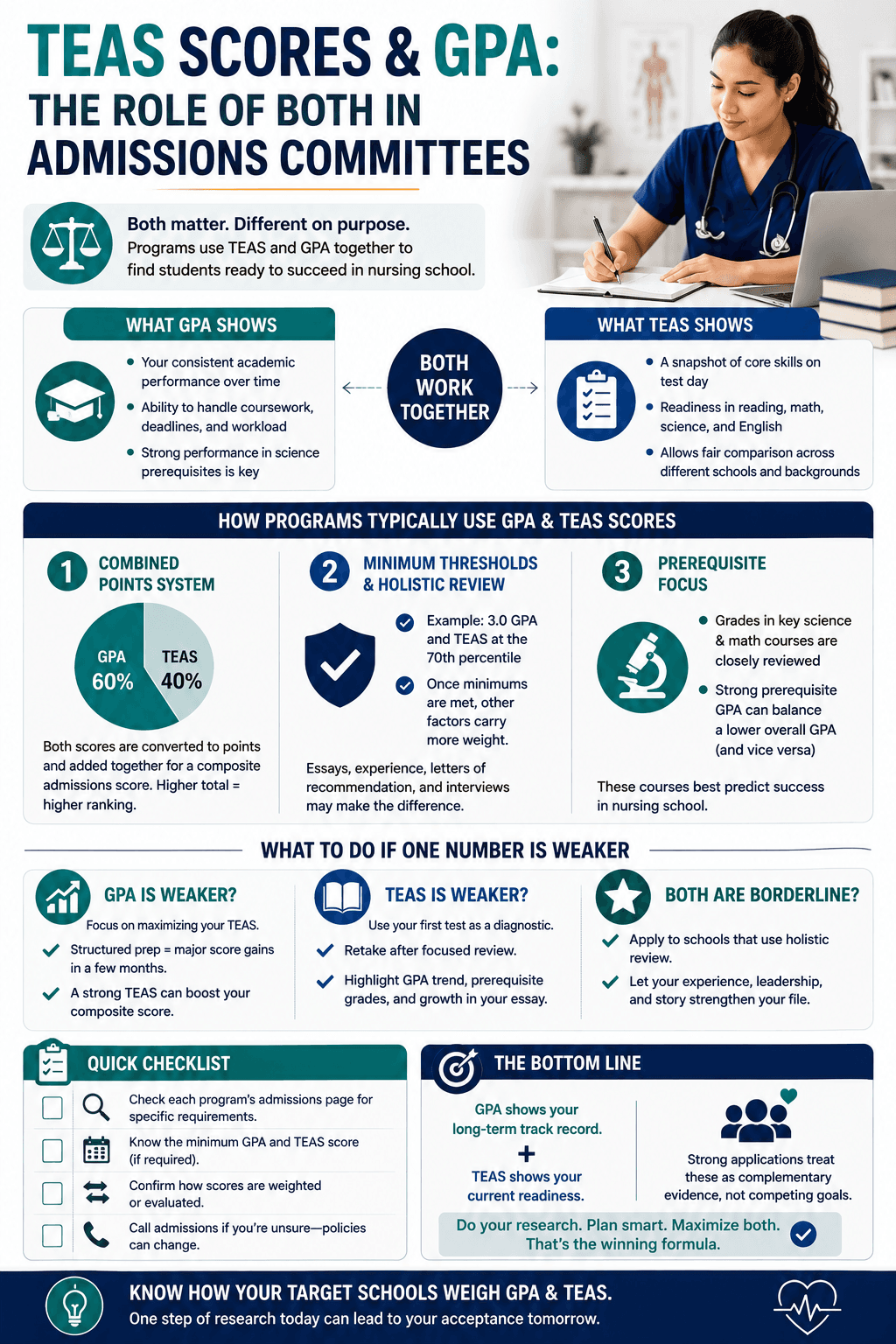
The TEAS and GPA are two totally separate things and most nursing programs demand both. GPA is a measure of your consistent academic performance over time – your ability to handle coursework, meet deadlines, and learn subject during an entire semester or degree program. The TEAS, in contrast, is a one-day snapshot of core skills in reading, math, science and English and language usage, conducted under standardized testing conditions.
A solid GPA attained in a tough course load indicates a committee that you can bear the intellectual rigors of nursing school over the long run. A good TEAS score shows you have the basic knowledge to hit the ground running, and it gives them a way to evaluate applicants from different universities, majors, and grading systems on comparable footing. GPAs can vary substantially among institutions due to grade inflation, course difficulty, and institutional norms. The TEAS provides a normalizing factor that admissions committees can rely on when evaluating a diverse applicant pool.
How the Weighting Usually Works
Most applications utilize one of three general methods:
- Combined points systems. Many programs translate both GPA and TEAS scores to a point system on a common scale and then combine them with a composite admissions score. So, for example, a program may allocate up to 60 points for GPA and 40 points for TEAS performance or somewhere closer to an even split. The candidates are then rated by total score and the highest ranking candidates are awarded seats until the cohort is filled.
- Minimum thresholds, and comprehensive review. Some institutions have minimum cutoffs for both criteria (such a 3.0 GPA and a TEAS score in the 70th percentile) and consider anything beyond that to be acceptable for further examination. Once you get beyond the bar, the committee might give greater consideration to other considerations – personal statements, healthcare experience, letters of recommendation or interviews – than marginal variations in your figures.
- Weighting of prerequisites. Many committees really look at your grades in the prerequisite scientific and math classes (anatomy and physiology, microbiology, chemistry, statistics) and not so much your total GPA because these are better predictors of how you’ll do in the nursing program than your GPA in electives that have nothing to do with nursing. A high prerequisite GPA can occasionally compensate for a lower overall GPA, and vice versa.
Because these procedures can differ widely from institution to institution, the single most critical action you can take is to read the published admissions criteria of each program or call their admissions office directly. Anecdotal forum discussions on weighting tend to encourage applicants to overweight the wrong metric.
What a Strong GPA Means
Admissions committees typically see GPA as an indicator of stability and discipline. A good GPA – maintained over numerous semesters and especially in science-heavy classes – demonstrates your ability to handle the workload required in nursing schools. Committees also look at trends: a GPA that improves substantially in subsequent semesters can make up for a shaky start, particularly if you can explain what changed in your approach to schoolwork.
What Does a High TEAS Score Mean?
The TEAS score has a more specific function. It means you have the knowledge base in reading comprehension, basic algebra, human body science and grammar that will be needed right out of the gate for nursing coursework and clinical documentation. It’s standardized, so it also helps committees compare applicants with widely varying academic backgrounds and GPAs. For example, an atypical applicant returning to school after some years away might have an obsolete or unrepresentative GPA; a good current TEAS score can reflect present-day readiness in a manner an old transcript cannot.
Practical Strategies If One Number Is More Susceptible Than the Other
If your GPA is less than you would want, focus your remaining time and work on the TEAS. As it’s a shorter term investment, a great score might swing a composite ranking dramatically in programs that utilize point based systems. Structured test prep – practice tests, targeted review of weak material areas, and a good bit of time on math and science parts – typically yields noticeable score increases in a matter of months.
If TEAS is the weaker metric, most testing services have a waiting period before retaking, so interpret a bad first try as diagnostic, not definitive. In the meanwhile, bring your GPA trend and prerequisite grades into your personal statement, and consider taking a prerequisite course again if you have one bad grade that is dragging down an otherwise solid record.
If both statistics are borderline, search for schools that do holistic review specifically, as there is more potential for context (healthcare experience, leadership, service work, or a compelling personal statement) to sway the conclusion.
The Bottom Line
There is not one-size-fits-all formula that every nursing program uses, but the reasoning behind it is the same. GPA shows long term academic track record; TEAS shows readiness at present on a standardized scale. The best applications are those that treat these as complimentary evidence, not competing objectives. That one piece of research might save you months of wasted effort and significantly enhance your odds of admission, so before you spend big on boosting one number over the other, see exactly how your target programs weigh them.