Why There Is Any Regional Pattern at All
Even without a formal state requirement, clear patterns emerge when you aggregate data across several programs within a state. A few reasons are driving this:
- Number of applicants against number of seats available. When there are a lot of nursing school applications for a limited number of spots, you expect to see higher average TEAS scores for admitted students in those states. Programs can be more picky when demand is greater than supply.
- Competitive research university density. States with many top-ranked or Ivy-affiliated nursing programs tend to bring regional averages up, even if community college and open-enrollment programs in the same state remain relatively accessible.
- Severity of the regional nursing shortage. In places with more acute nursing shortages, certain schools, notably community college ADN tracks, have more accessible admission criteria to increase the pipeline of new nurses more quickly.
- Cost of living & program rates. Higher-cost locales may also correlate with more selective private program admissions, as these schools tend to have a large applicant volume relative to available seats.
Regional Patterns to be Aware of
There are certain broad regional trends that seem to appear fairly frequently, based on aggregated data from published program minimums and reported averages for admitted students. However, the actual numbers change every year, and you should always double-check current program pages.
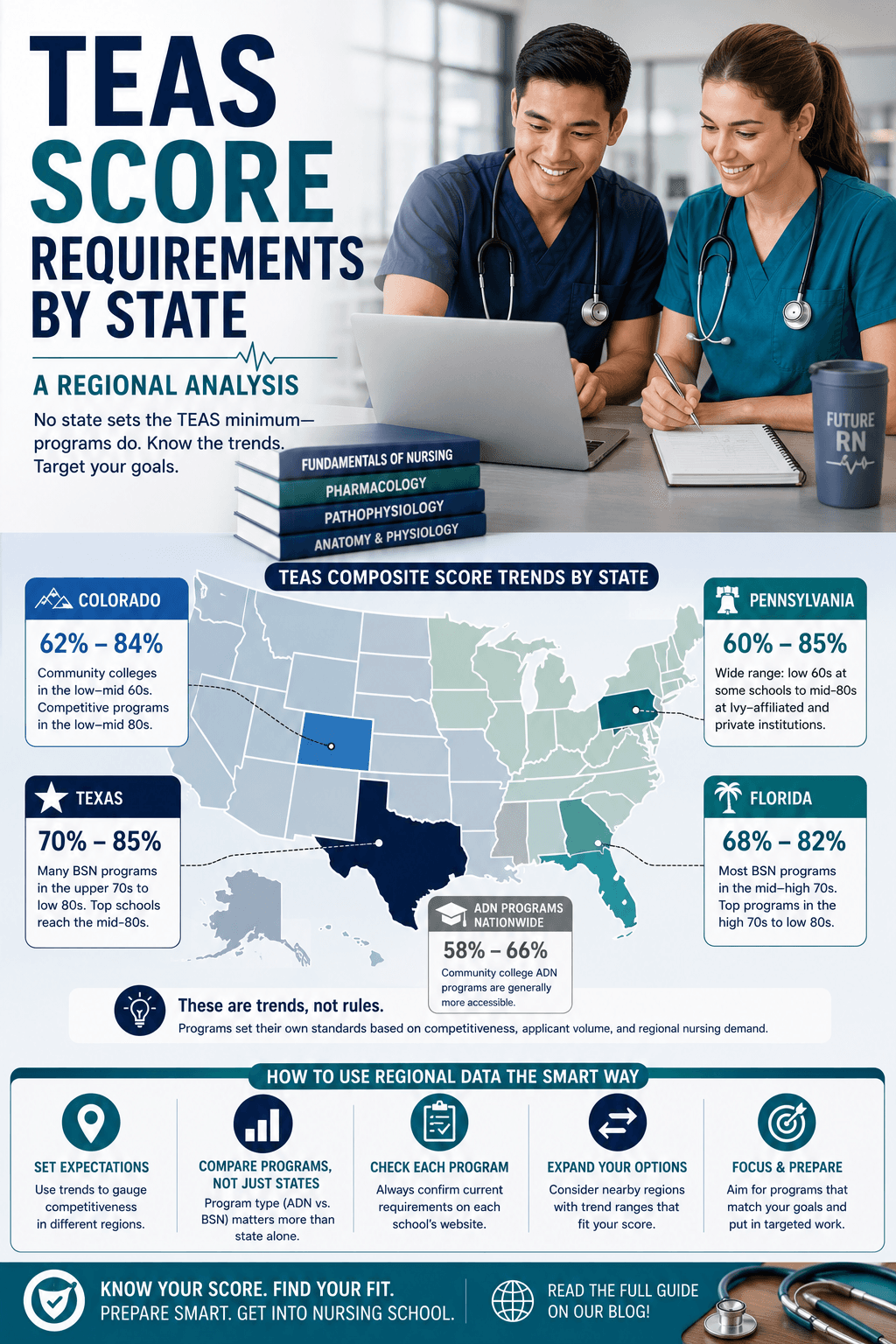
- Texas tends to run on the high end nationally, with many BSN programs clustering in the upper 70s to low 80s percent range, and highly competitive flagship schools occasionally demanding composite scores in the low-to-mid 80s. ADN programs in many other states are generally somewhat lower, but still trending higher than the national ADN average.
- Florida exhibits a similar competitive pattern, especially among its most selective public university programs, with many clustered in the mid to high 70s, with flagship programs in the top tier reaching into the high 70s to low 80s.
- Pennsylvania has some of the most significant internal diversity of any state, offering a range of possibilities from more accessible institutions in the low-to-mid 60s to some of the most selective private and Ivy-affiliated colleges in the country, many of which do not require the TEAS and undertake holistic assessment instead.
- Colorado is no exception, featuring community college and open-enrollment programs in the low-to-mid 60s and more competitive university and private schools in the low-to-mid 80s.
- The ADN programs at community colleges nationwide tend to fall within a more attainable range (usually somewhere in the upper 50s to mid-60s), regardless of state, due to their broader access objective compared to a selective university BSN program.
Why You Should Not Treat These as Fixed Rules
Averages hide enormous variety within. State-level averages include a combination of open-enrollment community colleges and the most competitive private university programs in that state, which can vary by 20 or more percentage points. Knowing the broad trend for your state tells you little about what your unique target program truly requires. The requirements alter year to year. Programs change their minimums depending on the number of applicants, the number of seats available and the changing philosophy of their admissions process so even statistics one year old can be stale. In some states, certain programs do not require the TEAS at all. As stated above, even competitive states have specific programs that have shifted to holistic review or an alternate exam, so a state’s overall “average” is not indicative of programs that don’t use the TEAS at all. Geography is less important than program type. The difference between an ADN program and a competitive BSN program in the same location is sometimes greater than the difference between two ADN programs in different states. The program type is a better predictor of the score needed than the state alone.
How to Use Regional Data Effectively
- Think of it as a blunt instrument for managing expectations, not an end. If you are moving, or trying to decide between states to attend nursing school, regional trends can help to give you an idea of whether your current score is likely to be generally competitive, but should not substitute reviewing the specific requirements of programs.
- Use it to compare program kinds inside your state, not only across states. That is a more useful comparison for most applications, since most applicants are actually making that choice between ADN versus BSN or accelerated BSN in their particular state or region.
- Be sure to check the current, published requirement for each institution on your list. Regional trends can only be used as background information to build reasonable expectations. Your actual application strategy can be constructed from particular program websites and direct confirmation with admissions offices.
- Imagine having a bordering region that is below average that can add to your choices. If you want to make a geographic leap, consider looking at regional trends to see which states or regions may be a good fit for you based on your present score. This may expand your range of realistic target programs.
The Bottom Line
There are true regional variations in TEAS scores, and they are driven by real disparities in program competitiveness, volume of applicants, and regional employment dynamics. But, this is a pattern that is the result of several separate program decisions, not a state-mandated requirement. Use regional comparisons to set realistic expectations and identify potential opportunities, but always build your actual application strategy around the current, published requirement for each specific program rather than a state-level average that may not be representative of the specific school or program type you are applying to.