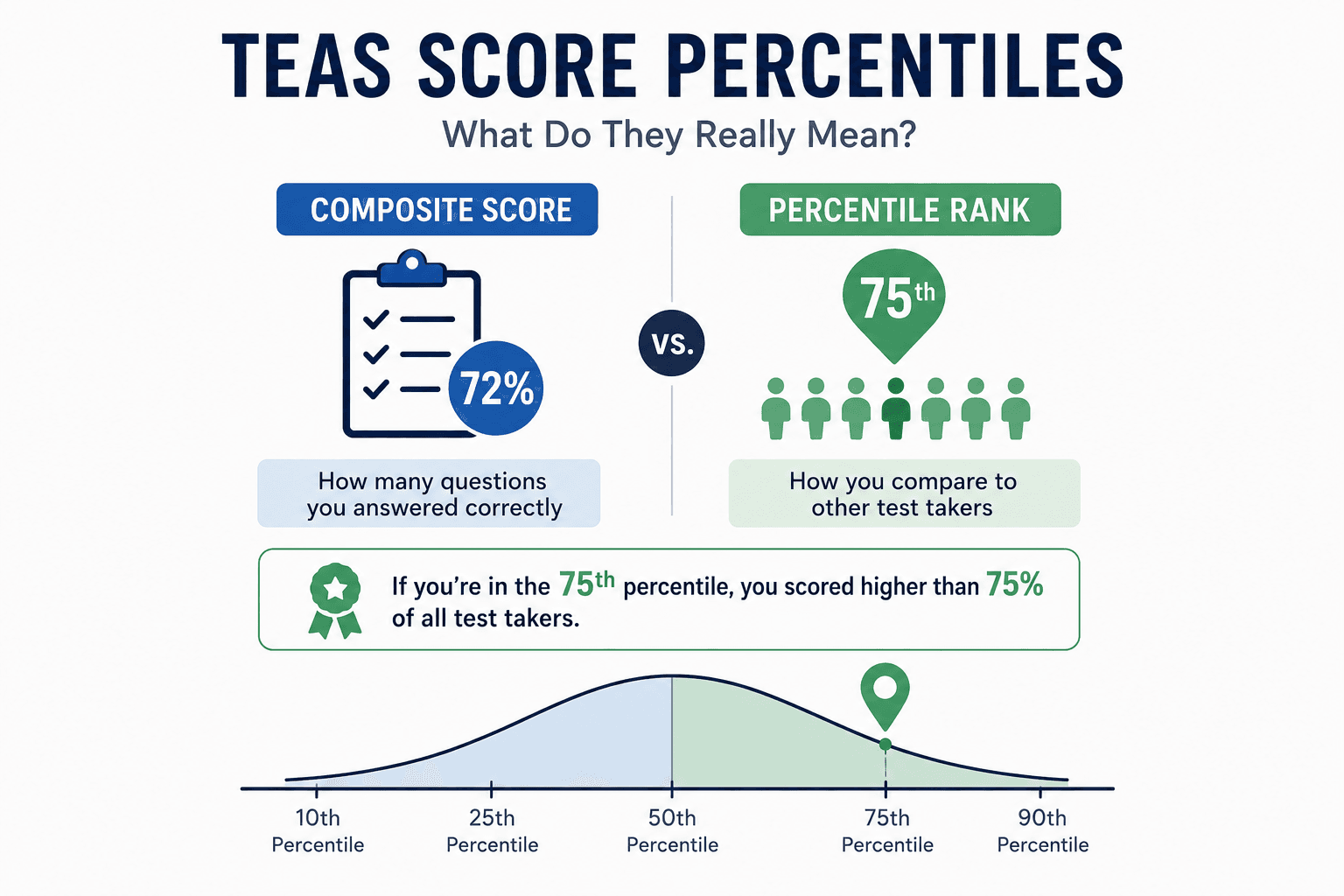
What is the percentile?
Your percentile rank indicates the percentage of other test takers who scored equal to or lower than your score. If you're in the 75th percentile, that simply translates to the fact that you scored the same or better than about 75% of all the people who took the test — not that you got 75% of the questions right.
This is the one most frequently confused item: Your composite score is not the same as your percentile rank and it is measuring two things. Your composite is based on accuracy—that is, the percentage of questions that you answered correctly. Your percentile is a comparison score — it's how you compare to other national test takers.
It is quite possible that you might have a modest composite score with a strong percentile rank, if the test takers as a whole had low scores—just as it is quite possible that you might have a strong composite score with a percentile score in the middle, if you didn't expect.
Why percentiles exist as well as raw scores
If there's a highly competitive nursing program with significantly more applicants than spots, for instance, they must have a method to differentiate between the applicants other than just the pass/fail mark. A composite score only tells a program "this applicant met the minimum", not "how the applicant compares with the other applicants that the program is choosing from. That's why some competitive programs give percentile rank a credit, either explicitly or implicitly, during holistic review.
National Percentile vs. Program-Type Percentile
There's a detail you might miss in ATI's score report: it can contain a plurality of percentile scores. Some reports mention a Program Mean Score and a Program Percentile Rank, which are calculated within your program type (i.e., comparing you only with other applicants who took the TEAS within the same program type, such as ADN and not with those who took it for a BSN program or LPN program).
This is important because one can be statistically worse or better off when compared to various comparison groups. A score that is in average range nationally could be at the very center of a very narrow range of program-type scores that is considered average within that specific program. Unless you're looking at the number itself, you should interpret your report with focus on the percentile number.
What Percentile Ranges tend to Indicate
When it comes to program cutoffs, they are not always published in percentile terms and there are no hard-and-fast rules, but there are general trends:
- A program may have a minimum eligibility threshold (lower percentile) that will still qualify an applicant, but give the applicant less competitive odds against other candidates.
- Mid-range percentiles can be a good, solid applicant for many of the "standard" programs.
- The higher percentile numbers are correlated with the profiles of students placed in competitive or limited seat programs such as accelerated or high ranking BSN programs.
If a program doesn't have a clear percentile goal, an admitted-student's profile is likely to fall in a range above the minimum, particularly at more selective institutions — hence the need for percentile context even if you've met the minimum.
Common Problems and Misunderstandings
Problem: "My composite score is okay, but I am not sure it is a competitive percentile. Solution: A passing composite does not equal a strong percentile. Look at both numbers on your report, and if your target program is competitive, find out whether they're talking about a percentile or a range of students who were admitted to the program—your percentile will help you get a true sense of how competitive you are.
Problem: "There are a number of percentile scores on your report because they are available to assess your child's achievement in relation to other children. Solution: Determine if the percentile is based on the national or the program-type specific percentile. They respond to different tests; one will compare you to everyone who has ever taken the TEAS test, whereas the other will compare you to all of the other applicants who are seeking the same kind of program you are, which is probably the more important comparison.
Problem: "I did not feel I scored well enough in my programs' minimum level, but I'm feeling like I'm not scoring as low as I should be. Solution: To be considered, a child must achieve a minimum score; to be competitive, a child must achieve a higher score. A lower percentile, even with a passing composite, might be worth retaking, if you have the time, if the program in question is making a decision between a number of qualified applications and will tend to prefer stronger composites.
Problem: "I don't know if a 5-point composite increase will make a significant difference in my percentile. The solution: If you are in the middle of the percentile distribution of the entire score distribution, you may drag your percentile higher or lower than would otherwise be anticipated, especially if there are a lot of students taking the test and they are all in the same percentile range. The relative improvement might seem small, but if it's targeted and modest, it can still take you significantly up the rankings, based on your Individual Performance Profile.
How to Use Percentile Information Practically
- If your report has both, find both your national percentile and program-type percentile and determine which is more relevant to your application.
- Avoid using your composite score by itself – they will need to be compared to your percentile so that they can get a complete picture of the actual position.
- Check the competitiveness of the program you are interested in, not only their stated minimum, as admitted students may have scores well above the minimum.
- Relative ranking will also be important to consider, especially for limited seat and competitive programs, and use percentile context to determine retake.
Final Thoughts
Your percentile rank is there for a reason: a raw composite score alone is not enough. The composite number alone is not nearly as accurate as an understanding of the difference between accuracy and comparison (your composite vs the percentile), knowing which percentile number you are on, and using that context to determine your real competitiveness, not just whether or not you are eligible.