Why a System-by-System Approach is Better
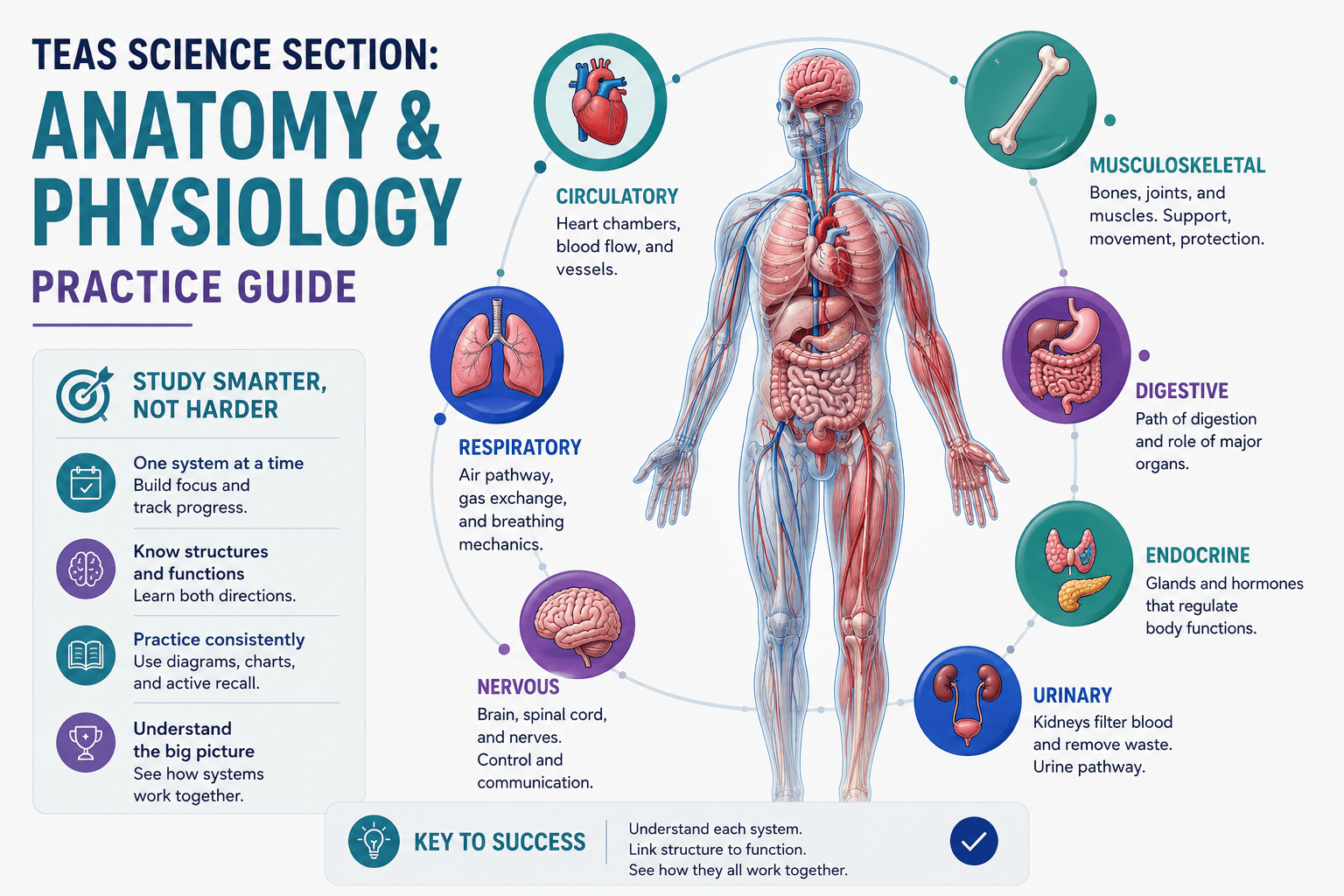
To look at “anatomy” as a single subject usually makes for a scattered, stressful experience of study. There is no natural ending point and no means to judge progress. Dividing the review into individual bodily systems provides clear boundaries, a sense of completion after each one, and a structure that mimics the way the subject is actually tested—questions usually deal with the structures and functioning of one system at a time, or with how systems interact.
The circulatory system.
Focus on the chambers of the heart (atria and ventricles), the path blood takes through the heart and body (pulmonary versus systemic circulation), and the basic functions of arteries, veins, and capillaries. Know the general process i.e. deoxygenated blood enters the right atrium, then the right ventricle, then gets pumped to the lungs to get oxygenated, then goes back to the left atrium, then the left ventricle, then gets pumped out to the body.
Problem solving tip: A common area of confusion is becoming confused about which side of the heart is oxygenated blood vs. deoxygenated blood. It’s anchored by one simple rule: the right side is always about blood going to the lungs, the left side is always about blood going to the body.
The Respiratory Apparatus
Follow the course of air: nose/mouth → pharynx → larynx → trachea → bronchi → bronchioles → alveoli for gas exchange. Know the basic mechanics of in- and exhalation, and the role of the diaphragm.
Problem-solving tip: Questions often evaluate the precise location of gas exchange (the alveoli) versus other respiratory structures that only convey air. Don't only learn the process, know the single structure that is accountable for the actual oxygen-carbon dioxide exchange.
The Nervous System
The primary difference is that the central nervous system consists of the brain and spinal cord, while the peripheral nervous system consists of the nerves that extend throughout the body. Understand the basic functions of the primary parts of the brain – the cerebrum is where you do higher-order thinking, the cerebellum is for coordination and balance, and the brainstem is responsible for essential life activities like breathing and heart rate.
Problem solving tip: A very common way to lose points is to confuse the names of structures with what they do. Make a basic two-column list—structure on one side, function on the other—and test yourself both ways (function to structure, and structure to function).
The Muscular-skeletal System
Know the main kinds of bones and their functions (support, protection, movement and mineral storage), the main types of joints, and how the axial skeleton (head, spine, ribs) differs from the appendicular skeleton (limbs, shoulders, hips). Muscles: Know the basic difference between skeletal, smooth, and cardiac muscle tissue.
Problem-solving tip: Rather of memorizing each and every bone, start with the categories and important landmarks, because the exam is more about basic structure knowledge than comprehensive bone-by-bone memory.
The Digestive System
Learn the basic path of digestion: mouth → esophagus → stomach → small intestine → large intestine and the general functions of the liver, pancreas, and gallbladder in digestion (bile generation, enzyme secretion, and nutrient processing).
Tip for problem solving: Focus on the difference between where nutrient absorption occurs (small intestine) and water absorption/waste generation (big intestine) – a common comparison question in exams.
The Endocrine System
Focus on the big glands and their main hormones - pancreas (insulin and glucagon to regulate blood sugar), thyroid (to regulate metabolism), adrenal glands (for stress hormones). Comprehend the basic idea of hormonal feedback loops that regulate bodily function.
Tip for problem solving: Rather than trying to memorize the hormones in isolation, try to associate each hormone with a specific physiological consequence. Exam questions are typically testing function of a hormone, rather than just the name.
The Urinary (Renal) System
Know what the kidneys do (filter blood) and the overall flow of urine creation and excretion (kidneys > ureters > bladder > urethra).
Problem-solving tip: A common confusing point is the orientation of this pathway. Anchor it with the sequence above and don’t merely recall organ names in isolation.
Common Problems Students Have with A&P Review
Problem: “There is too much content and I don’t know where to start”. Solution: Pick one body system and go over it in detail, then go on to the next. Don't try to skim across all the systems at the same time. When the system is complete there is a sense of true progress; when only part of everything has been reviewed there isn't.
Problem: “I keep getting mixed up with similar sounding structures. Solution: Instead of memorizing each structure individually, create comparison tables for commonly confused couples (arteries vs. veins, tendons vs. ligaments) as comparing them side-by-side forces you to articulate the precise distinguishing element that exam questions love to test.
Problem: “I Know structure names but freeze when asked about function. Solution: Be able to test yourself both ways – structure to function and function to structure – as exam questions may ask about the same topic from either perspective.
“I spend too much time in A&P, not enough time in chemistry and biology.” Solution: A&P is the largest single subject area, yet chemistry and biology are assessed separately from each other. routine a certain amount of time for A&P review so that it’s not taking over your whole Science study routine.
Conclusion
Anatomy and physiology is intimidating, but mostly because of the amount of material, not the real complexity. Organize your review in a systematic fashion, system by system, creating structure function comparisons in both directions, establishing clear boundaries so that A&P does not crowd out chemistry and biology in your overall Science preparation. By taking one system at a time, in an organized way, the daunting amount of material is broken down into a series of small, compliable review sessions.