The Real Question Behind an Inference Question
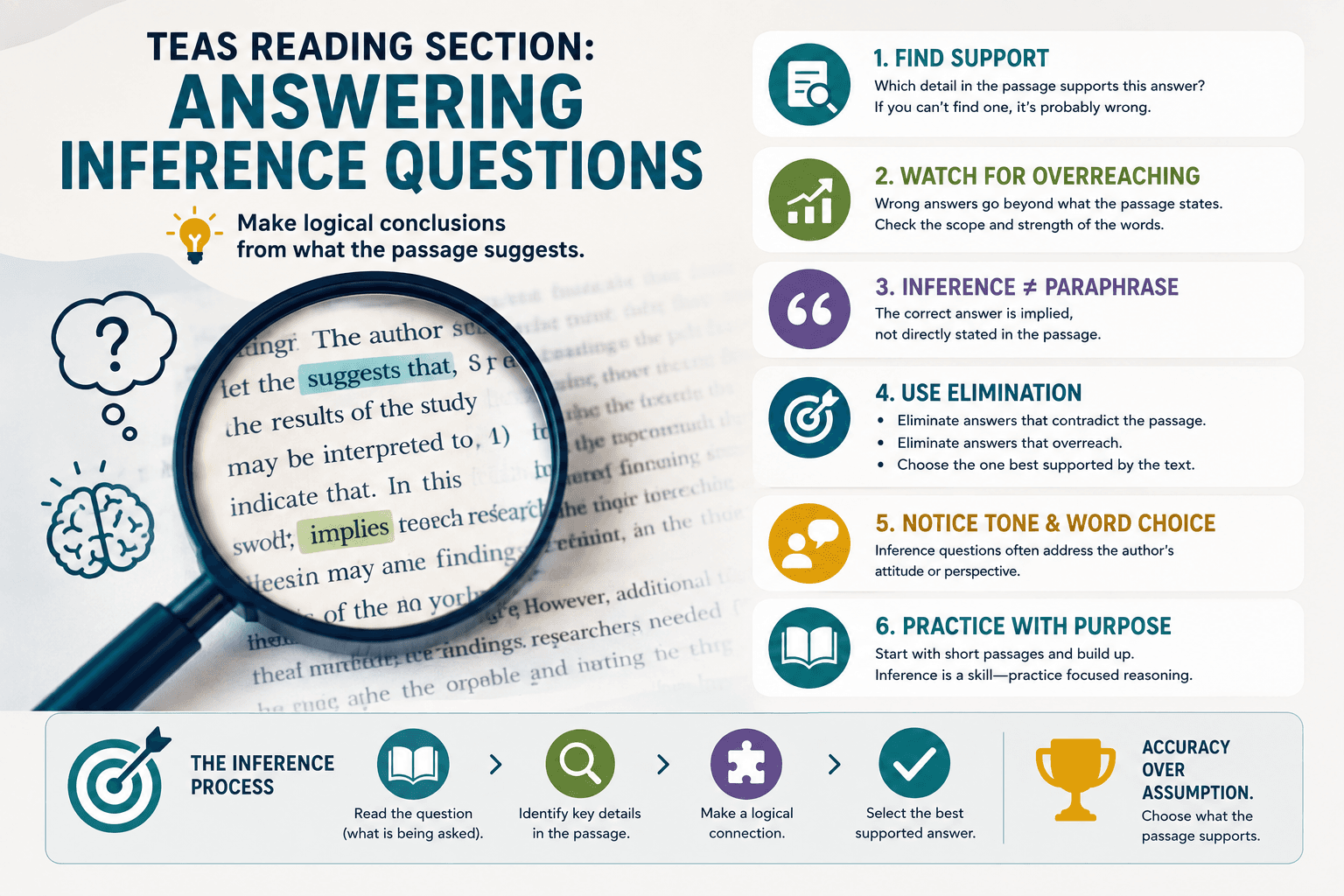
An inference question asks you to infer something that the passage indicates but does not mention outright. This question is categorized under Integration of Knowledge and Ideas in the Reading section, which also covers comparing texts and interpreting pictures – inference is all about whether you can draw a logical, well-supported conclusion from evidence in the passage.
The important difference is that a proper inference is supported by specific details in the paragraph, not just reasonable in general. This is the number one misconception that causes even normally strong readers to miss these questions.
The Fundamental Error: Confusing Plausible with Supported
Many wrong answers to inference questions are plausible – they may be true in the actual world, and they don’t contradict anything in the paragraph. But ‘could be true’ is not ‘the passage in fact supports this.’ The correct response is the one that logically and clearly follows from the supplied details, not the one that just "sounds right" in general.
Fix: For each answer choice, ask yourself, “What one sentence or detail in the passage supports this?” If you can't point to something tangible, that solution is likely a trap, even if it sounds reasonable.
Watch for Overreaching Options
A common tendency in wrong answers: they take something from the passage that's true, then blow it up into a more general or stronger statement than the passage supports. For example, if a sentence says that a treatment “showed improvement in some patients,” a response choice that says the treatment “is effective for all patients” has gone beyond what the evidence actually supports.
Fix: Compare the scope and strength of language in the passage with the extent and strength of language in the response choice. If the answer choice is more absolute or more general than what is actually said in the passage, it is probably wrong.
Differentiate Inference from Paraphrase
Some wrong response selections merely repeat a detail from the passage rather than making an inference from it. When an answer choice is what the passage directly states, it’s not evaluating your inference skill, the question is asking what the paragraph indicates, which involves a little logical step beyond what is openly stated.
Fix: If one of the answer choices looks like it’s just repeating something you already read word-for-word, double check if the question is asking for a direct detail (Key Ideas and Details) or a true inference (Integration of Knowledge and Ideas) — these are two different skills being tested in two different ways.
Use the process of elimination wisely
Inference questions tend to have one plainly erroneous answer, one or two overreaching choices, and one well-supported solution. Systematic elimination tends to be more reliable than trying to pick off the correct answer on the first try.
Fix: First, delete any response choice that directly contradicts the passage. Then eliminate any that goes beyond what the passage says. Finally, ask yourself if the answer choice is actually supported by specific details in the passage, or if it is just the least wrong of the choices left.
Be aware of tone and word choice
Inference inquiries are often about the author's attitude or specific words they use, not direct factual information. The tone of a piece (cautious, confident, critical, hopeful) may be an inference about the author’s underlying perspective in and of itself, even without a stated expression of opinion.
Fix: When you read, take a moment to notice the general tone of a section, since inference questions frequently ask what the author probably believes or would probably agree with, which depends on tone as much as explicit information.
Start with Short Passages, and Then Build Up
If you find inference questions difficult, start with shorter sections first so you may isolate the specific ability before tackling longer passages and the added difficulty of tracking the complete passage context. When you feel comfortable with understanding the supported inferences in the short passages, apply the same thinking to the lengthier passages you’ll see on the real test.
Fix: Treat inference exercise as a separate study block, not part of regular reading practice. It is a different kind of reasoning and it is best developed by concentrated repetition.
Typical Problems and Their Solutions
Problem: “I keep choosing answers that sound right to me but are marked wrong. Solution: You are mixing plausibility with actual evidence from the text. Be sure to find the specific passage detail that supports each answer choice before you select it.
Problem: “I don’t know what a detail question is or an inference question.” Solution: direct question asks about anything stated directly in the passage; inference question asks about something implied by the paragraph but not stated immediately. Notice the language of the question. Words like “suggests,” “implies,” or “the author would probably agree” are very good clues that this is an inference question.
Problem: “I select answers that are correct according to the passage but still get marked wrong. Solution: The answer must be what the question is truly asking about; being truthful is not enough. Some wrong selections are accurate restatements of the material, not true inferences—inferences require a distinct (and inaccurate) match.
Problem: “I can’t get through inference questions and run out of time.” Solution: Do not try to get the "obviously correct" solution immediately, but instead apply the elimination approach in a systematic way. By eliminating conflicts and overreaches first, you restrict your decision faster than beginning from scratch every time.
Conclusion
Inference questions reward accuracy, not imagination. The correct response is always the one most directly and clearly supported by the actual substance of the paragraph – not the most plausible-sounding choice, and not a mere re-statement of a given detail. Practice discriminating between supported conclusions and overreaching or merely plausible ones. This category goes from being one of the most irritating areas of the Reading section to one of the most consistently answerable.