Two senses of the word “version”
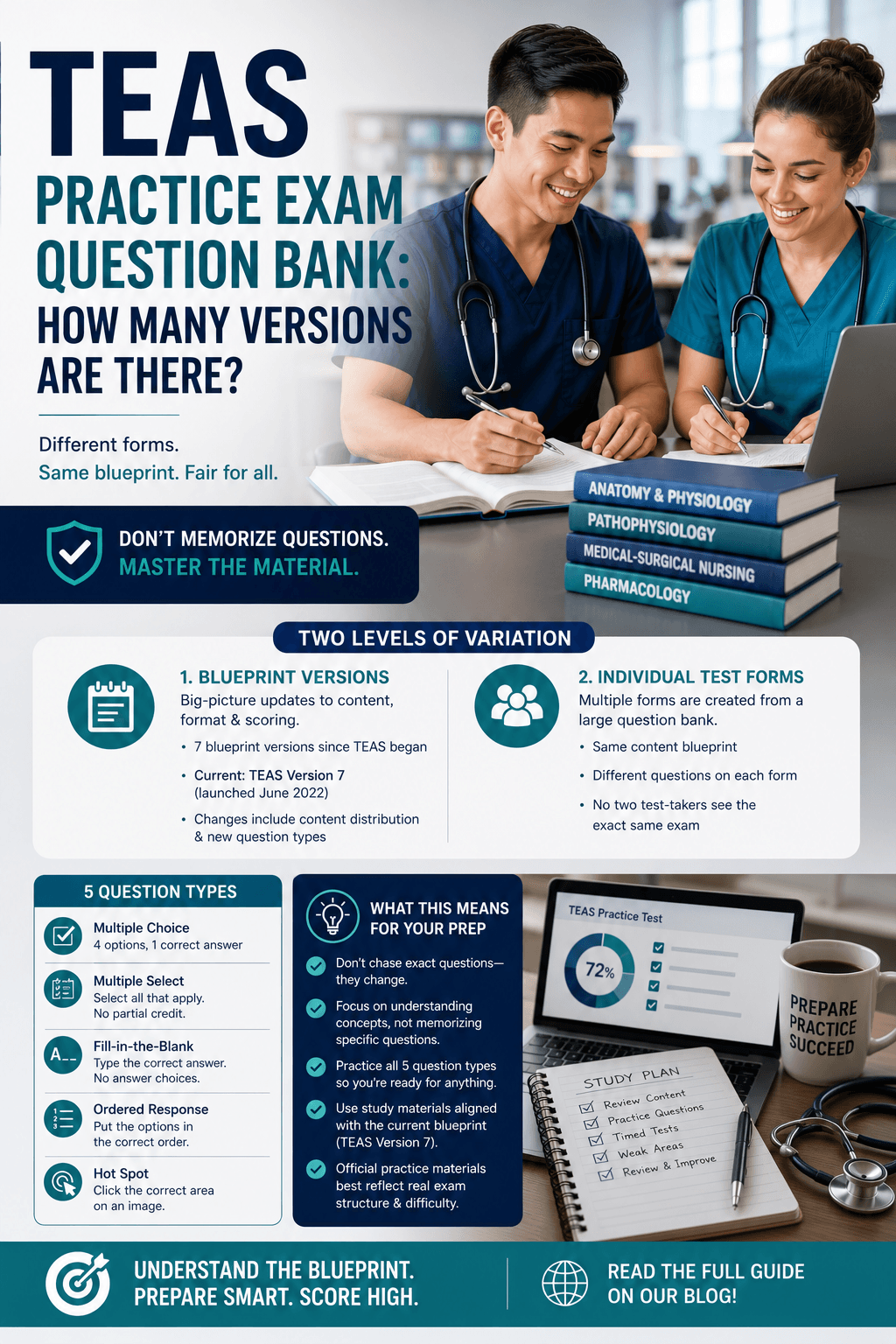
Before we go into the details, it’s helpful to separate two things that people tend to lump together under the word “version”: the overall blueprint of the exam (the big content and format changes, like TEAS 6 vs. the current TEAS 7), and the individual test forms that are drawn from the question bank within that blueprint (the particular set of questions any one test-taker receives on a given day). Most of the misunderstandings around the structure of the exam originate from the confusion between these 2 concepts.
Blueprint Versions: The Big Picture Updates
Since the inaugural administration of the TEAS, the organization that administers the TEAS has created seven different test blueprints, each reflecting a significant change to the content categories, question format, or scoring structure. The newest version, TEAS Version 7, was launched in June 2022 to replace TEAS Version 6.
These are blueprint level alterations, which are infrequent and represent major improvements, not trivial tweaks. For example, the transition from Version 6 to Version 7 altered how science content was distributed. Under the current blueprint, content previously grouped under general life and physical sciences has been more clearly divided into separate biology and chemistry sub-areas, and the percentage of questions dedicated specifically to anatomy and physiology has been reduced from the previous version. Version 7 also saw the introduction of other item types for the first time, beyond standard multiple choice questions (single response).
This distinction is quite important if you are using older study materials. The content review from a Version 6 guide may still be useful for the overall subject matter but will not prepare you for the new question forms seen in Version 7. The percentage of questions per topic area has changed enough that outdated information can misdirect your study priorities. Always make sure that any study guide, practice exam or prep course you use is properly aligned to the current blueprint version before you count on it.
Questions Types in the Current Design
The current TEAS plan has five different question formats. The exam is still made up mostly of traditional multiple-choice questions, with four choices, one correct. Now the exam also has four types of alternate item types. They together make up about 15% to 20% of all the questions. They include: Multiple select questions (commonly known as "select all that apply" where more than one answer might be correct and there is no partial credit for partially correct selections)
Fill-in-the-blank questions (don't have answer options and you have to provide the answer directly) Ordered response questions (ask you to order several responses from a list into the correct order) Hot spot questions (give you an image with several clickable areas to select the correct location based on the question)
This turn to other item types was not random. These are styles that are more and more popular in nursing and allied health training and on the NCLEX licensure exam, so practicing on the TEAS gives you early exposure to a testing style you will continue to see throughout your nursing education.
Individual Test Forms: Why No Two Test-Takers See the Same Test
For one blueprint version, the administering organization produces numerous separate exam forms from a bigger question bank. Even if you take the exam the same day, at the same testing site, you aren’t likely to get the exact same questions as the next person taking the test. Each form is created to the same general content pattern (similar percentage of reading, math, science, and English and language usage questions), however exact questions on forms will differ.
There is a good reason for this structure: it preserves the integrity of the exam by making it significantly more difficult for test takers to gain an unfair advantage by memorizing specific questions from someone who tested before, and it allows the exam to be administered on an ongoing basis at testing centers across the country without every candidate seeing the exact same content.”
What It Means for How You Need to Prepare
Don’t listen to rumors about “exactly what’s on the test.” Each test form can be quite different even within the same blueprint. Therefore, an applicant's report of specific questions he or she encountered is not a good study tool. Even if their account is true for the date they took the test, it informs you very nothing about what you will really see.
Concentrate on understanding the material and the format, not the questions themselves. You can't forecast the individual questions, so a more useful method is to really learn the material behind each of the assessed areas, and get comfortable with all five types of questions so that you're ready for anything, regardless of whatever specific questions your particular form has.
Ensure your study material is aligned with the latest plan. The content distribution, as well as question formats, have changed quite a bit between Version 6 and Version 7, so using old materials, even if they worked well for an older version, can leave real gaps in your preparation, especially around alternate item types that weren’t around in previous versions.
Use official practice materials when available. In terms of actual preparation, more important than the sheer volume of practice questions from unofficial sources are the practice materials generated directly by the exam’s administering organization, since they are most likely to precisely reflect the current blueprint’s topic proportions and question format mix.
Summary
The TEAS has two levels of variation: infrequent, large changes to the blueprint (there have been seven of these with Version 7 being the standard) and a much larger internal bank of questions that is used to generate multiple different test forms within that blueprint, so that no two test-takers can be sure to see the exact same exam. Understanding this structure also helps explain why chasing down specific questions remembered from other test-takers is a poor use of prep time, and why the more reliable path is authentic content mastery across all tested areas, familiarity with all five current question formats, and confirmation that whatever materials you’re studying from are aligned to the current blueprint version.