Why Memorization Is More Important Than You'd Think
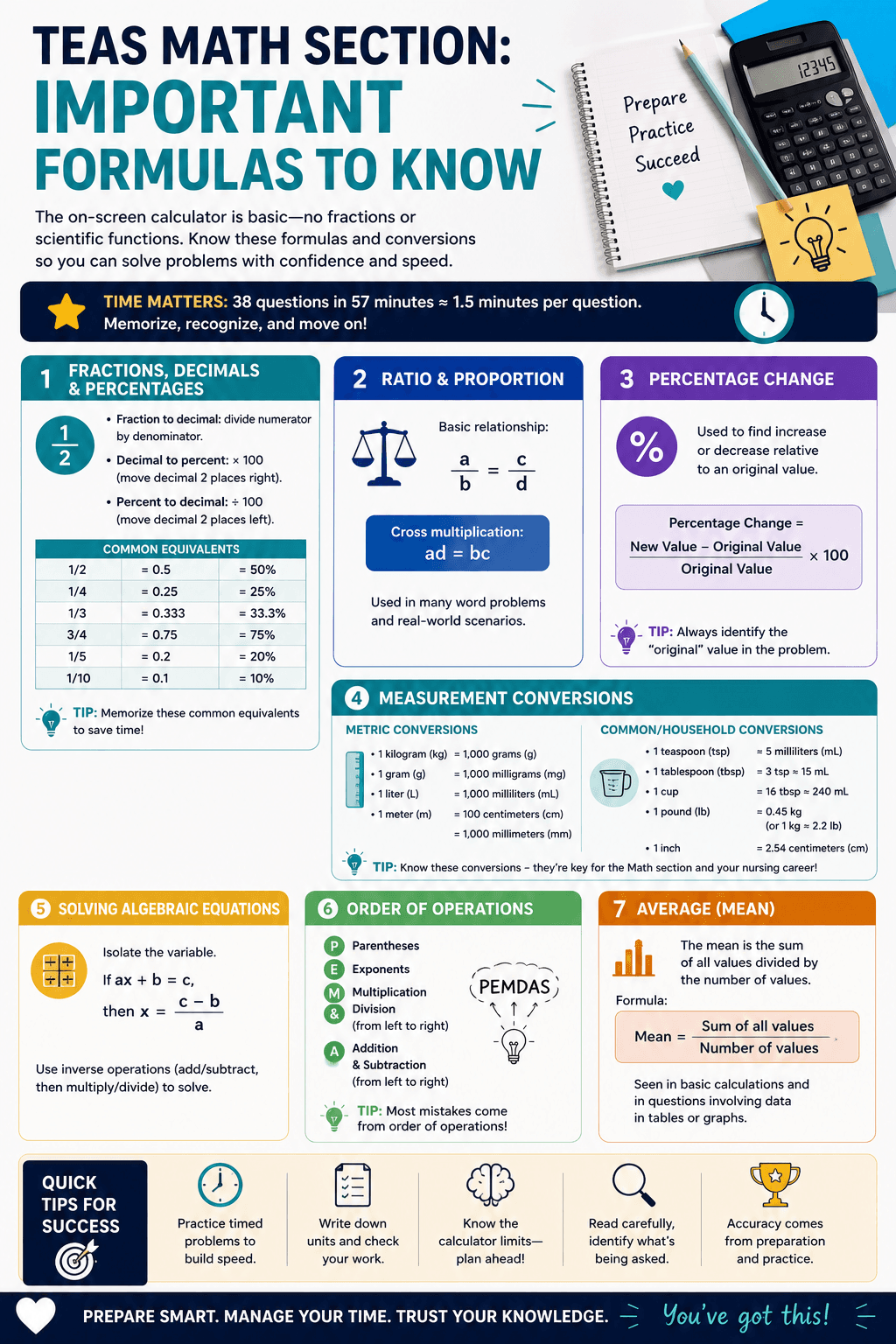
There are 38 questions in 57 minutes, which is about 1.5 minutes per question, so there is no time to derive a formula from scratch during the exam. Students who have learned important relationships in advance can use them on the spot. Students who need to recreate the reasoning under time pressure sometimes run out of time even if they grasp the fundamental notion.
Fractions, decimals and percentages conversions
The calculator doesn't support fractions; thus you need to do the conversions yourself:
- • How to turn a fraction into a decimal: divide the top number by the bottom number?
- • Decimal to percentage: multiplied by 100 (shift decimal point 2 places right).
- • Decimal to percent: multiply by 100 (move the decimal point 2 places to the right).
- • Common fraction-decimal-percentage equivalents to memorize: 1/2 =.5 = 50% 1/4 =.25 = 25% 1/3 =.333 = 33.3% 3/4 =.75 = 75% 1/5 =.2 = 20% 1/10 =.1 = 10%
Tip for problem solution: It is faster to memorize these common equivalents than to do the division each time a question refers to them.
Ratio and Proportion Formulas.
Ratio and proportion problems are very common, such as "if A is to B, what is C to Do?" The basic relationship:
a/b = c/d Cross multiplication: an x d = b x c
A considerable number of word problems, including many of the real-world scenario questions emphasized in the current exam, is based on one relationship.
Percentage Change Formula
Used in inquiries inquiring whether something has increased or decreased with respect to an original value:
Percentage change = (New Value – Original Value / Original Value) x 100
The problem-solving tip: Watch for whatever number is the “original” value in the problem – utilizing the wrong reference point is a common source of failures on these questions.
Conversion Factors for Measurement
This exam is mainly about measurement and interpreting data, learn these frequent conversions, don't expect to know them from general knowledge:
Metric:
1 kilogram (kg) equals 1,000 grams (g) 1 gram (g) = 1,000 milligrams (mg) 1 L equals 1,000 mL 1 meter (m) = 100 centimeters (cm) = 1000 millimeters (mm)
Standard/common household conversions tested:
1 teaspoon (tsp) is about 5 milliliters (mL) 1 tbsp. = 3 tsp ≈ 15 ml (milliliters) 1 cup = 16 tablespoon ≈ 240 ml 1 pound (lb.) = 0.45 kg or 1 kg ≈ 2.2 pounds (lb.) 1 inch = 2.54 centimeters (cm)
Problem-solving tip: Memorize these conversions as a double-duty investment, not just exam prep. These conversions are important not only for the Math part in the abstract but also indicative of the kind of dosage and measurement calculations you will be doing throughout your nursing career.
Solving Algebraic equations: Introduction
Review the conventional way to isolate a variable
If ax + b = c, then x = (c-b)/a
Most of the algebra on the test is single-variable, multi-step equations that follow this basic structure, so being fluent in isolating a variable with inverse operations (add/subtract, then multiply/divide) is more helpful than memorizing a bunch of complex algebraic identities that you probably won’t use.
Order of Operations
A basic rule that dictates how multi-step problems have to be addressed. PEMDAS - Parentheses, Exponents, Multiplication and Division (left to right), Addition and Subtraction (left to right).
Tip: If you’re having trouble with multi-step calculation issues, the issue is usually not that you don’t grasp the math but that you’re making order-of-operations blunders. When you have a multi-step problem, double check the sequence of operations before you finalize your answer.
Average (Mean) Formula
The mean is the sum of all the values divided by the number of values. This arises in basic calculation type questions and questions that you are asked to evaluate data in tables or graphs.
Problem solving
Problem “I know these formulas, but I still run out of time on practice tests.” Solution: Knowing a formula and implementing it rapidly are 2 separate talents. Practice timed problem sets, not just formula review, so that recall is rapid enough under real time pressure.
Problem: “I am confused on how to know what conversion factor to use in word problems.” Solution: Before you start guessing which number appears familiar, practice identifying the units given and the units requested for to choose a conversion factor. In practice, write down units explicitly to get in the habit of doing so.
Problem: “Conversions. I’m using the calculator on-screen and it’s not helping. Solution: The calculator given is just a simple four function with no fraction or scientific features. Find this constraint well in advance of test day, as finding it midway through the exam is a common—and avoidable—cause of lost time.
Problem: “I get the math conceptually, but then I make careless mistakes when I’m rushed. Usually it’s an order of operations or unit tracking problem, not a conceptual gap. In particular, slow down a bit on multi-step puzzles as this is where most sequencing errors tend to happen.
I don’t sure which formulas are genuinely worth knowing, and which I can derive when I need them. Solution: Note the conversions and relationships shown here, as they are used repeatedly and are time consuming to derive from scratch. If you have limited time to study, topics in algebra that are less common on the test and also more difficult are lower priority.
Summary
The Math segment is a reward for the extra preparation that crosses the line from conceptual to true memorization and rapid recall, because the calculator offered can’t do fractions, conversions, or complex calculations for you. Make sure to memorize the conversions, ratio and proportion relationship, % change formula, and basic mathematical technique given here before the test day. Get practice applying them under real timed settings so that recall turns into speed when it counts.