Understanding Ratios and Proportions for the TEAS Math Test
Ratios and proportions are useful mathematical concepts that appear in everyday situations, from comparing quantities to adjusting recipes. They are also important topics to review when preparing for the ATI TEAS Math section. Understanding how these concepts work can help you solve problems more confidently and avoid common calculation errors. You do not need to memorize complicated procedures to get started. The key is to understand what a ratio represents, how equivalent ratios work, and how to set up a proportion correctly.
What Is a Ratio?
A ratio compares two quantities. It can be written in three common ways:
- 2 to 3
- 2:3
- 2/3
For example, imagine a classroom with 10 students who prefer tea and 15 who prefer coffee. The ratio of tea drinkers to coffee drinkers is 10:15. Dividing both numbers by 5 simplifies the ratio to 2:3. Always pay attention to the order of the quantities. The ratio of tea drinkers to coffee drinkers is not the same as the ratio of coffee drinkers to tea drinkers.
What Is a Proportion?
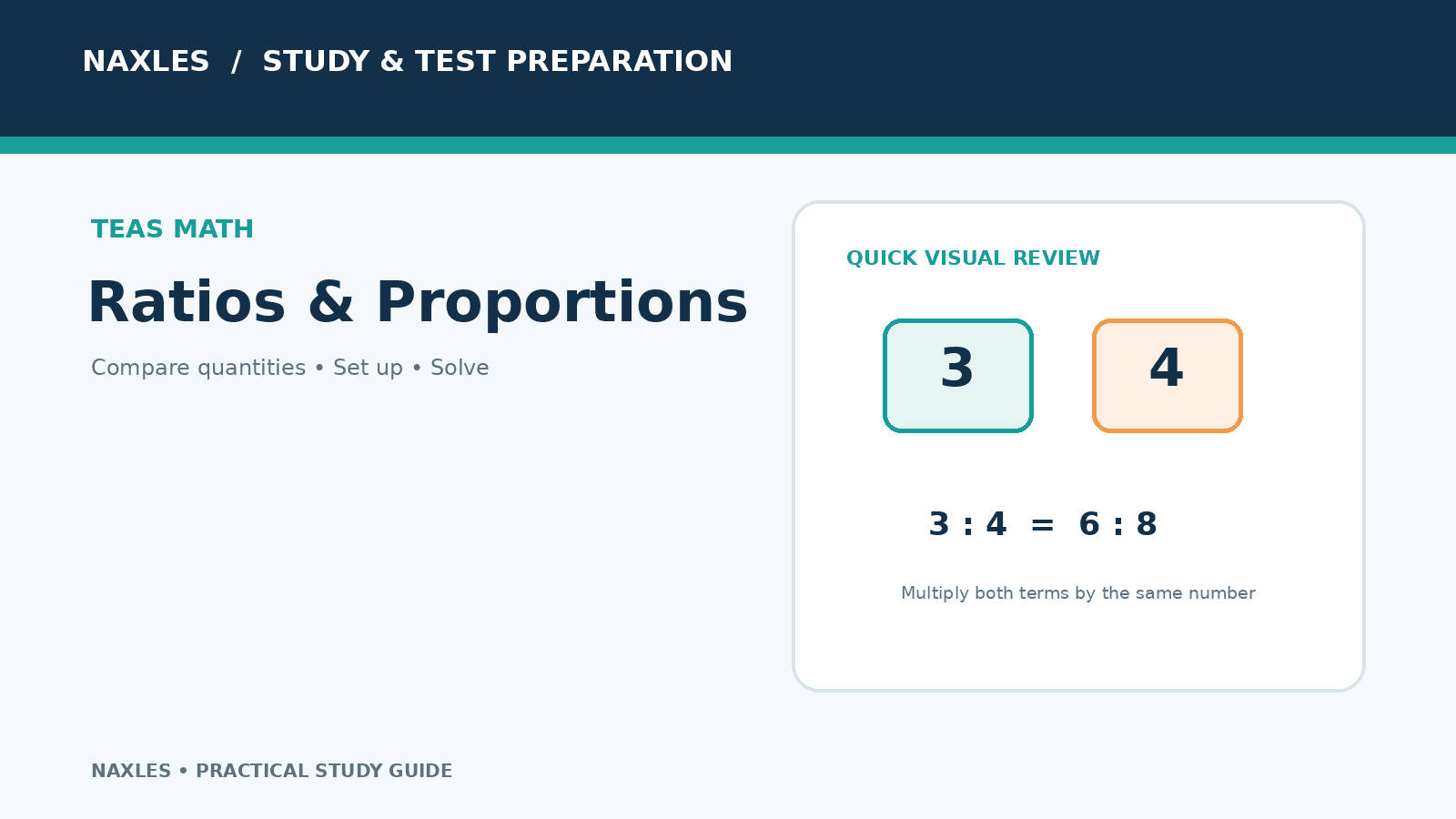
A proportion is an equation stating that two ratios are equal. For example: 3 2 = 12 8 Both fractions represent the same relationship. Proportions are often used when one quantity changes while the relationship between two quantities stays constant.
How to Solve a Proportion
Consider this example: A recipe uses 2 cups of flour to make 8 muffins. How many cups of flour are needed to make 20 muffins, assuming the recipe is increased proportionally? Set up the proportion: 8 2 = 20 x Cross-multiply: 8x=40 Divide both sides by 8: x=5 The recipe needs 5 cups of flour. Cross-multiplication is a useful method, but it is important to set up the ratios in the correct order before using it.
Common Mistakes to Avoid
One common mistake is switching the order of quantities. If the first ratio compares flour to muffins, the second ratio should also compare flour to muffins. Another mistake is forgetting to simplify ratios when the question asks for the simplest form. For example, 12:18 simplifies to 2:3. Finally, check whether your answer makes sense. If you are increasing a recipe from 8 muffins to 20 muffins, the amount of flour should increase rather than decrease.
How to Practice Ratios and Proportions
Start with simple examples involving whole numbers. Then practice questions involving recipes, distances, prices, and measurements. After solving each problem, write down the steps you used and check your answer. It is also useful to practice identifying whether a question involves a ratio, a proportion, or another type of calculation. Recognizing the structure of a problem can make it easier to choose the right method.
Final Thoughts
Ratios and proportions become easier when you understand the relationship between the quantities instead of relying only on memorized steps. During TEAS preparation, practice setting up proportions carefully, solving them, and checking whether your answers are reasonable.