TEAS Math: Measurement Conversions You Should Know
Measurement questions can become confusing when a problem switches from one unit to another. The mathematics may be simple, but using the wrong conversion factor can produce an incorrect answer. Understanding units is therefore an important part of TEAS Math preparation.
Identify the Starting Unit
Before doing any calculation, identify what unit you currently have. For example:
5 meters If the question asks for centimeters, you need to convert meters into centimeters.
Common Metric Relationships
Some basic metric relationships include:
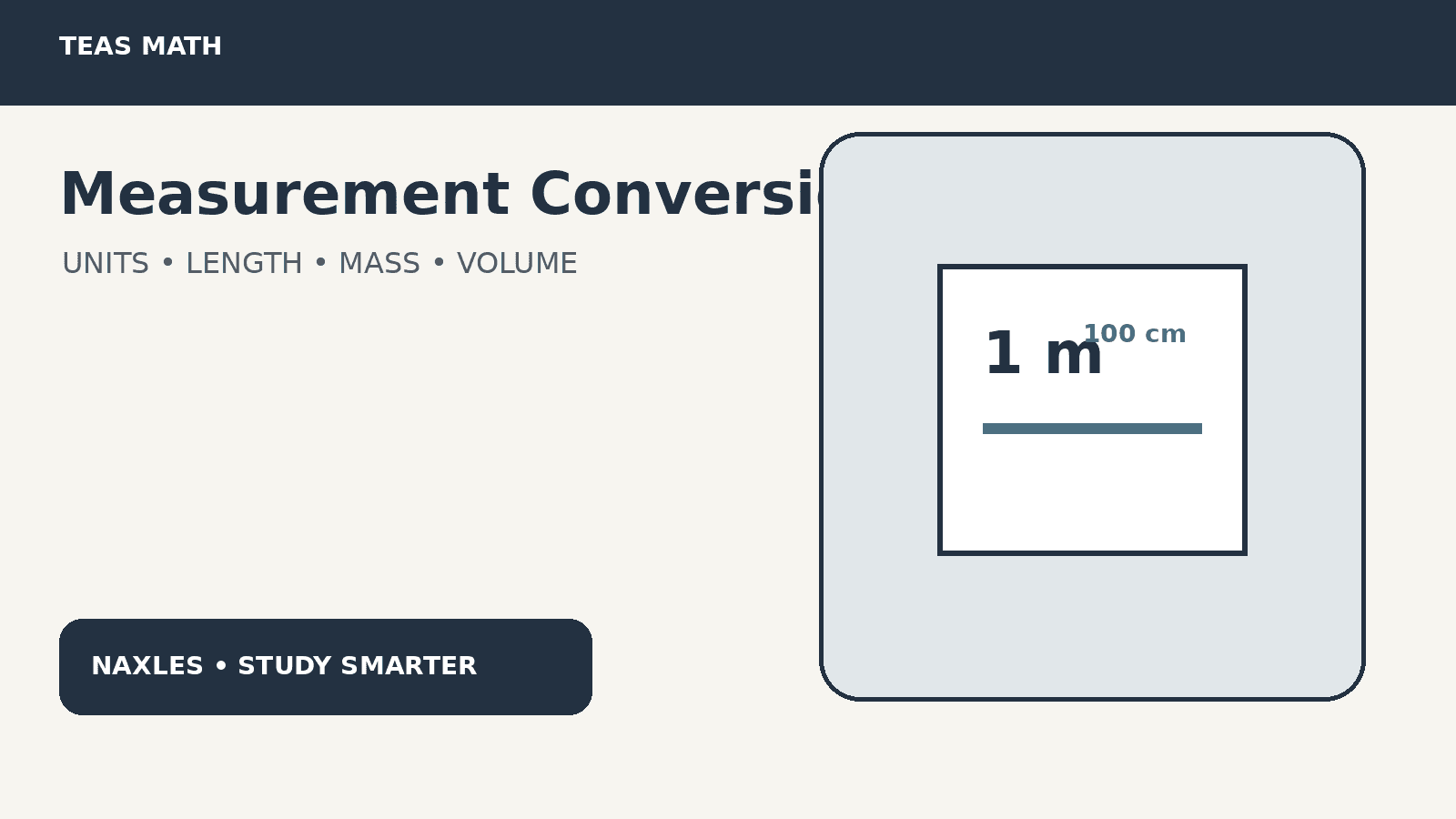
- 1 meter = 100 centimeters
- 1 centimeter = 10 millimeters
- 1 kilogram = 1,000 grams
- 1 liter = 1,000 milliliters
Pay attention to whether you are moving to a larger or smaller unit.
Smaller Units Usually Mean Larger Numbers
Suppose you convert: 2 meters → centimeters Because a meter contains 100 centimeters: 2 × 100 = 200 centimeters The numerical value becomes larger because centimeters are smaller units.
Converting Back
Now consider: 500 centimeters → meters Since: 100 centimeters = 1 meter you divide: 500 ÷ 100 = 5 meters
Write the Units During Your Work
One of the easiest ways to prevent mistakes is to write the units throughout your calculation. Instead of writing: 5 × 100 = 500 write: 5 meters × 100 centimeters/meter = 500 centimeters The units help you see whether the conversion makes sense.
Watch the Question Carefully
A problem may provide several measurements. Don't automatically convert every number. First determine what the question actually asks for.
Estimate Before You Finish
Ask yourself whether the answer should be larger or smaller. If you convert meters into centimeters, your numerical value should generally increase. If your answer goes in the opposite direction, check your calculation.
Final Takeaway
Measurement conversion questions become easier when you identify the starting unit, determine the required unit, choose the appropriate conversion factor, and keep your units visible throughout the calculation.