Two exams are offered for a reason
Both the TEAS and the Kaplan Nursing Entrance Exam are intended to do the same broad thing: provide admissions committees with a standardized method of determining if an applicant has the academic foundation necessary to succeed in nursing coursework. Different testing companies create these and each nursing program decides which test (or tests) to need as part of the admissions process. Some schools will accept scores from either exam, others will only collaborate with one provider. Your first step should always be to determine which exam, or examinations, your desired programs actually require.
Structural Differences
Both tests follow a similar four-section plan, but the details are different enough to be worth knowing before you start to prepare.
The TEAS has four sections: Reading, Mathematics, Science, and English & Language Usage. Testing time is around 209 minutes with 170 scored and unscored questions. The Science portion is the biggest single component, indicating its substantial weighting in the total composite score.
The Kaplan Nursing Entrance Exam similarly has four sections—Reading, Mathematics, Writing, and Science—but with a very different makeup. It has 91 multiple choice questions to be answered in about two hours and forty-five minutes. Usually, each section is given about 45 minutes. The fourth section of the TEAS is grammar and vocabulary questions, but they are presented in a “English and Language Usage” format. Kaplan’s fourth section is a dedicated Writing section, which is sometimes presented with short passages that look at grammar, sentence structure, and error identification, rather than the more reading-centric methodology the TEAS uses.
Where the Exams Diverge
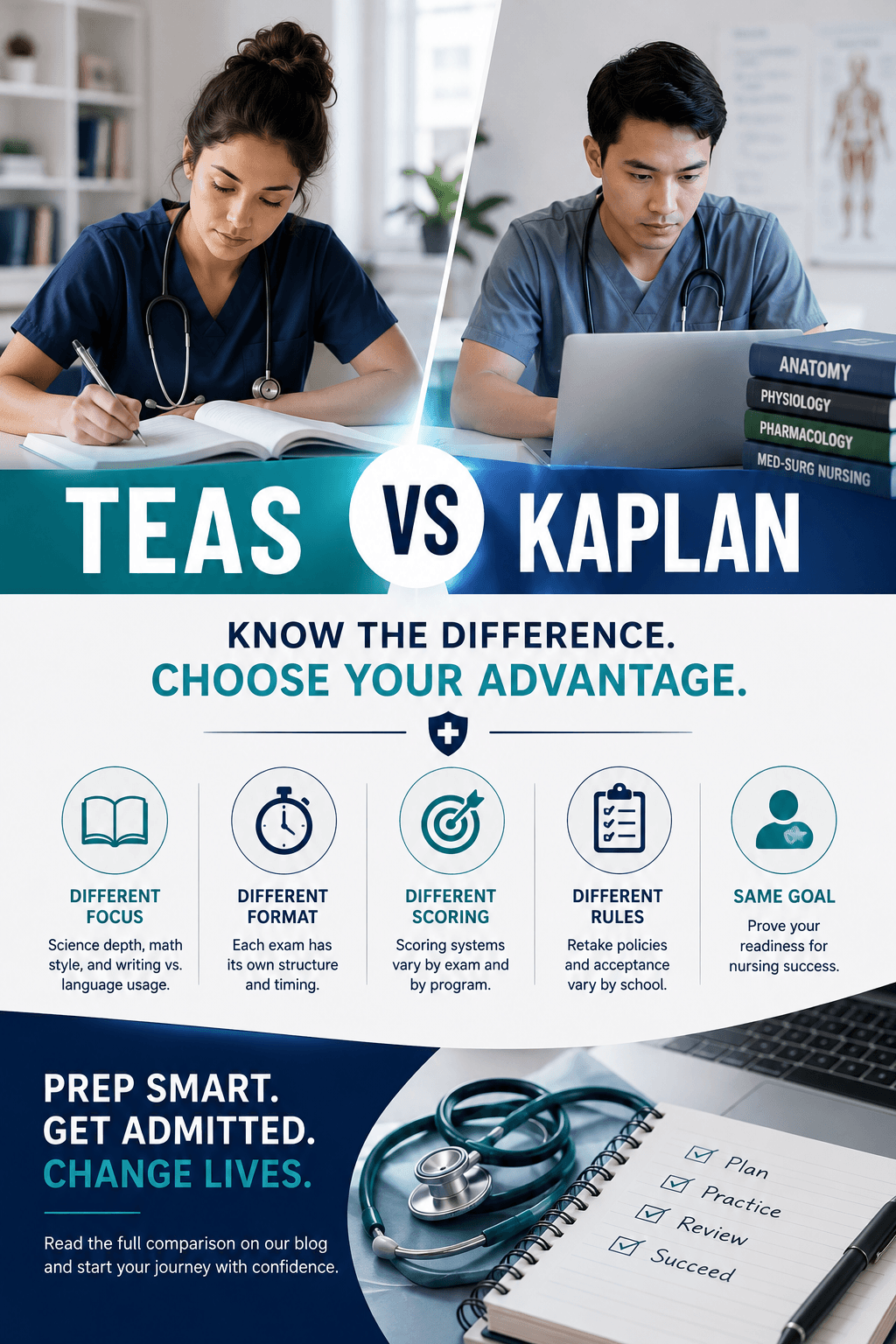
Science . Both tests test basic science but they test it in different fields. The TEAS Science portion has a somewhat broad scope, including anatomy & physiology, general biology, and chemistry fundamentals. Science: Kaplan’s Science section is more anatomical and physiology-specific, with special emphasis on how the body systems work and how they maintain homeostasis. The TEAS Science section is more general, but not as much in this area.
Mathematics. Both tests involve arithmetic, fractions, decimals, percentages and basic algebra. Kaplan’s math section is quite focused on medicine dosage calculations, ratios, proportions, unit conversions…all the things you need to know for clinical. The TEAS also assesses these topics, but instead of focusing as strictly on dosage-style calculations, it distributes its math material over a rather broader set of general arithmetic skills.
Reading. Both tests feature reading comprehension sections with passages and questions on main idea, inference and supporting facts. The skills examined at the heart of the two tests are relatively similar, so high reading comprehension generally carries over well, no matter which exam you're preparing for.
Writing and language use. This is one of the more meaningful structural distinctions. The TEAS incorporates grammar and language mechanics into a bigger “English and Language Usage” portion that directly examines vocabulary and use standards thru discrete questions. The Writing section of the Kaplan test emphasizes finding and fixing mistakes in grammar, punctuation, and sentence structure. Some versions also have a written response portion that is scored separately from the multiple-choice questions, testing for organized written communication rather than just error spotting.
Differences in Scoring
As you compare how you’ve done on each, it’s important to know how each test reports and evaluates scores.
There is no predetermined pass/fail score for the TEAS. Each nursing program determines its own minimum score requirement. Score ranges are often defined by proficiency bands.
Kaplan Nursing Entrance Exam Composite Score The Kaplan Nursing Entrance Exam will most often report a composite percentage score. Most schools expect a passing composite somewhere in the 60% to 70% range but this varies by school, and some programs require a minimum score in specific individual sections rather than the composite alone.
Because the two examinations are scored so differently, it’s not useful to compare “my TEAS score” to “my Kaplan score” – what counts is how each score compares to the particular cutoff score your desired program has published.
Re-take Policies
For both tests, the policies for retaking the exam are usually defined by the individual nursing program and not by the testing organization, thus they will vary. Many programs permit two or three chances at either exam, often with a mandated waiting period between attempts. Check with your individual program about the retake policy. Don’t assume it’s the same as what you heard for another school or test.
Which Exam Should You Study For?
If the programs you are interested in only take one of the two examinations, then the decision is decided for you and your preparation should be focused on the official structure and subject outline of that exam. If a program accepts either exam, consider your relative strengths: applicants who are more comfortable with dosage-style math problems and prefer a narrower, more clinically-focused science section may find Kaplan’s format more approachable, while applicants who prefer broader science coverage and a vocabulary-based language section may find the TEAS format a better fit.
It’s also important determining whether one exam is more generally accepted across your whole list of desired schools. The TEAS is utilized by a very large number of nursing programs nationally. Those applying broadly to multiple schools sometimes find it more efficient to prepare for the TEAS as a default , then confirm whether individual programs on their list require Kaplan or HESI as an alternative or supplement.
Bottom Line
The TEAS and the Kaplan Nursing Entrance Exam measure similar core academic skills, but differ considerably in structure, section focus and scoring method. It’s better to confirm exactly which exam your target programs require, understand where the content diverges (especially in science depth and the writing vs. language usage split), and prepare with materials that are specifically aligned to that exam’s official format than to assume that preparation for one exam fully transfers to the other. If you have the chance, choose the exam you want to prepare for based on your own academic strengths, rather than the general reputation.