Why this confusion so often happens
The two tests have the same overall objective: to see if a candidate has the academic background to succeed in a rigorous health sciences curriculum. This overlap often leads applicants to believe that the examinations are fundamentally the same or that if they prepare for one, they’ll be prepared for the other. The truth is that these two tests are different in structure, focus and scoring and studying from the wrong materials might cost you important time. The fix to this problem is to handle exam selection as a separate research effort, apart from content review.
What the TEAS Exam Covers
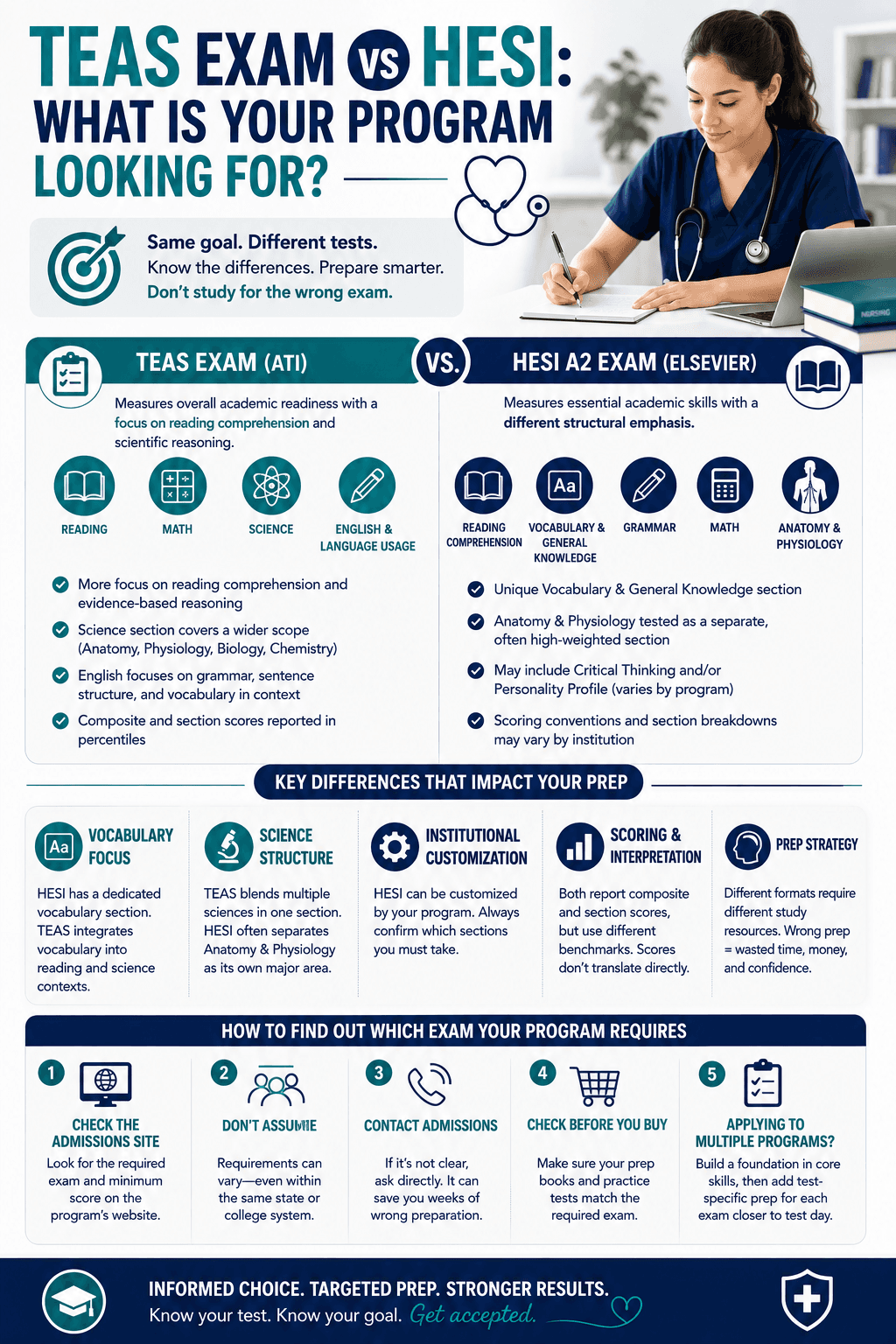
The TEAS (Test of Essential Academic Skills) conducted by ATI includes four main sections: Reading, Math, Science, and English and Language Usage. It is meant to measure overall academic preparedness with a focus on reading comprehension and scientific reasoning, which is the kind of analytical thinking required in all of nursing school curricula.
Features to mention:
- More focus on reading comprehension approach and evidence-based reasoning
- Science Section usually covers a wider scope of subjects such as Anatomy, Physiology, Chemistry and Biology
- English portion focuses on grammar, sentence structure and vocabulary in context.
- Composite and section scores are given in percentiles
What the HESI A2 Exam Measures
The HESI A2 (Health Education Systems, Inc. Admission Assessment) is also owned by Elsevier and assesses fundamental academic topics, but with a different structural emphasis. It normally covers Reading Comprehension, Vocabulary and General Knowledge, Grammar, Math, and Anatomy and Physiology. Optional sections, such as Biology, Chemistry, and a personality or learning style assessment, are also available in some editions.
Key features:
- Unique Vocabulary and General Knowledge part not offered on the TEAS in the same format.
- Anatomy & Physiology is usually assessed as a separate unit and not as part of general Science.
- Critical thinking or personality profile component included in some versions.
- Scoring conventions and section breakdowns may vary significantly by institution while HESI does enable some customization.
Key Differences That Influence Your Prep Strategy
- Emphasis on vocabulary. The HESI has a distinct Vocabulary and General Knowledge section that is more likely to evaluate broader, more general academic vocabulary. The TEAS incorporates vocabulary more directly into reading and science contexts. One's study resources will not prepare you well enough for the specialized format of the other.
- Depth and structure of science The TEAS Science portion sometimes blends numerous scientific subjects into one section. The HESI often separates Anatomy and Physiology as a different, more strongly weighted area. If your curriculum is HESI requiring, the biggest and most expensive mistake is to underestimate the anatomy and physiology portion.
- Institutional customization. The format of your HESI exam may differ based on the program you are applying to. HESI permits programs to customize which portions to include. It is therefore particularly crucial to check the version of your unique program rather than to assume a common format.
- Score interpretation and reporting Both tests report composite and section results, but they employ different benchmark programs to evaluate them. A good score on one exam’s scale doesn’t often translate straight to the other, so comparing your practice scores across exams isn’t a reliable way to tell how ready you are.
How to Determine Which Exam Your Program Requires
- I'd go straight to the admissions site. Most nursing and allied health programs will list their required exam and minimum score requirements immediately on their admissions or prerequisites website. This should always be your first stop.
- Don’t assume from other programs. Even schools in the same state or within the same college system may require different exams. Another typical error is to think that your program is using the same test as a program that a friend applied to.
- If the requirement is not specified, please contact admissions. If a program website doesn’t make the exam clear, ask an admissions representative. Asking directly will save you weeks of prep for the wrong test.
- Check before buying prep items. TEAS and HESI prep books, practice tests, and study guides are created around the specific structure of each exam. Buying the wrong materials is not only a waste of money, but it can give the illusion that you are ready for a test format that you will not actually see.
If You're Applying to Multiple Programs
Some applicants apply for various programs with differing exam requirements. In this instance:
- The first thing you want to do is design a basic study plan around the overlapping curriculum areas like general math and reading skills.
- Then, as each test date approaches, layer in test-specific prep like HESI’s vocabulary part or TEAS’s integrated science approach.
- Don’t put the two tests too close together. The different formats can confuse you if you are rushed and you haven’t totally separated your review of each.
It’s a Choice, Not a Presumption
While the TEAS and HESI A2 may seem identical at first glance, confusing them is one of the most avoidable mistakes a candidate can make. Knowing well in advance what your particular program needs, knowing how the two tests differ structurally, and choosing prep materials that mirror the real test you will be taking removes a major source of wasted effort and allows you to walk into exam day prepared for the test in front of you.