Begin with the Official Study Manual
Before resorting to third party resources, consider if the official study material from the organization conducting the exam is worth it compared to the free options out there. It’s generally the resource that most closely mimics the actual exam material and format, because it’s developed by the same organization that develops the test. This is usually the best value if you’re going to pay for only one resource, because this is the best way to avoid studying things you won’t actually see on test day.
Free Practice Tests and Diagnostic Tools
There are a number of test-prep websites that offer free TEAS practice problems and diagnostic assessments, and there are some that are worth checking out before you contemplate paying for a full course.
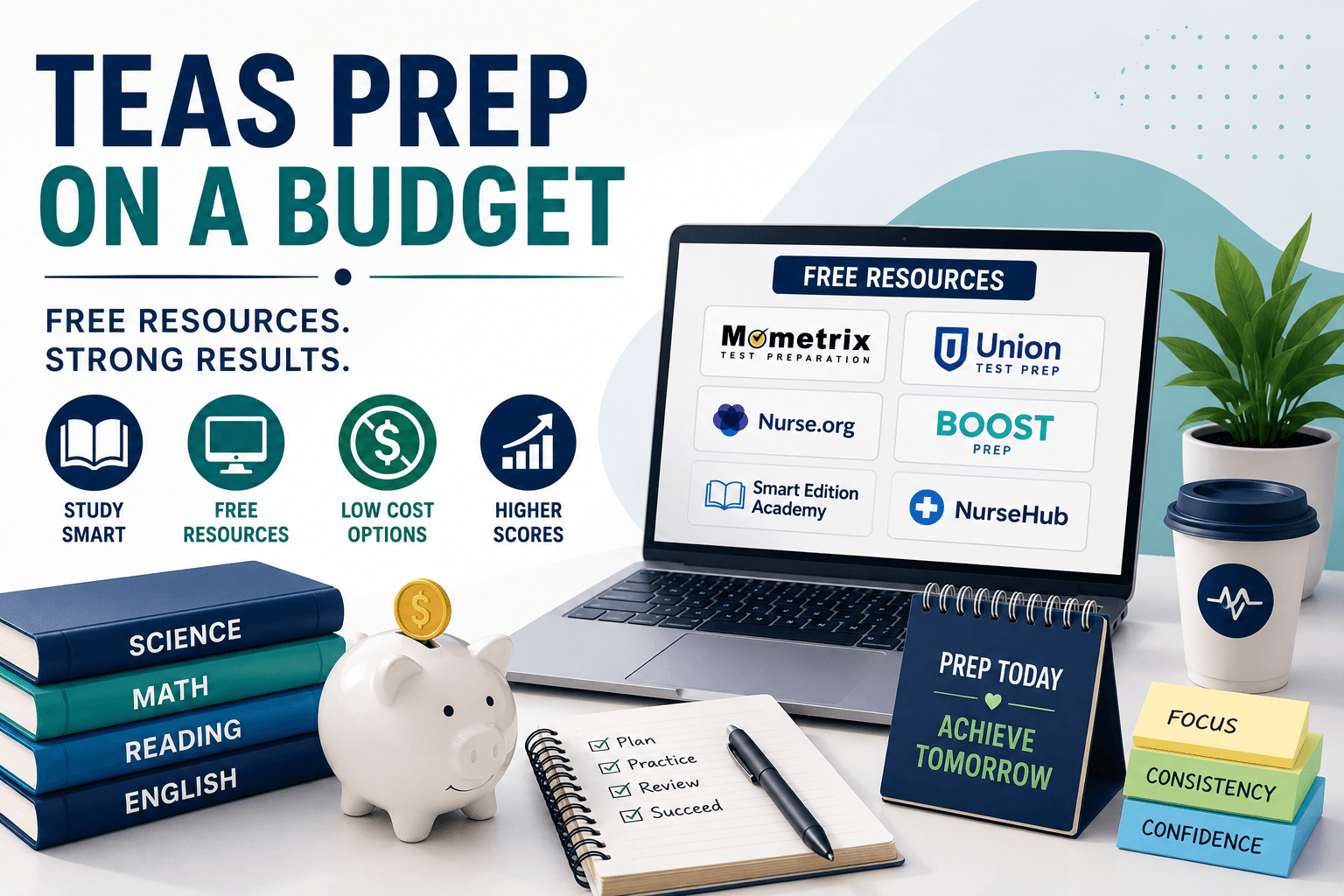
- MO Metrix offers free practice exam questions for each area and additional study materials such as flashcards and review sheets, all without paying for the core practice content.
- Union Test Prep offers free practice exams and section breakdowns in reading, math, science, and English and language usage with explanations for each question.
- Nurse.org offers a free diagnostic quiz that pinpoints your weak spots and creates a basic individualized study plan, free of charge. This can help you focus your little study time.
- Both Boost Prep and Smart Edition Academy provide free diagnostic and full-length practice tests with immediate scoring and answer explanations. Great resources for pacing on test day, and they don’t require a cash investment.
- AllHealthCareCareers and NurseHub provide free practice question sets by TEAS subject area, with content updated frequently.
- Free resources vary greatly in quality and accuracy, so it’s worth cross-referencing a few different sites rather than relying on just one; and prioritizing practice questions that include clear, detailed answer explanations over those that simply mark answers right or wrong without teaching the underlying concept.
Institutional and Library Resources
Many public and college libraries have hard copies or e-books of TEAS study guides that you can check out for free, which can help you save the cost of buying your own copy. Additionally, a lot of libraries offer free access to online learning platforms and standardized test prep databases with a library card, which at times includes TEAS-specific content or similar science and math study material.
If you are now enrolled or have been recently enrolled in prerequisite coursework, your college’s tutoring or academic assistance center may offer free tutoring in the math or scientific topics assessed on the TEAS, even if the institution does not overtly market TEAS preparation. Ask tutors directly whether they can help you to review information relevant to the exam.
Sometimes career or academic counselors in nursing programs have lists of free or discounted local resources. Occasionally, the program itself has free workshops or study groups for prospective applicants.
Review of Specific Sections for Free
Free instructional platforms include general algebra, biology, chemistry and anatomy foundations which can supplement TEAS-specific practice problems for math and science curriculum review. A lot of the knowledge assessed is overlapping with normal high school and early college curriculum. Reviewing basic topic in this way , rather than only TEAS - branded content , is often just as helpful at gaining true content mastery.
You will discover that many flashcard sites, even those that are free and enable users to make and share study sets, contain TEAS-specific flashcard decks made by other test-takers that cover vocabulary words, anatomy terms, and formulas. These can be a cheap approach to reinforce memorization-heavy knowledge, by repeating it.
General education platforms that provide video content can be beneficial for clarifying specific ideas you might be having trouble with, especially in physics and math where seeing a process presented graphically is sometimes more helpful than just reading a written description.
Create a Free Study Plan Using These Resources
- Don’t squander effort. Begin with a diagnostic test. Before you commit study time anywhere, take a free full-length diagnostic exam early in your prep process to find out your genuine weak areas. This one step avoids the usual mistake of going over portions you already know well.
- Use two or three free resources instead of one. Different free resources will have different depths and styles of questions. Using a small handful together exposes you to more question formats than any one free resource alone.
- Use practice examinations to measure your improvement, not hours of study. Every couple weeks, take a full-length free practice exam to see if your studying is converting into actual score progress, and alter your concentration based on which sections are and aren’t improving.
- Reserve compensated resources for your most stubborn gap if needed. If you did a lot of free study, and one section is still weak, it might be worth it to pay selectively for one targeted resource (e.g. a short paid course module) or a few hours of tutoring that focuses on that one section rather than paying for an entire course that goes over material you already know for free.
A Note About Quality Control
There are free resources, and then there are free resources. Some third-party practice problems don’t adequately reflect the complexity or style of the real exam. If the practice questions included in a free resource seem way easier or harder than what you see in the official exam subject outline, consider it a supplement and not your major source. And make sure that you prioritize resources that are clearly marked with the current edition of the exam.
The Final Word
You don’t have to skimp on prep just because you’re on a budget. With library materials, free diagnostic and practice exams from reputable test-prep sites, general educational content for basic review, and free tutoring through your college, it is possible to put together a comprehensive, well-rounded TEAS study plan without breaking the bank. The trick is to be intentional: assess your weaknesses early, rotate among a few trustworthy free resources instead of just one, and track your progress with regular practice testing so you know that your effort is actually paying off before test day arrives.