How Bridge Programs Handle the TEAS Differently
Traditional entry-level nursing applicants generally do not have clinical healthcare experience, therefore programs use standardized testing and necessary GPA to determine preparedness. LPN-to-RN bridge applicants are a whole other population. They already have an actual nursing license, real clinical hours under their belt, and they’ve already passed the NCLEX-PN. That previous track record provides admissions committees with greater, perhaps more direct, evidence of preparation than a first-time applicant would have, and that’s part of why TEAS policy differs so much more at the bridge-program level than it does for standard BSN or ADN entry.
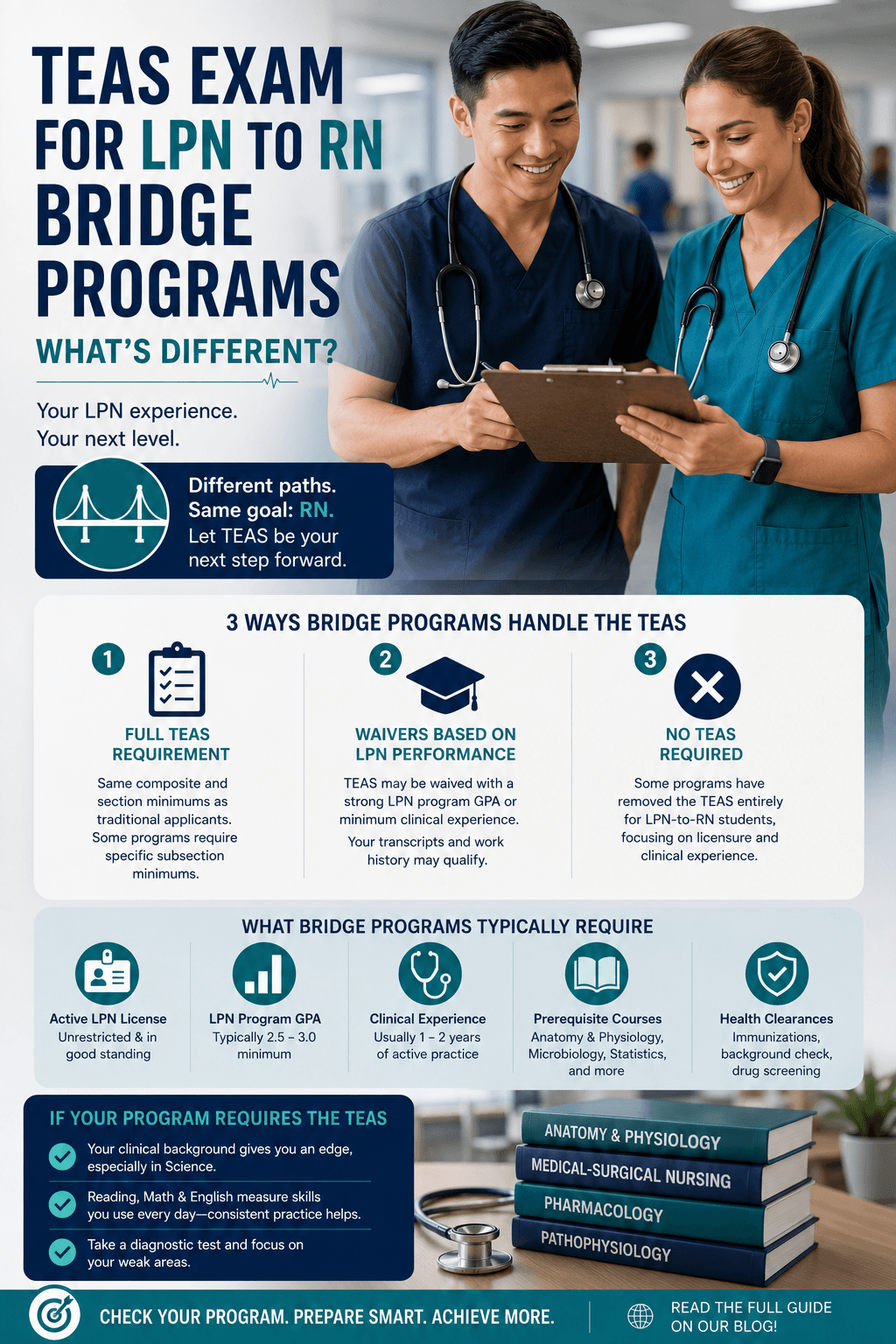
Three Common Approaches Used by Bridge Programs
1. Full TEAS requirement, no exemptions. There are a good number of bridge programs that require all applicants, including licensed LPNs, to take the TEAS with the same composite and section-minimums as any other applicant. Some programs also set specific subsection requirements in addition to the composite criterion, such as requiring a minimum score in Reading and Science individually, not just an overall passing composite. If the bridge program you are targeting is in this category, you need to take the requirement just as seriously as a first-time application to nursing because there is no built-in leniency because you are an LPN.
2. Waivers contingent upon LPN performance. In some programs the TEAS requirement will be waived if applicants satisfy other criteria, usually a solid LPN program GPA or a demonstrated minimum number of years in active clinical practice. Instead, this method considers your previous LPN courses and job experience as a valid substitute for the test, as long as you meet the minimum GPA or experience level required by the program. If you are looking to receive this type of waiver, be sure to request your official LPN program transcripts early and find out what the specific GPA limit your school of choice has, as these differ.
3. None of the TEAS at all. A smaller but growing number of bridge programs have eliminated the TEAS requirement entirely for LPN-to-RN students, part of a broader tendency to prioritize licensing status and clinical experience over standardized tests for this particular group of applicants. If you are applying to many bridge programs, do not assume this applies to all. Because policies might vary greatly, even between schools within the same region or the same college system, you will need to check with each individual program.
What Bridge Programs Usually Ask For In Addition to (Or Instead of) the TEAS
But whatever their TEAS policy is, there are several other general requirements that most LPN-to-RN bridge programs have in common that are good to prepare for ahead of time:
- An active LPN license without restrictions (usually current and not subject to disciplinary action; sometimes a license thru a Nurse Licensure Compact state if the program permits students from outside the state)
- An LPN program minimum or necessary GPA is often anywhere between 2.5 and 3.0, although again, the actual numbers vary from school to school.
- Clinical work experience. Many schools need one to two years of active LPN practice and some require formal verification from your employer.
- Completion of required necessary curriculum, usually anatomy and physiology, microbiology and statistics, if not already taken as part of your LPN program.
- Most nursing programs, regardless of admission point, include health clearances, which include immunization records and drug tests, and background checks as basic requirements.
If your Target Program requires the TEAS
Great news if you’re an LPN and have to take the full TEAS. Your clinical background will usually give you a real leg up on the Science section in particular, because there is meaningful overlap between the content of anatomy and physiology and general health science and the material you have already put to use in practice. This doesn’t mean you can skip prep, as the exam still tests some content beyond direct clinical application (general biology, chemistry basics, and math concepts you may not use daily), but it does mean your prep timeline might be somewhat shorter than a first-time applicant with no healthcare background.
The Reading, English and Language Usage sections tend to measure skills that don’t suffer much from regular workplace reading and documentation, so these sections are often less of a worry for working LPNs than they might be for other applicant groups, such as career changers from unrelated fields.
Practical Steps for LPN to RN Applicants
- Do not assume anything, get the exact TEAS policy of the program in writing. Don’t rely on second-hand information from other LPNs who applied to a different program or other admissions cycle, with the variety that exists even within the same state or college system.
- If a waiver is available, collect your papers early. GPA verification and job history forms might take a while to process, especially if your employer’s HR department has to submit formal verification papers, so get this started well in advance of your application date.
- If you are required to take the TEAS, take a diagnostic practice test to determine where your prep should be focused. A clinician doesn't mean you've aced the Science segment. Try taking a practice exam early on to see whether you need to brush up on general biology or chemical topics that you may not see in your regular day-to-day work.
- Don’t only ask about a composite threshold but about subsection minimums. Some programs have additional requirements such as passing certain portions, not simply an aggregate score, therefore check this aspect specifically to avoid a surprise rejection in spite of a great composite .
Bottom line:
TEAS policy for LPN-to-RN bridge schools isn’t as consistent as it frequently is for first-time nursing applicants. Some schools demand it in full; some will waive it based on your LPN performance or experience; and a rising number have dropped it entirely. Always the best thing to do is to check with your specific program about their current policy rather than assume that your LPN license automatically changes the requirement. If the TEAS is required, take advantage of the real advantage your clinical background gives you on Science-related content, while still preparing seriously for the sections that fall outside your daily practice.