Why the TEAS is Different for Career Changers
The TEAS examines reading, arithmetic, science and English and language usage at a level similar to what is taught in high school and early college education. For a career changer, the difficulty isn’t often that the material is tough in itself, it is that much of it has not been actively used in years, often decades.
This produces a particular kind of gap: you learned algebra, basic chemistry, and anatomy terminology well enough to pass a class at some point, but you haven’t used that knowledge since. Forgetting something and then learning it again is not the same cognitively as learning something new. It demands a distinct study strategy, one that emphasizes the reactivation of existing brain connections, not establishing comprehension from scratch.
Career changers also face a time crunch not experienced by traditional-age students: managing full-time work, family duties, and perhaps current enrollment in preparatory courses, all while trying to find consistent time for study for a standardized exam.
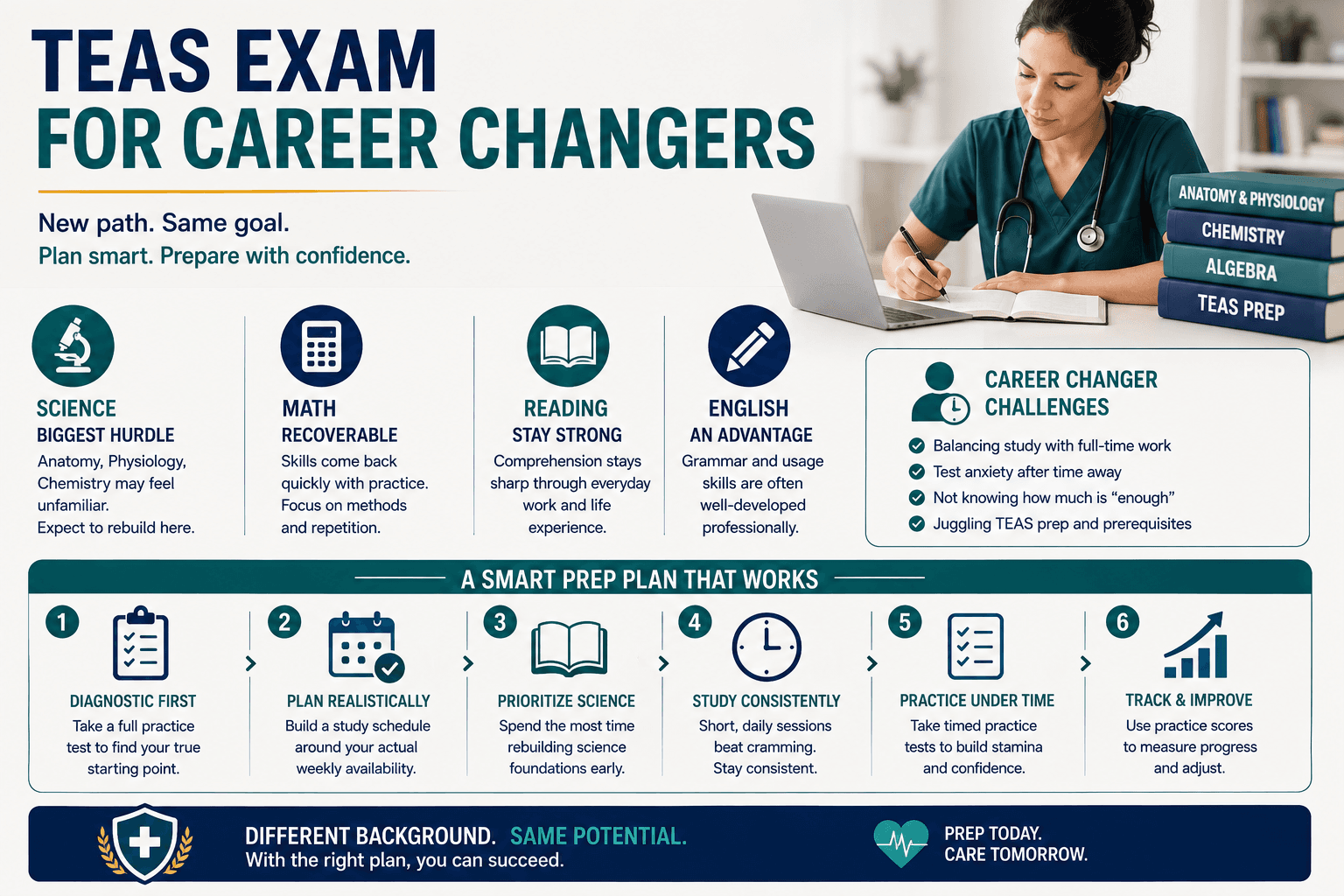
The Science Section: Usually the Greatest Obstacle
- For most career changers the scientific portion is where the rust appears most plainly. If you didn’t have a job in biology, chemistry, or healthcare in some capacity, this part will typically contain material you haven’t seen since a high school or early college science class.
- Anatomy and physiology issues (body systems, nomenclature, basic physiological processes) are sometimes the most unknown to those coming from non-science backgrounds. If your career hasn’t needed any scientific literacy, things like atomic structure and chemical reactions, the basics of chemistry, can feel foreign too.
- The takeaway: Career changers will likely need to dedicate a significant chunk of their study time to the sciences, even if math or reading appear to be the bigger hurdles initially. This will be confirmed by a diagnostic practice exam early in your prep phase, but for most non-science job changers, expect to do the most rebuilding in science.
The Math Section: Often More Recoverable Than You Think
Career changers often suffer math anxiety, especially if they haven’t used algebra since high school. The good news is that TEAS arithmetic is more mechanically recoverable than science content, because it is based on methods (solving equations, working with ratios, analyzing basic stats) rather than memorized facts. Most career changers saw math scores increase rather fast relative to science with steady practice problems, because the basic abilities come back with repetition even if they felt totally lost at the outset.
Reading and English: The Strongest Sections Usually
But many people changing careers do just as well, if not better, on the reading comprehension and English and language usage portions, because these skills tend to be sharp through day-to-day professional life: writing emails, reading reports, talking with colleagues, no matter what field you came from. If you are budgeted prep time across sections, these are frequently the ones that need the least devoted preparation and therefore more time in science and math.
Typical Challenges for Career Changers
- Fitting study around full-time work. Career changers usually study while working a full day, unlike students who are still enrolled in school. Realistic preparation plans need to consider this from the very beginning, rather than expecting several hours of daily study time that may not be accessible.
- Test anxiety after years out of standardized testing. If you have not taken a timed multiple-choice exam in a while, the format itself can feel strange and unpleasant, in addition to the content. You need to face this head on by taking practice exams under timed conditions, not merely reviewing the subject.
- Uncertainty as to how much review is “enough.” Without the yardstick of recent classroom achievement, job changers sometimes have difficulty judging if they're ready. Practice exam scores are a better indication than any subjective feeling of preparation.
- Balancing TEAS preparation and required classes Many job changers are taking nursing pre-reqs while also studying for the TEAS. This can serve to either aid (recent coursework reinforces tested knowledge) or be an added strain to their schedule depending on how the timing works out.
A Practical Prep Strategy for Career Changers
- Begin with a diagnostic test, not review. Before you spend any time studying anywhere, take a full practice test to determine exactly where you are. This prevents wasting time examining areas such as reading that may already be sound.
- Plan a calendar based on realistic weekly availability, not an ideal one. Instead of saying you're going to set aside two hours every day and then give up after a week, figure out what is realistically sustainable with your job and other obligations, even if it takes longer.
- Science content evaluation is best done early as it takes longest time to rebuild. But starting with the scientific review, and spending the most actual time on it, seems to provide better results than trying to give equal attention to all the sections from day one.
- Study a little bit often, rather than a lot on rare occasions. For working adults, thirty to forty-five minutes on most days is more effective than trying to preserve a rare three-hour block, both for consistency and for retention through spaced repetition.
- Take practice tests under real timed situations before test day. This serves both to fill in content holes as well as to get you used to the standardized testing structure, and gives you a real, measurable metric of readiness beyond how confident you feel.
The Bottom Line
Career changers confront a distinctly different TEAS prep challenge than regular applicants. Not because the content is harder, but because the material involves re-activating knowledge that’s been dormant often while juggling a full-time job and other commitments. If you know that science usually needs the most rebuilding, that math generally rebounds faster than you expect, and that reading and English abilities tend to stay very strong throughout your career, then you may put together a study schedule based on where you actually are, not where someone else tells you to be. With a realistic timeline and honest diagnostic tracking, career changers can do just as well on the TEAS as standard applicants. The prep just needs to be planned around a different set of restrictions.