Why This Question Is Not Simply Yes or No
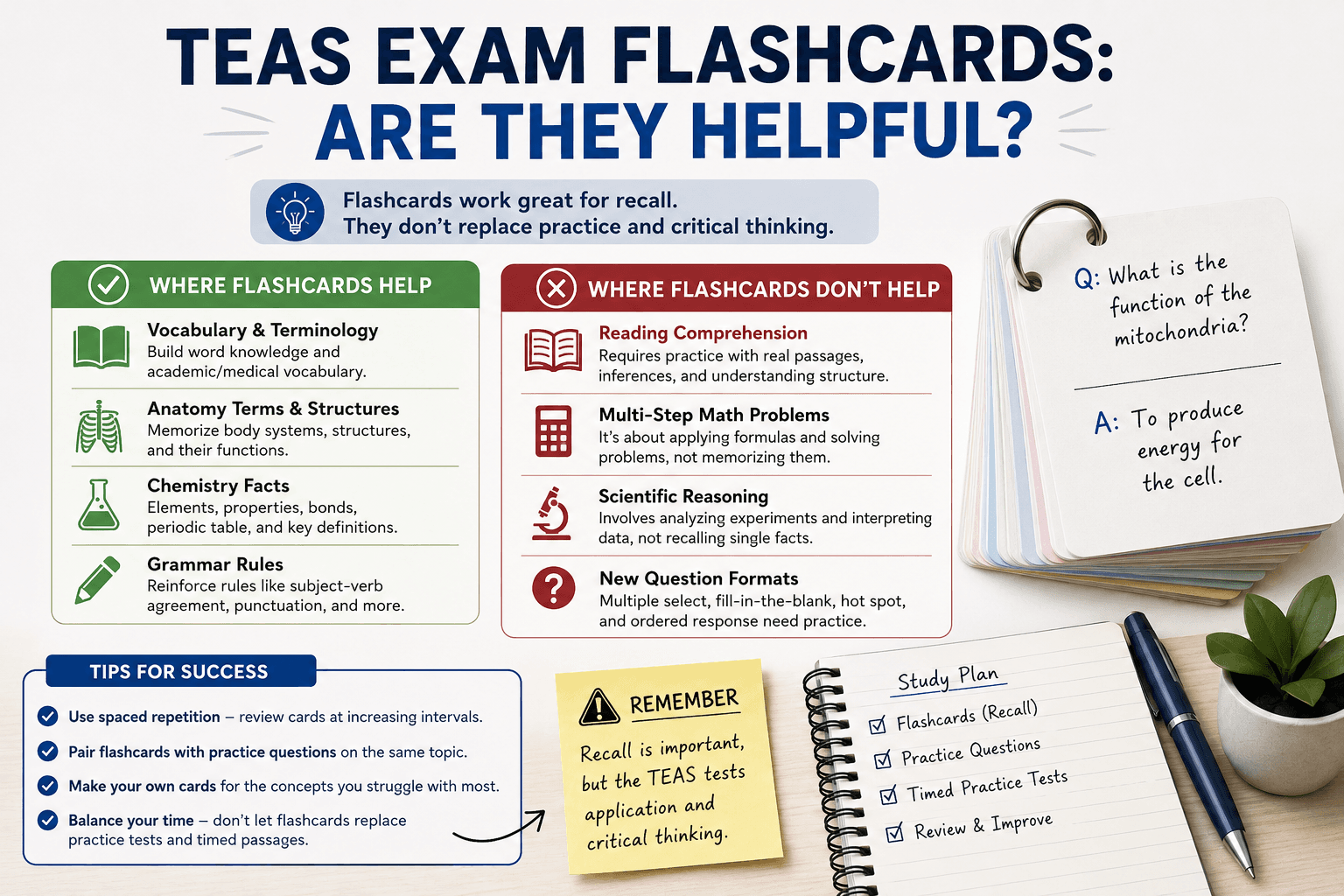
The TEAS is not one form of content. Some of it is simply recall – vocabulary definitions, anatomical names, chemical symbols – where flashcards are really useful. Other sections of the examination measured applied reasoning, such as interpreting a reading passage, solving a multi-step math issue, or reasoning through a scientific method question. No matter how beautifully designed, flashcards can’t truly imitate that kind of reasoning. This distinction is the number one thing to understand before you develop a study strategy that’s heavy on flashcards.
Where Flashcards Really Help
Language and terminology (English and language use). This component is a straight up test of word usage and academic/medical vocabulary. Flashcards are one of the best tools for this, a word on one side, an explanation and example phrase on the other, reviewed through spaced repetition.
Science - Anatomy terminology and structures This is mostly a recall activity and flashcards work well for this purpose, especially for anatomy and physiology studies where the names of structures and their functions need to be memorized.
Chemistry facts (Science). Flashcards are great for the easy recall stuff, including the periodic table, the properties of elements and definitions of forms of bonding.
English and Language Usage (Grammar Rules) Flashcard repetition can work well to reinforce rules (including subject-verb agreement patterns, punctuation rules), particularly if they are accompanied by sample sentences, and not just abstract rule declarations.
Where Flashcards Don't Cut It
Understanding reading. There’s no useful way to “flashcard” the skill of reading a passage’s structure or making an inference—it takes practice with real passages, not isolated information.
Multi-step math problems Flash cards are good to memorize a formula, but the real skill to be assessed is in the application of that formula, where there are multiple computation steps, typically including unit conversions. Working a comprehensive problem is way more important than looking over an individual formula card.
Scientific logic. It’s not about memorizing how to analyze the design of an experiment or interpret the findings from a study. It’s about practicing problems that mimic the actual thinking process.
New formats of questions. Multiple-select, fill-in-the-blank, hot spot, and ordered-response questions are a distinct skill than recognizing a term. Flashcards don’t promote familiarity with these formats at all because they are intrinsically a single-question, single-answer tool.
The Real Danger: Flashcards Appear Productive, But Are Ineffective
This is the most crucial point in problem solving in this whole subject. Think of studying as going through flash cards. It’s active, it’s repetitious, and you might get a nice sensation of progress. But if you're spending outsized time on flashcards for stuff that really needs practical practice (like arithmetic problem sets or whole reading passages), that time can feel helpful while accomplishing relatively little for your actual score.
Problem-solving tip: After each flashcard session, ask yourself honestly: is this content something I need to recall, or something I need to apply? If the latter is the case, flash cards should be used to augment practice questions, not to substitute for them.
How to Effectively Use Flashcards
- Use flashcards for material you need to memorize a lot of (vocabulary, anatomy terms, chemical facts, grammar rules) but don’t make them your primary tool for all four sections.
- Instead of a one-time review, review using spaced repetition. You want to review the cards at increasing intervals (not just cram through a whole deck at once). This is far better for long term retention. Why? Well, your test date may be weeks away.
- Match flashcards to complete practice questions on the same material. Knowing the terminology and being able to appropriately apply it to a question are not the same talent. Build the foundation using flashcards and then verify that the skill transfers with real practice problems.
- Don’t just use pre-made decks, make your own cards for material you individually struggle with. As a rule of thumb, writing a card yourself will cement the material more than passively looking at someone else’s.
- Measure the actual time flashcards consume for studying. If they’re taking up an inordinate amount of your calendar for how much of the exam is actually recall based, re-balance towards full length practice questions and timed passages instead.
Common Issues and Solutions
Problem: “I’ve gone through hundreds of flashcards and my practice test scores haven’t changed one bit.” Solution: Make sure your flashcard content is what the test is truly testing. If you have a solid vocabulary but still miss questions on Reading or Math, the problem isn’t that you’re using flashcards. The problem is that those parts require practice with application, not drills with recall.
Problem: “I don’t know what content is worth making flashcards for.” Solution Anything that has one correct definition, phrase, or fact (vocabulary, anatomical labels, chemical facts, grammar rules) is a good choice. Full questions are ideal for practice of anything that is multi-step or needs interpretation.
Problem "I prefer using flashcards to other study methods and so I keep falling back on them." It’s okay to maintain some flashcard studying in your routine since you like it, but make sure to limit the time you commit to them and schedule full practice problems and timed passages so recall-based comfort does not take over for applied-reasoning exercise.
Final thoughts
Flashcards are really helpful – given the proper content. They are a good, low-friction way to acquire vocabulary, anatomy recall, and chemistry knowledge, but they cannot replace practicing whole reading passages, multi-step arithmetic problems, or the newer question formats that need applied reasoning. Use them in places where recollection is the ability being examined, but make sure that they are a supplement to, not a replacement for, full practice questions everywhere else.