There is no one national standard of eligibility
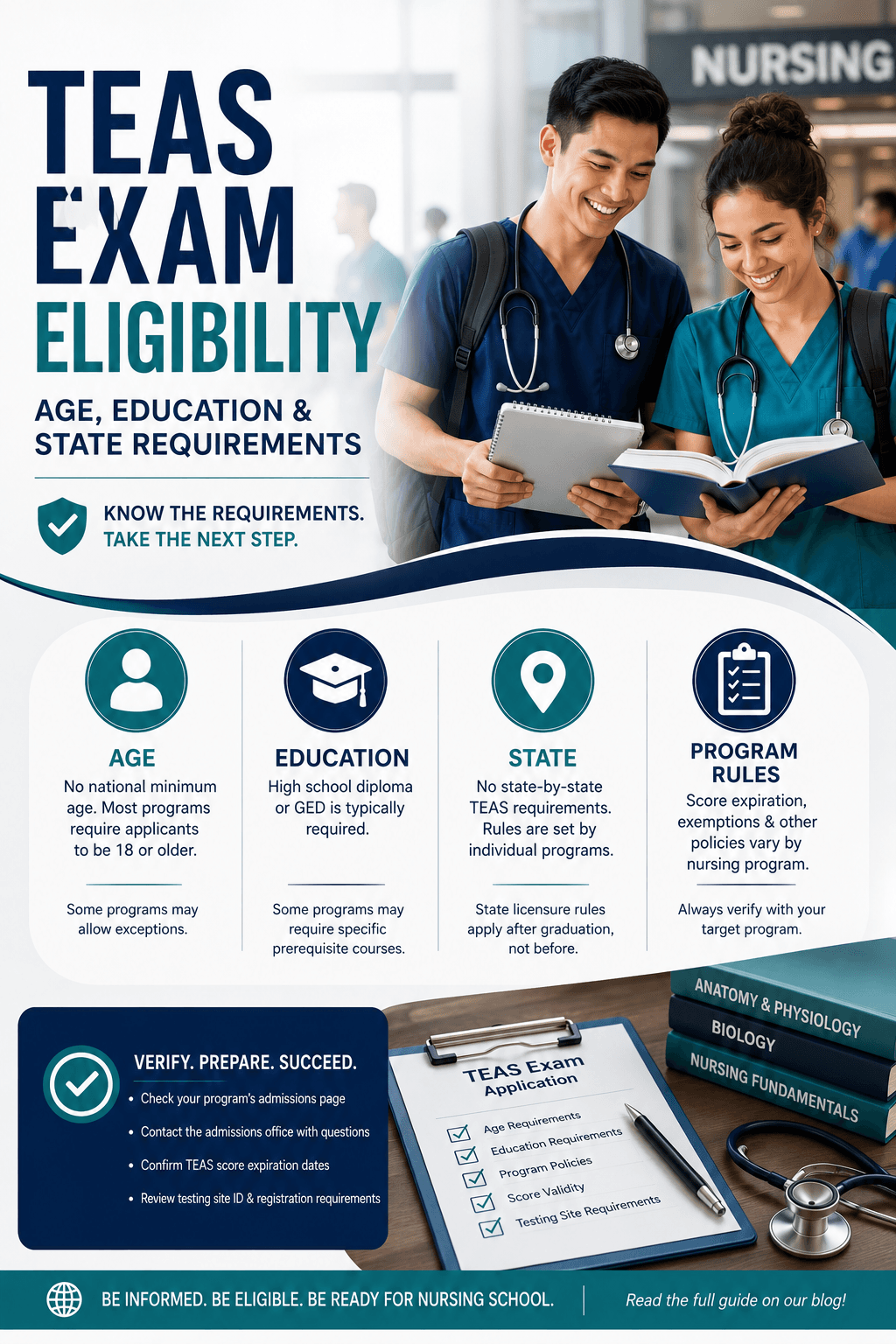
Unlike a professional licensure exam, there is no single, countrywide eligibility policy for the TEAS. The organization that creates and runs the exam supplies the testing infrastructure, but eligibility to take the exam and what the resulting score is utilized for is established almost exclusively by whatever nursing or allied health program you are applying to. Which means the honest starting point for questions of eligibility isn’t a general guideline – it’s your specific target program’s admissions page or admissions office.
That said, there are some commonalities that apply to most testing sites and programs, and knowing them can give you a realistic baseline before you verify details with your chosen institution.
Age Restrictions
There is no minimum age strictly enforced by the exam's own administering institution. However, in fact, many testing sites and nursing programs tacitly require candidates to be at least 18, as this coincides with when most applicants have finished high school and are pursuing college-level admission processes. Some schools do allow exceptions for younger applicants, especially those who are high school students with aspirations to get ahead of the game and enroll early or take dual-credit nursing classes, but this is decided by the individual program, not the exam provider.
If you are a high school student contemplating taking the TEAS early, the best approach is to contact the admissions office of your intended program directly rather than assuming automatic eligibility or automatic exclusion. Some programs also don't require the TEAS at all for certain applicant categories — for example, some schools waive it for current high school seniors admitted thru direct-entry pathways, or for applicants who already possess a prior nursing-adjacent credential — so it's worth confirming not just whether you can take the exam, but whether your specific program even requires it for your situation.
Education Requirements
The most common eligibility requirement across programs is a high school diploma or equivalent, such as a GED. It's understandable considering that the examination covers material usually taught in the last years of high school and the first years of college. Some programs take it a step further than the baseline and add on extra educational requirements before they will take your TEAS score as part of a complete application. For example, they may require that you have completed or are currently enrolled in specific prerequisite courses, such as anatomy and physiology or college-level algebra.
It’s important to differentiate between eligibility to take the exam itself (usually open to anyone with a high school diploma or equivalency) and eligibility for a specific nursing program’s admissions cycle (which often comes with additional academic requirements on top of the TEAS score requirement). Passing the TEAS alone does not guaranty that you have met a program’s whole admission requirements. Think of it as one piece of the puzzle, not the sole gatekeeper.
The Myth of “State Requirements”
A typical (but sensible) point of confusion is the notion that TEAS eligibility or scoring requirements are different from state to state, like certain licensure tests are. In fact, the TEAS itself is not even a state-regulated exam and there is no state-by-state eligibility process that determines who is eligible to take the test or what score would be necessary. Yes, there are state-by-state differences, but they’re not about whether or not you can become a nurse. What varies by state is nursing licensure, specifically NCLEX requirements and state board of nursing regulations, which come into play after you graduate from a nursing program, not before you attend one.
You can see indirect state-level variance in the disparities between the nursing programs that run in a state and the requirements of each individual program. Program requirements are all over the map, even within the same state (and sometimes between campuses of the same university system). Any "state requirement" you see online should be taken with a grain of salt unless it's directly from an official state board of nursing or a specific program's own published admissions criteria, and not assumed to be an official, state-wide TEAS policy.
Practical Steps to Confirm Your Eligibility
- Start with the admissions page of your preferred program — not generic search results. Eligibility is determined at the program level, therefore generic publications (this one included) can only explain general trends – the only truly authoritative source is your particular program’s published requirements.
- If you have any inquiries, call or e-mail the admissions office. Admissions staff are typically able to answer questions about whether age, prior education or required courses will impact your eligibility for that program’s TEAS requirement more quickly than searching for an answer online.
- Check if your TEAS score has an expiration window. Many programs only accept scores from within the past two to three years, so if you took the exam before for a different purpose, determine whether that score is still valid for your present application instead of thinking it transfers forward eternally.
- Check testing site requirements independently of program requirements. Your testing center or platform for sitting for the exam may have its own, separate requirements for identification and registration, such as government-issued photo ID, from your academic eligibility standards for your nursing program, so review both before your test date.
Bottom Line
There’s no one national rulebook, no patchwork of state regulations that regulate TEAS eligibility, as some may think. Practically speaking, most nursing programs will let about anyone with a high school diploma or equivalent sit for the exam, and there usually isn’t a hard and fast minimum age requirement — they just deal with age on a case-by-case basis. And any other requirements, such as educational prerequisites, expiration dates on scores, or exemptions for certain types of applicants, are determined individually by each nursing program. The best method to go about it is always the same: check directly with your particular targeted program instead of assuming based on age, education, or state-level criteria that may not apply to you at all.