Punctuation Rules to Review for the TEAS English Section
Punctuation helps readers understand how sentences are organized and how ideas relate to one another. In the ATI TEAS English and Language Usage section, students should be familiar with standard English conventions, including punctuation. Many punctuation questions test whether you can recognize a sentence that is clear and grammatically correct. Learning a few basic rules and practicing them in context can make these questions easier to approach.
1. Commas
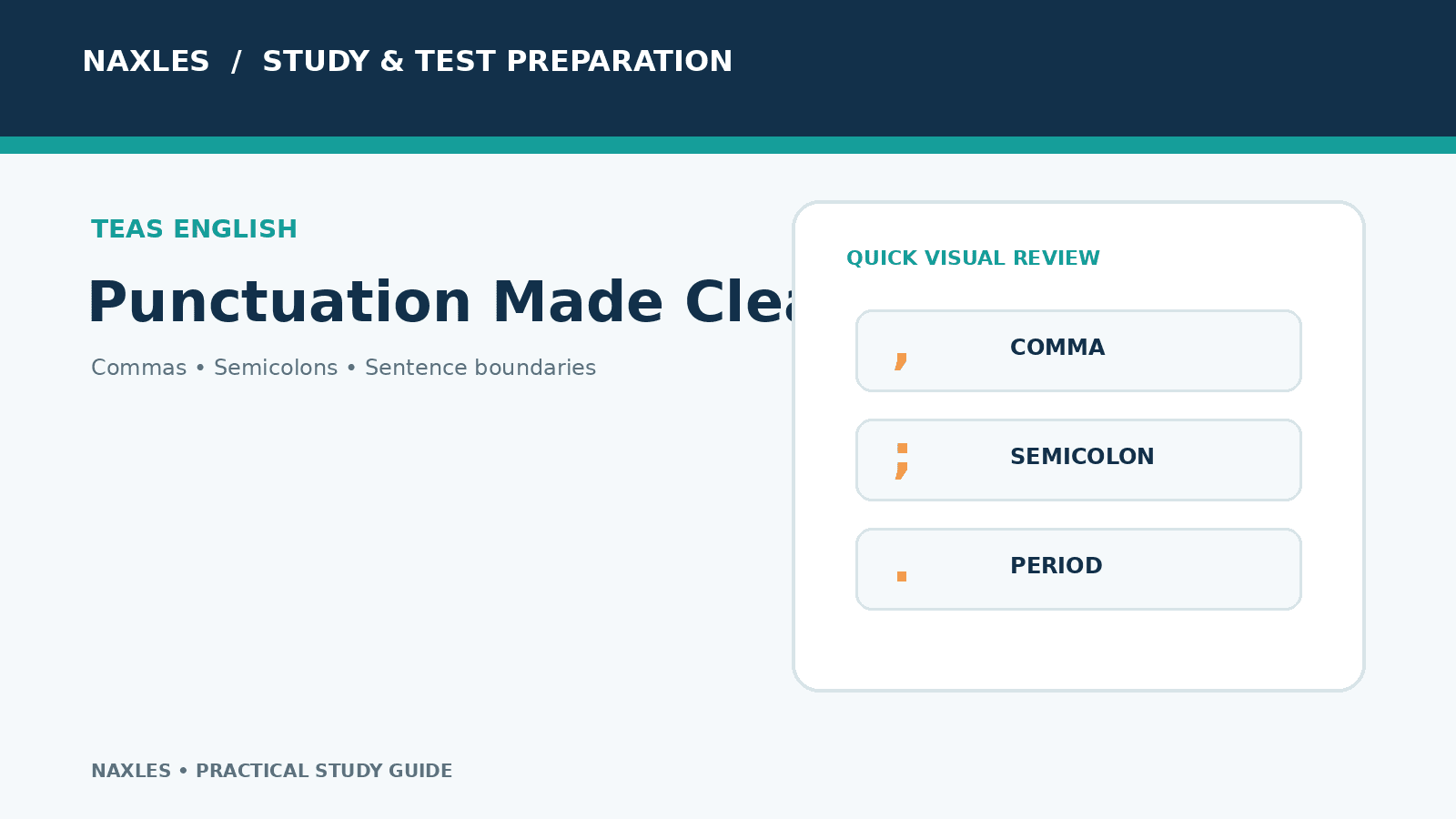
Commas separate parts of a sentence and help prevent confusion. Use a comma to separate items in a series: The student packed pencils, notebooks, and a calculator. A comma is also commonly used after an introductory phrase: Before the exam, Maria reviewed her notes. When two independent clauses are joined by a coordinating conjunction such as and, but, or so, a comma is generally used before the conjunction: The student studied carefully, but she still felt nervous. An independent clause can stand alone as a complete sentence. A comma by itself should not usually be used to join two independent clauses.
2. Apostrophes
Apostrophes are commonly used to show possession or form contractions. For a singular noun, add an apostrophe and s to show possession: The nurse's notebook was on the desk. For a plural noun ending in s, an apostrophe is generally added after the s: The students' books were on the table. Apostrophes also appear in contractions: It's means it is or it has. They're means they are. You're means you are. Do not confuse its with it's. The first is possessive; the second is a contraction.
3. Semicolons
A semicolon can connect two closely related independent clauses without a coordinating conjunction. For example: The exam begins at nine; students should arrive early. Both parts can stand alone as complete sentences. The semicolon connects them because their ideas are closely related. A semicolon can also help separate items in a complicated list when the items already contain commas.
4. Colons
A colon can introduce a list, explanation, or example after a complete introductory clause. For example: Bring three items to the review session: a notebook, a pen, and your practice questions. The words before the colon form a complete sentence. This is an important detail to remember when choosing between a colon and other punctuation marks.
5. Periods and Question Marks
Use a period to end a statement: The student completed the practice test. Use a question mark at the end of a direct question: Did the student complete the practice test? A question embedded within a statement does not automatically require a question mark: The instructor asked whether the student had completed the practice test.
How to Practice Punctuation
Read each sentence carefully and identify its structure. Ask yourself whether it contains one complete thought or multiple independent clauses. Then check whether the punctuation matches the relationship between the ideas. Try correcting sentences that contain missing commas, misplaced apostrophes, or comma splices. Reviewing why an answer is correct is more useful than memorizing a rule without understanding it.
Final Thoughts
Punctuation questions become easier when you understand how sentences are built. Review one rule at a time, practice with examples, and pay attention to the difference between complete sentences and dependent phrases.