Gender and Number
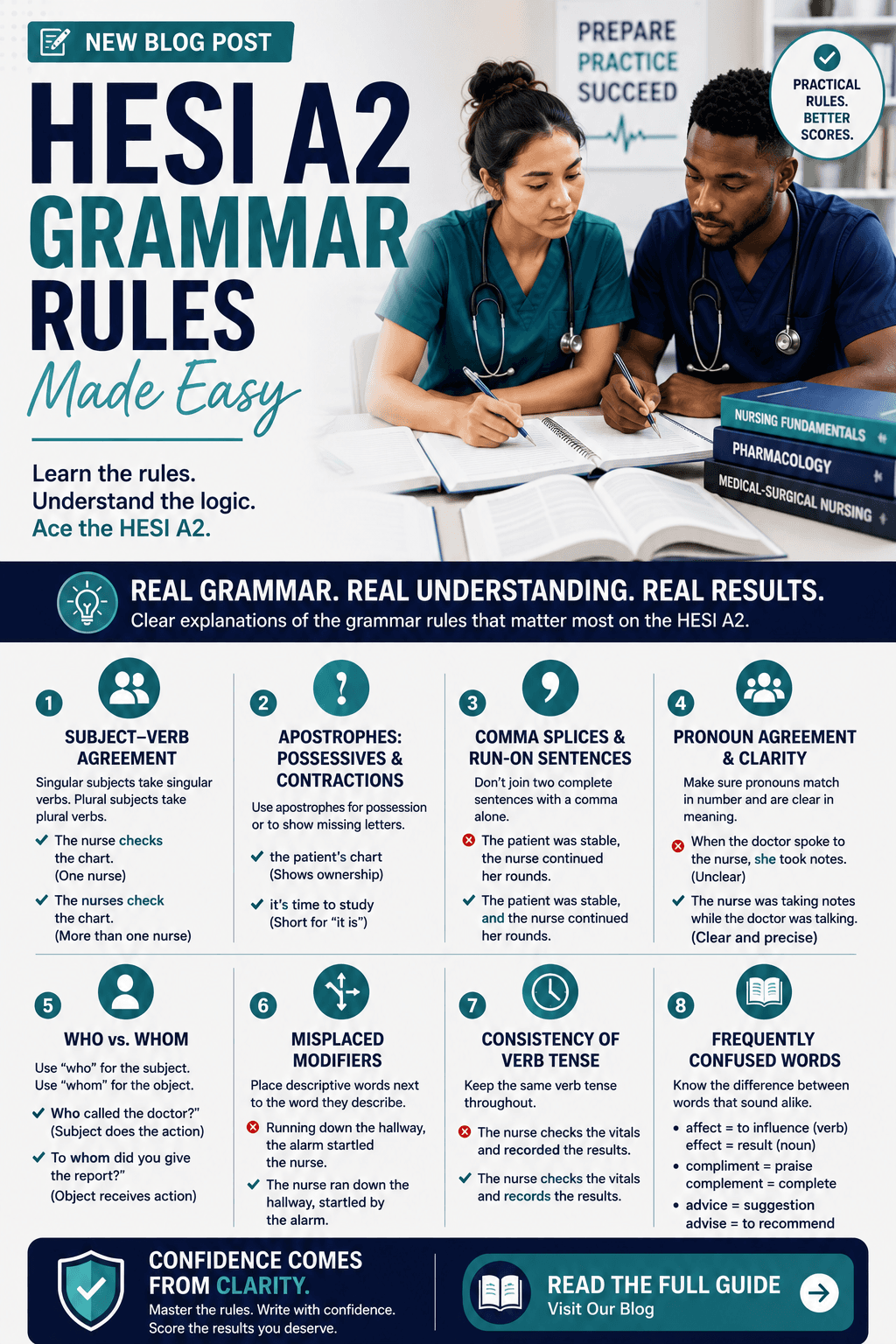
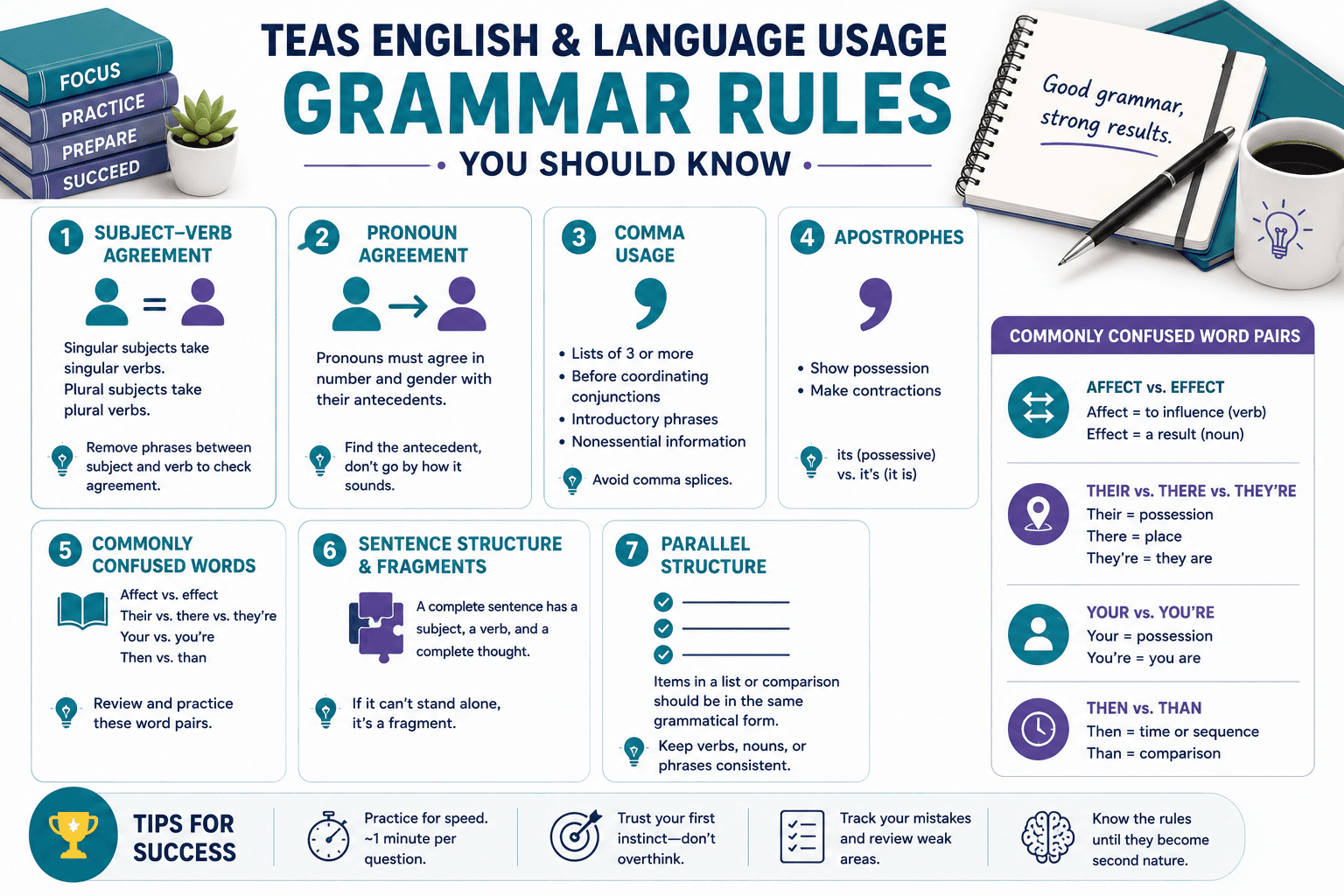
The basic rule is that singular subjects take singular verbs and plural subjects take plural verbs. It’s a basic idea, but the test typically puts the subject and verb far apart in a sentence, with lots of words in between, so it’s tougher to tell if they agree.
Common trap: Prepositional phrases between subject and verb. ("The list of items is on the table," not "are" since "list" is the true subject, not "items").
Here's a solution for fixing this problem: When you check for subject-verb agreement, mentally remove prepositional phrases before checking to see if the verb agrees with the rest of the sentence.
Pronoun Antecedent Agreement
Pronouns agree in number and gender with their antecedents (the nouns to which they refer). One common test pattern is collective nouns or indefinite pronouns that sound multiple but are grammatically singular ("everyone," "each," "neither").
Widespread trap: "Each of the nurses submitted their report" is widespread in colloquial conversation, but it’s grammatically incorrect in formal speech, because "each" is singular; the traditionally tested correct form is "his or her report," but usage is changing.
Problem-solving tip: Before you choose a pronoun, figure out if the antecedent is singular or plural. Don’t depend on how the sentence sounds. Informal speech patterns don’t always follow formal grammar rules.
Use of Comma
There seem to be a few different rules on commas:
- Commas in a list: between 3 or more elements.
- Before a coordinating conjunction between two independent clauses: “She finished the assessment, and wrote her findings.”
- Introductory phrases: “The nurse, having reviewed the chart, proceeded with the assessment.”
- Parenthetic information that is not crucial to the meaning of the sentence should be set off: “The patient, admitted the previous night, showed improvement.
Tips for overcoming problems: The comma splice (connecting two separate sentences with just a comma (“She finished the report, she submitted it” is wrong, it needs a conjunction, a semicolon, or a period).
Apostrophes
Apostrophes have two primary uses: to show possession and to make contractions. Often confused with:
its vs. it's: "its" is the possessive form, without an apostrophe; "it's" is short for "it is." Plural versus possessive: “the nurses’ station” (possessive, plural nurses) against “the nurses were busy” (plain plural, no apostrophe).
Word pairs that are often confused
There are a few word pairs that recur on standardized English portions in general that are worth reviewing specifically:
- Affect versus effect. "Affect" is usually a verb (to influence); "effect" is usually a noun (a result).
- There, there and they’re: possession, location and a contraction of “they are.”
- Your vs. you’re: possession vs. contraction of “you are.”
- Then vs. than “Then” refers to time or sequence “Than” is used for comparison.
Problem-solving tip: Keep a record of pairs of words that you yourself confuse in practice, not just a generic list, because your individual error patterns are the most efficient thing to target.
Sentence Structure and Sentence Fragments
Understand the difference between a complete sentence (a sentence that contains a subject, verb and gives a complete thought) and a sentence fragment (a phrase that is missing one of these three elements). The test can include sentence fragments that appear to be whole thoughts, especially when they begin with subordinating conjunctions (i.e., "Because the patient reported pain" is a fragment in itself and not a complete sentence).
Problem-solving tip: Check if a sentence can stand alone and make perfect sense in isolation. If it relies on an unstated idea before or after it, it’s probably a fragment.
Parallelism
If you are making a list or comparison, all items should be in the same grammatical form. For example, "The nurse assessed the patient, documented the findings, and reporting to the physician” is not parallel. It should be "reported," in the same past-tense verb form as the other two items in the list.
Problem-solving tip: If you have a sentence that contains several acts or items, make sure they all follow the same grammatical pattern (all verbs in the same tense, all nouns, etc.).
Common issues and how to resolve them
I understand the rules, but when I have to use them under pressure, I run out of time. Solution: This portion favors instinct over deliberation, with around one minute per question. Practice these principles until you can quickly and automatically see an error, rather than having to actively work through the rules every time.
Problem: "I keep second guessing myself on questions I actually know the solution to. One of the most typical ways students waste time in this part is by overthinking short-form grammar and vocabulary questions. If your initial impulse is to apply a rule you’ve just reviewed, go with it.
Problem: "I keep mixing up the same pairs of words." Solution: Keep track of your specific repeating faults during practice sessions and do tailored review around those precise pairs, not a generic list uniformly.
Problem: “I don’t know if a sentence is a fragment or informally phrased. Determine whether the sentence has both a subject and a verb and communicates a complete, stand-alone thought. If it depends on some idea not in the sentence itself, it's a fragment no matter how natural it seems when uttered.
Conclusion
The English and Language Usage part is heavily weighted toward speed rather than careful thought, given the one-minute-per-question pace. Review subject-verb agreement, pronoun agreement, comma rules, apostrophe usage, commonly confused word pairs, fragments, and parallel structure until finding errors is second nature — then rely on that instinct on test day instead of second-guessing questions you already know how to answer.