Why This Decision Is Worth More Than A Snap Decision
It can be easy to just go with the one that’s easier to schedule. But online testing and in-person testing have quite distinct requirements, contexts, and sites of failure. A test-taker choosing online testing without a solid setup, or in-person testing without allowing for travel time, is solving the incorrect problem – optimizing for convenience rather than performance. The right way to do this is to test both formats in your real setting, with your technological access and your testing habits.
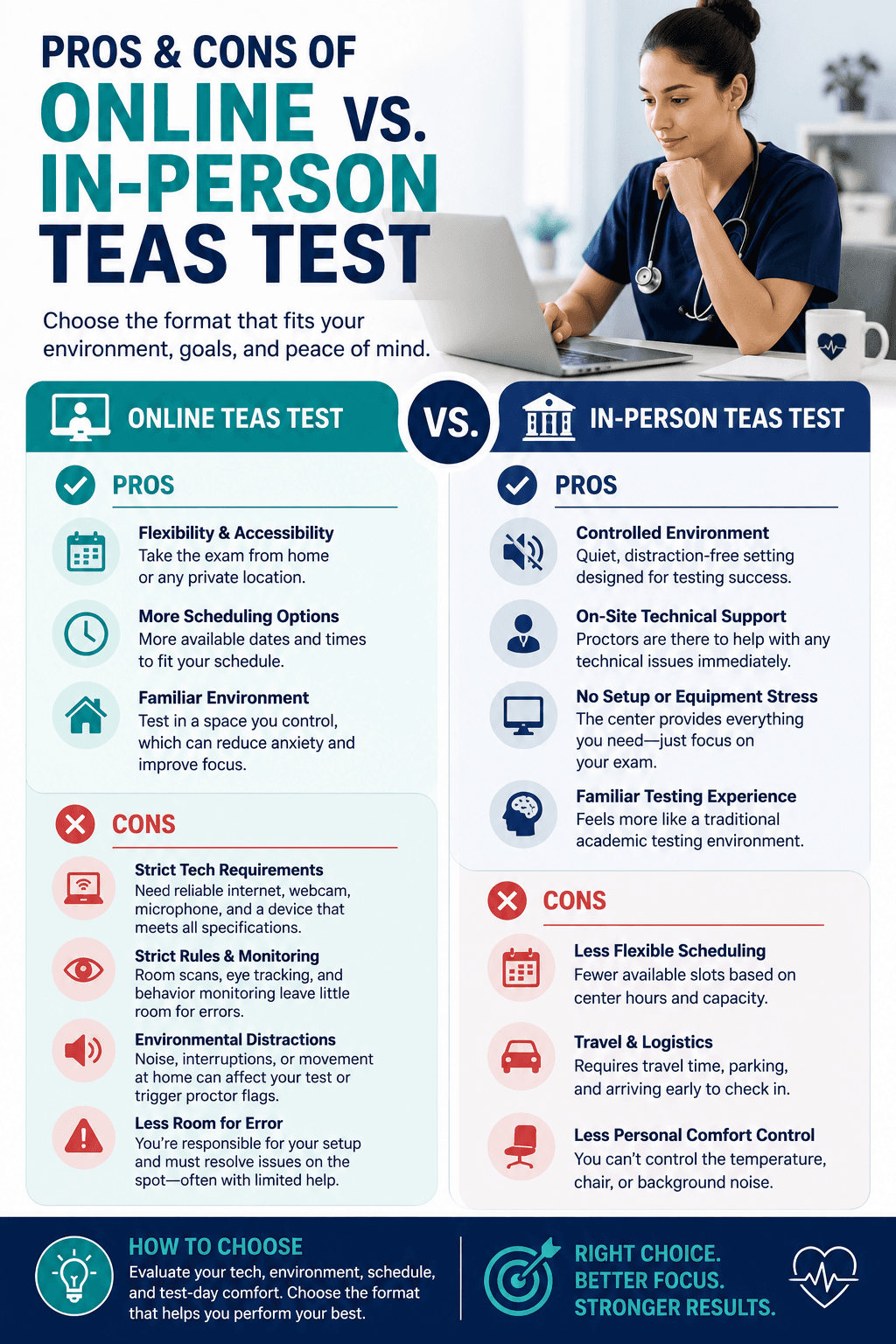
Advantages of Online TEAS Testing
- Flexibility, Accessibility. Online testing allows you to take the exam from home or another private location instead of having to drive to a testing center. This is a great option for test-takers in rural locations, people with limited transportation, or anyone juggling the exam with a demanding work or caregiving schedule.
- More scheduling choices. Online testing is not constrained by the hours or space of a physical facility, so appointments might be more frequent — which can be important if you’re up against a tight application deadline and need a seat sooner rather than later.
- An atmosphere familiar. For some test-takers, being in a room they control — their own workstation, their own chair, their own lighting — cuts down the anxiety that comes with an unknown testing center. If you are comfortable in your physical setting, you will be able to concentrate better on a long exam.
Drawbacks of Doing TEAS Online
- Strict technological specifications. To take the online test, you will need a reliable computer, steady high-speed internet access, a working webcam and microphone, and a private, quiet environment that fulfills specified set-up standards. A technological glitch during the exam, whether it’s a failed connection, background noise flagging, or a webcam malfunction, might delay or void your session, and a trivial logistics issue can become a serious concern if it’s not tested out beforehand.
- Strict room and conduct rules. Remote proctoring software scans your room, tracks your eye movement, and alerts suspicious conduct. Test-takers must remove their desks fully, keep household members out of the area and occasionally utilize a mirror or phone camera to illustrate all aspects of the space. A potential violation can be recorded for an inadvertent deviation.
- Limited control over environmental disturbances. Your home isn’t a regulated environment like a testing lab. Distractions can come from a doorbell, a cat, a noisy neighbor, or someone in your house who doesn’t know when your exam is – or in tougher situations, cause a proctor to step in.
- Less room for user error. You’re responsible for own setup, so if you mess something up, like you don’t have enough bandwidth, your browser is too old, or your webcam isn’t pointed in the right direction, you have to fix it right then and there, often with less help than there would be if there was an in-room proctor standing right next to you.
Advantages of In-Person TEAS Testing
- Control surroundings, distractions controlled. Testing centers are built for standardized tests: quiet rooms, controlled conditions, and the same conditions for everybody taking the test. This takes away the variability of testing from home.
- Technical help on premises. If a computer crashes or there’s a problem, then a proctor is physically there to fix it right away, not a chat or phone troubleshooting process that can take into your exam time.
- No equipment or setup responsibility. The testing center offers the computer, the scratch materials and the setting. This gets rid of a whole category of pre-exam prep, because you don't have to test your own webcam, internet speed or room arrangement before the exam.
- Psychological familiarity for many test takers. To those used to testing in academic settings, including classrooms, standardized test sites or past licensing examinations, an in-person center can feel more procedurally familiar, which helps reduce first-time exam anxiety.
Cons of Taking the TEAS In-Person
- Less flexible schedule. The testing center’s capacity and hours of operation limit the number of available appointment slots, so you may have to wait longer for a seat, particularly near application deadlines in competitive regions.
- Travel and logistics needs You will have to account for the extra areas of potential delay of driving time, parking and being there early enough to complete check in procedures over testing from your home.
- Less personal comfort control. You cannot control test center circumstances – room temperature, chair type, ambient noise from other test-takers – and this might be a significant influence for test-takers who are sensitive to their physical environment.
Choosing the right format for your needs
Instead of viewing this as a general pros/cons list, apply it to your particular situation:
- Online testing can save substantial time and stress of trip, if there is a peaceful and private space at home with reliable high-speed internet.
- If you’re concerned about your internet connection, or you live with others or in a loud environment, or you just do better in a proctored, in-person setting, a testing center eliminates those variables altogether.
- And if your application deadline is short, check appointment availability for both formats in your area before choosing, as scheduling access can vary greatly by location and time of year.
Making a Decision You Won't Regret
There is no "better" format, only the structure that works best for your environment, technological access and testing habits. By objectively analyzing both possibilities based on your real situation, instead of choosing the more convenient option at the moment, you are able to settle the format question early and devote all your energies to what is most important: preparing for the exam itself.