Why These Two Tests Are Commonly Compared
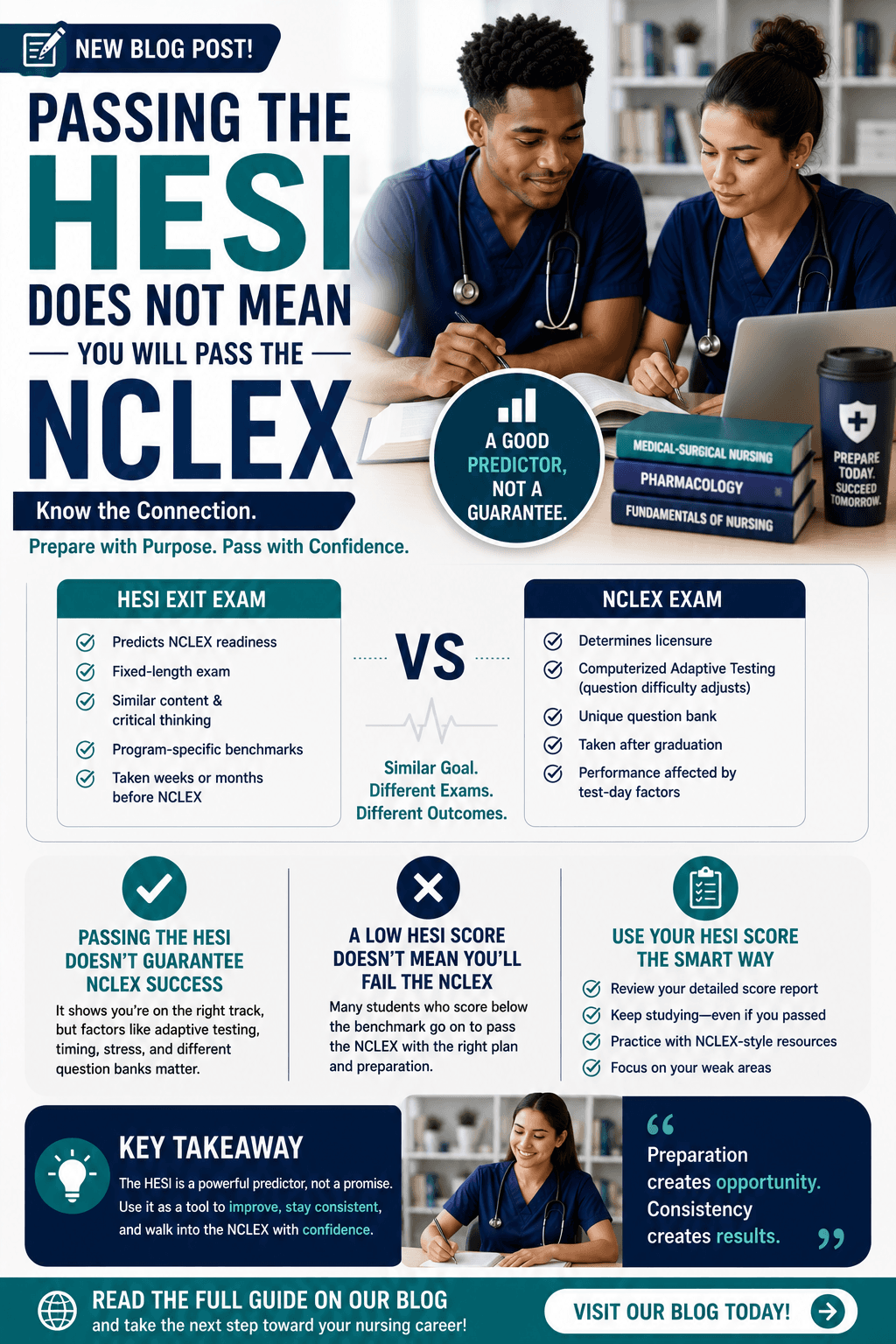
The HESI Exit Exam is what is designed to predict if a student will pass the NCLEX that is why the comparison comes up so often. Because NCLEX pass rates are an important factor in the accreditation and reputation of nursing programs, this predictive relationship is used by nursing programs to identify students who may require additional preparation before attempting the NCLEX.
With this close relationship, it is tempting to think that if you pass one exam, you are pretty much guaranteed to do well in the other, but the reality is a bit more complicated.
What a Passing HESI Score Really Means
- A high score on the HESI Exit Exam is a good, positive predictor that a student is ready to take the NCLEX but is not a guarantee.
- The Exit Exam is designed to reflect NCLEX style critical thinking questions and your Exit Exam performance is based on your performance on similar types of content.
- It is a statistical likelihood of passing the NCLEX. Based on the data, programs set their own standards for passing rates.
- It does not take into account every variable, such as test day performance, timing differences, or how you personally handle the adaptive testing format of the NCLEX.
The Main Differences That Bridge the Gap
The two exams are very similar, but there are a few structural differences that account for why a passing HESI score is no guarantee.
- Format Differences the HESI Exit Exam is a fixed-length test. The NCLEX uses Computerized Adaptive Testing. The difficulty of the questions on the NCLEX adjusts according to how you are doing on the test.
- Timing Differences — the Exit Exam is usually taken weeks or months before the NCLEX, so content retention and continued preparation still matter in between.
- Test-day variability – things like stress, fatigue or not being used to a new testing environment can affect performance on any exam, no matter how well you do on practice tests.
- Separate question banks the tests are similar in content and reasoning skills, but the questions are not the same. Being familiar with one does not mean you will perform the same on the other.
A Low HESI Score Doesn’t Mean You’ll Fail the NCLEX
Just as if passing the HESI does not guarantee you will pass the NCLEX, not passing the HESI does not mean you will not pass the NCLEX. Many students who fall below their program benchmark are eventually successful on the NCLEX, especially when they use their HESI results to help them develop a plan for additional targeted study.
The Exit Exam should be viewed as a diagnostic tool, not a final verdict on NCLEX results one way or the other, but an indication of where more attention may be needed.
How to Use Your HESI Scores Wisely
- Whether your HESI score was higher or lower than your program's benchmark, there are concrete ways to use that information wisely, as you begin NCLEX prep.
- Review your detailed HESI score report and identify any specific content areas that may need additional reinforcement.
- Do not use a passing score as an excuse to stop studying. Regularly reviewing between the Exit Exam and NCLEX helps you retain and strengthen your knowledge.
- Use practice resources specific to the NCLEX, since these are designed to help you get used to the adaptive testing style that the HESI does not exactly simulate.
- Do not just assume a general review will be enough. Focus on the weak areas your HESI score revealed.
Concluding thoughts
Passing the HESI Exit Exam is a strong, encouraging indicator that you are probably well prepared for the NCLEX, but it is a prediction based on similar content and reasoning skills, not an absolute guarantee of the outcome. The best way to approach this is to use your HESI scores as diagnostic information. Continue to study for both exams and do not think you are finished after you pass your Exit Exam. That sustained effort, along with a good HESI score, can go a long way toward boosting your confidence and readiness as you approach the NCLEX itself.