The real answer
The TEAS is best characterized as moderately tough, with accessible subject and demanding breadth. It is based on academic information most applicants have technically seen previously, in high school biology, mathematics, and English classes. It is rarely described as conceptually obscure. For many applicants, it’s not new material that’s difficult, it’s rusty material – material you studied years ago and haven’t actively used since, together with the stress of being tested on four different subject areas in a timed, standardized style in one session.
The national average composite scores tend to be somewhere in the 60s . Commonly stated first attempt values tend to fall in the 65 % to 72 % ballpark. That average falls short of the 80%+ range that many competitive programs prefer, and it’s telling. A significant share of test-takers enter underprepared for the level of review the exam actually demands, not because the material is inherently obscure, but because it’s broader than a quick refresher can cover.
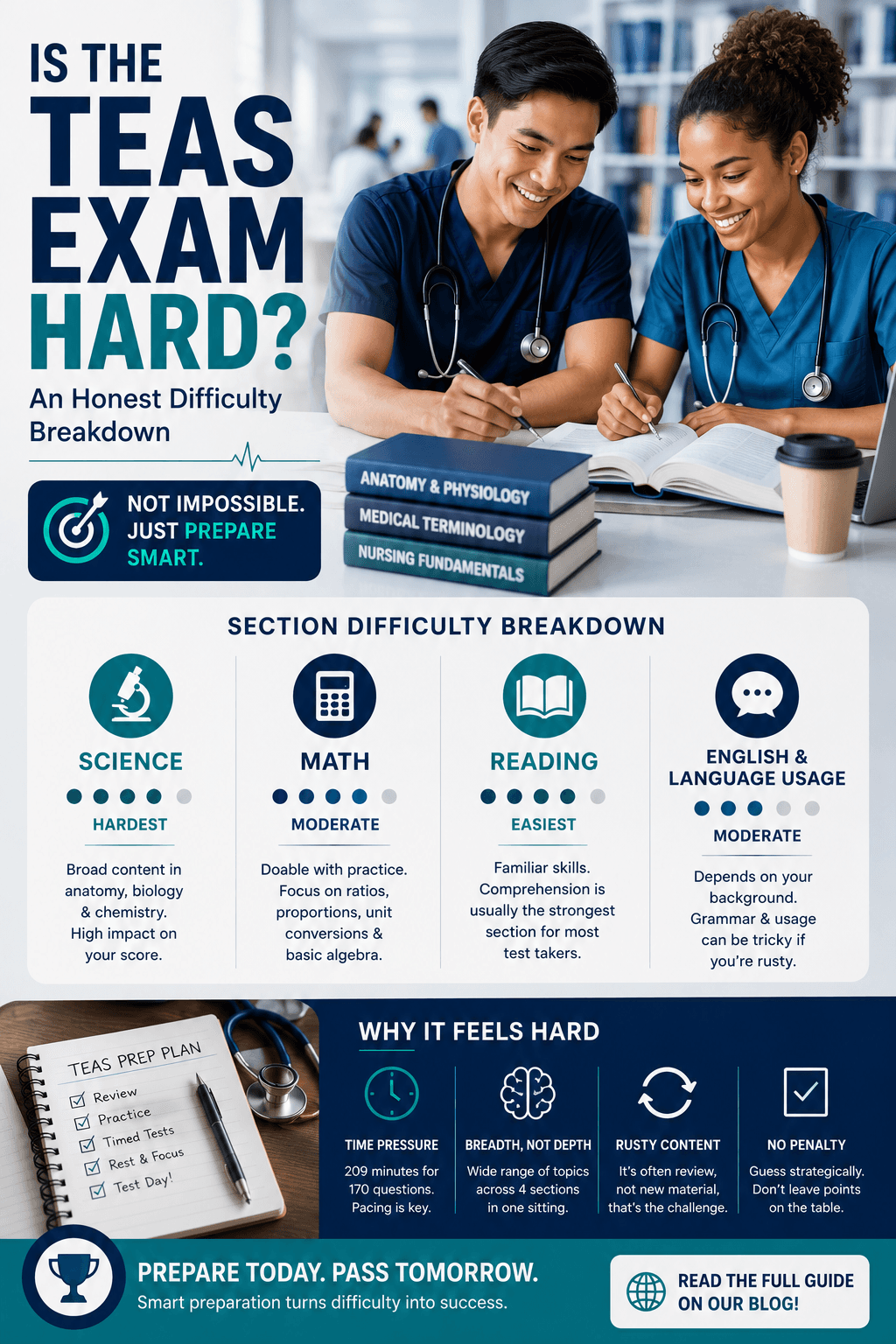
Section Difficulty
Science: Usually the hardest section. Science is consistently the hardest subject according to most data and candidate input. It also accounts for a considerable portion of scored questions, so troubles here skew your composite disproportionately. The challenge seems to be two-fold; either foreign or forgotten language (especially anatomy and physiology), or the sheer variety of sub-topics crammed into one segment (body systems, general biology, and fundamental chemistry).
Math: fairly difficult, but usually solvable. Most applicants find that arithmetic difficulty is doable once they examine essential methods including ratios, proportions, unit conversions and basic algebra. Compared to the more memorization-heavy Science part, arithmetic skills tend to improve rather rapidly with focused practice because these are mechanical skills that react well to repetition.
Reading: often the most accessible section. The reading comprehension questions evaluate skills that most applicants utilize frequently in their day-to-day lives and courses. This section is often thought to be the least challenging segment for applicants who read regularly in academic or professional situations.
English and Language Usage: Moderate difficulty, Inconsistent on the part of applicant. This portion is more likely to weed out test-takers on the basis of background rather than difficulty. Generally, it is pretty easy for applicants who read and write a lot or have recently taken English classes. However, applicants who have not recently studied formal grammar, including some ESL applicants and career changers, report finding this area more difficult.
Why the Exam Feels Harder Than It “Should”
- Breadth not depth. The TEAS usually does not focus on one concept, but rather, it covers a lot of ground with four different areas in one test. This can be a bit more daunting than taking an academic exam that deals with only one subject.
- Time crunch. Most test-takers can get thru 170 questions in four sections in around 209 minutes if they pace themselves evenly across the exam, but even those who do that aren’t immune to the stress of running out of time if they spend too much time on a difficult question.
- Death of content. Most of the trouble applicants report is not that the subject is difficult, per se, but rather that it has been a long time since they have been exposed to the content. This is especially true for career changers and any applicant who is returning to school after a multiple year hiatus.
- No advertised removal shortcuts or partial credit. Since there is no penalty for a wrong answer, it is always best to guess strategically on topics you are unsure about rather than leaving them blank, but many candidates do not know this and lose points to blank replies instead of smart guesses.
What the Difficulty Really Means for Your Prep
- Don’t confuse “not conceptually hard” with “doesn’t need prepping.” Since the TEAS is testing basic material and not advanced stuff, it is easy to fall into the trap of not preparing well enough, thinking you learned it all years ago. With this sort of content, there might be so much rust, that it’s a good idea to review on purpose, rather than relying on previous exposure to get you thru.
- Science will be the most time consuming study. If you’re planning your prep schedule, expect Science to take up a disproportionate amount of space in your calendar vs. the other three areas, especially if you’re low on biology or anatomy material.
- The timing issue can be worked on using carefully timed practice exams. Because the time pressure is a major element of the challenge of the exam, not just the topic itself, preparing under realistic timed conditions is a different skill than content review and should not be sacrificed in exchange for studying without the clock.
- A score in the 60s on a first try should be seen as informative, not disheartening. That range is so frequent nationwide that the first try in that territory is not indicative of unique struggle; it’s indicative of the standard gap between casual familiarity and the level of review the exam truly rewards. And it’s a gap that’s very commonly closed considerably with a second, better-prepared attempt.
The Bottom Line
The TEAS is hard the way most standardized examinations are hard: not because the content is difficult, but because it demands wide, current, and rapidly-accessed knowledge across four areas under time pressure. Generally, science is the hardest, math and English are middle tier, and reading is typically the easiest part for most applicants. The truth is not that the exam is unfairly hard but that it rewards real preparation more than casual confidence, and that those who approach it in that way from the start find it far more doable than its reputation would lead one to expect.