Start with An Honest Assessment of Your Actual Available Time
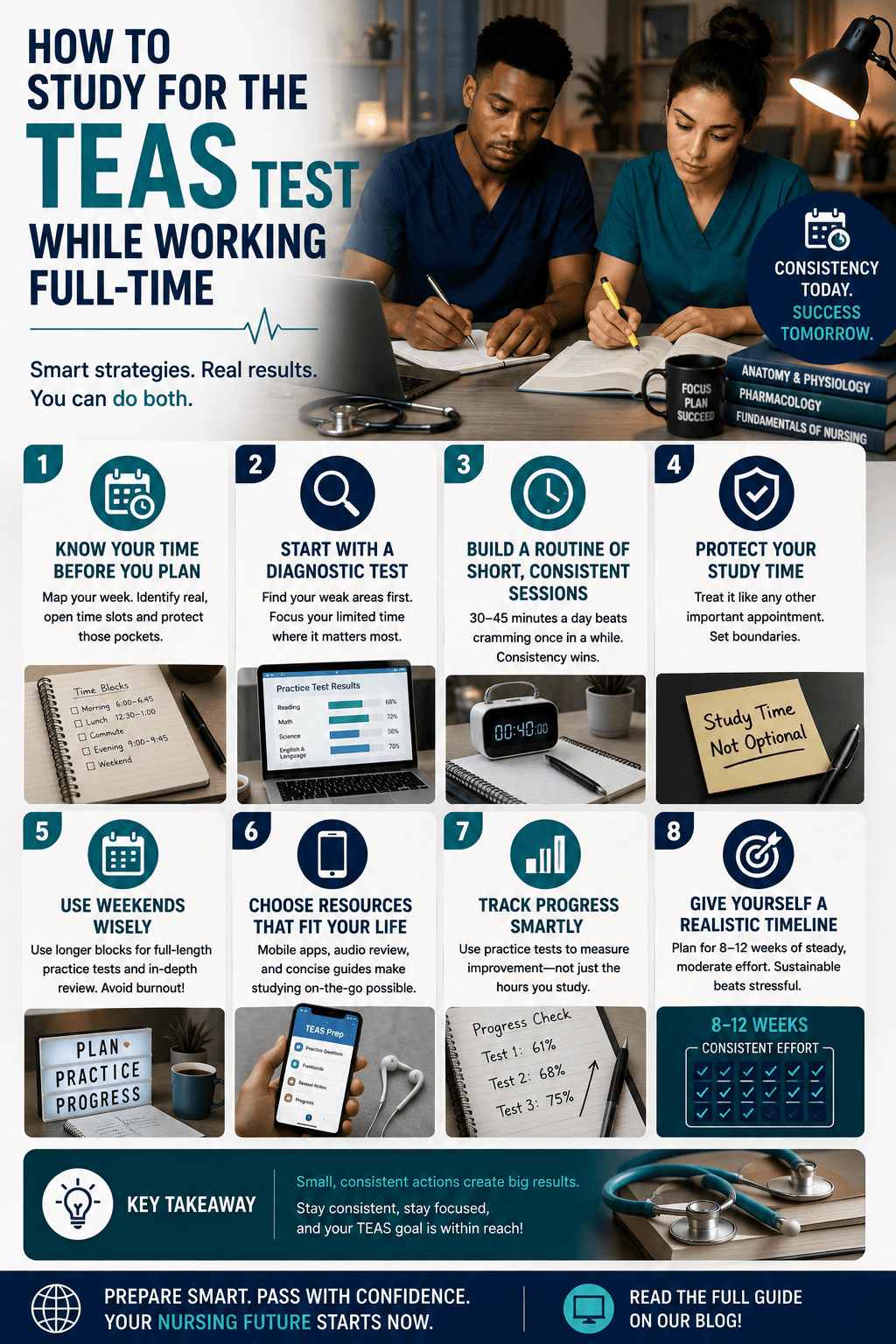
So before you make a study plan, map out your actual weekly calendar, including job hours, commuting time, sleep and any existing obligations, and find the particular pockets of time that are truly open for studying. It’s better than starting with an idealized plan (“I’ll study for two hours every night”) that falls apart in the first week because it didn’t take account of your actual life.
Instead, look for short, recurrent windows: a lunch break, a commute if you take public transit, the twenty minutes before your home wakes up, or a steady block on days off. Working professionals are more successful when they develop a strategy with multiple short, protected sessions rather than trying to carve out enormous blocks of time that can be easily displaced by a long day or an unforeseen obligation.
Before you start building your schedule, take a diagnostic test.
First, take a full-length practice exam to see your real weak areas before determining where to spend your limited time. This phase is even more important for working professionals than students who have lots of time to study, since every hour you spend studying something you already know is an hour you didn't have to spare. A diagnostic test tells you just where to put your effort so you don't squander any of your limited time.
Plan a Program of Frequent, Brief Sessions
It’s better to have a consistent daily routine than to do heavy workouts sometimes. Most days of the week, thirty to forty-five minutes is better than trying to protect a rare three-hour block on weekends; this is because consistency supports memory retention through spaced repetition, and because short sessions are far easier to actually follow through on around a demanding job.
If the content does not need deep focus, go for micro-sessions. You can perform vocabulary review, flashcards for anatomy terminology or quick math drills in ten or fifteen minute chunks while commuting, during a lunch break or while waiting for something else to happen. Save your longer, more protected practice periods for subject that truly needs your continuous focus, like going via practice reading passages or whole timed sections.
Group comparable tasks together. Don’t hop among areas of knowledge in one quick session, but rather spend each session on one topic or task. This lessens the mental overhead of context-switching, and makes better use of restricted time blocks.
Make your study time as serious as any other commitment
Treat study sessions like planned appointments, not "if I have time" activities. Block the time off on your calendar just like you would for a meeting and convey the boundary to family or roommates if needed. The working professionals I know who have had success with this type of planning nearly generally indicate that the key to keeping the plan sustainable is to treat study time as non-negotiable, not as something to be fit around everything else.
Keep a cushion for bad weeks. Sometimes work will require more than the normal amount, whether because of a busy period, overtime, or an unexpected catastrophe. If this happens, instead of completely ditching your plan, create a lighter backup version of your calendar for very difficult weeks, so you can still keep some regularity even when your ideal plan is not realistic.
Maximize Your Weekends Without the Burnout
Reserve the weekends for the longer and more rigorous study projects, such as full-length timed practice tests. It’s hard to squeeze these into short weekday slots, but they’re really crucial for improving pacing and stamina.
Do not try to squeeze a whole week's worth of study into one day over the weekend. This tends to lead to decreasing results when fatigue sets in, and it places huge strain on a single day that, if interrupted by any other activity, can undermine your entire week’s work. It is usually more sustainable to spread weekend study throughout both days in more moderate sessions rather than putting everything into one marathon session.
Choose study materials that fit into a working schedule
Resources like mobile-friendly practice question applications or audio-based review information that you can listen to while commuting are more flexible than resources that need you to have a desk set up that you may not have time to use every day.
Don’t put too much money into materials you won’t realistically have time to use to their fullest. It’s better to have a brief, focused study guide that you will actually finish, than to have an exhaustive guide that believes you have many more hours to study than you actually do.
Track progress without any added pressure
Instead of monitoring hours studied as the primary indicator of improvement, use occasional practice exams spaced a few weeks apart to see if your studying is effective. With so limited time, the question is not how many hours you are putting in, but whether your prep is actually converting into greater performance.
Alter your plan according to what the data tells you. If a certain part is not improving with persistent effort that is useful information to guide you to use the limited remaining time on a different technique or resource for that specific area than continuing an approach that is not working.
Give Yourself a Realistic Overall Time Frame
Working professionals tend to have a longer total prep window than full time students, simply because they have fewer hours to dedicate each week. Instead than cramming prep into 4 weeks and burning out trying to keep up with a student’s speed, plan on 8-12 weeks of constant, moderate effort, which tends to deliver better outcomes and be way more sustainable with a full-time job.
Conclusion
A full-time job doesn’t mean you don’t have time to study for the TEAS; it just means you have to use the time you do have more efficiently than someone with an open schedule. If working professionals have a diagnostic-driven strategy, short and consistent daily sessions, protected weekend time for lengthier practice, and a realistic overall timeline, they can prepare properly for the exam without having to reorganize their entire life around it. But consistency, even if it’s a little bit, always beats the random long sessions squeezed in between a busy schedule.
