Before Week One: Use the Diagnostic Test to determine the level of background knowledge and skills required
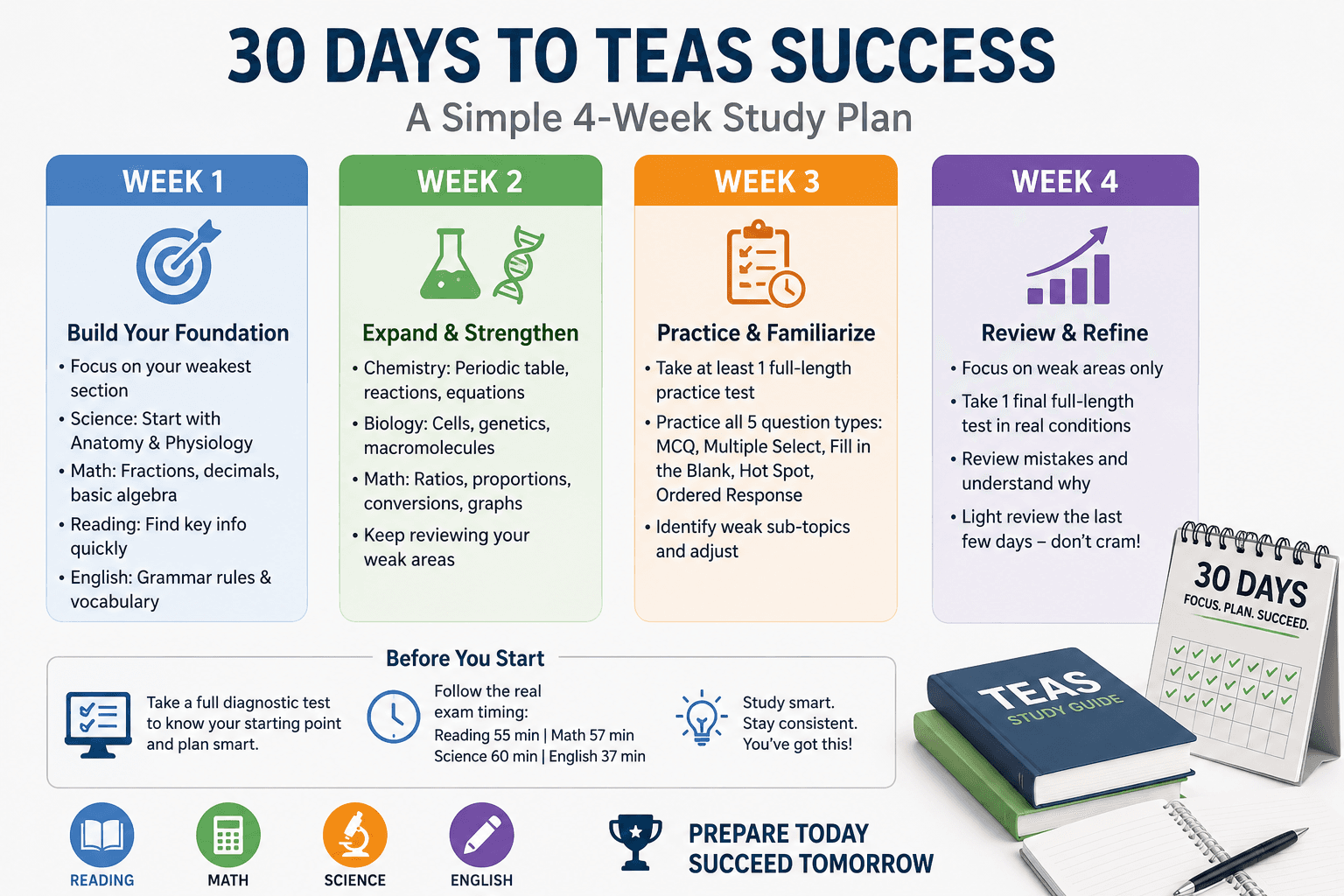
Do not begin study of content yet. Complete one full timed practice test, with the actual section timing (Reading 55 min, Math 57 min, Science 60 min, English 37 min). This one step will give you a complete idea of where your time is best spent, otherwise you're guessing for the next four weeks.
Problem solving Tip: Don't skip this step because you are short on time. A diagnostic actually saves time overall, because you don't need to study the areas in which you're good.
Week One: Your Strongest Section and Foundation
Pick one of the three areas in your diagnostic results that is your weakest and spend a little extra on it this week, but also devote some time to the other two areas.
- If Science is weakest: Begin with anatomy and physiology as it is the bigger content area. Do not try to memorize all the information all at once, but rather build up a system-by-system review.
- If Math is weakest: First concentrate on doing manual fraction-to-decimal conversions and basic algebra, as the on-screen calculator you get is basic four-function only — you do not have to rely on it for decimal conversions.
- When Reading is weakest: Read for specific information; do not read whole paragraphs, as you are most likely to run out of time when reading for information.
- If English is the weakest: Review the basic grammar rules and create a running list of vocabulary (academic and medical) terms.
Daily schedule for Week One: 60-90 minutes/day on your worst topic plus 20-30 minutes/day lightly on another topic 5-6 days a week.
Week Two: Extend to Chemistry and Biology and Build Math fluency
As a priority area, do not have to sacrifice chemistry and biology for anatomy and physiology; both are tested separately on the TEAS 7. Set aside time for the following:
- Chemistry: Basics of the periodic table, chemical bonding, chemical reactions, and balancing equations.
- Biology: cell structure, genetics and DNA, and macromolecules.
- At the same time, reinforce math facts: ratios, proportions, conversions, reading numbers from tables and graphs—the latter of which is important on the current test.
Problem-solving Tip: If you feel that you're only studying anatomy because you're more comfortable with it, then you're on a red flag path to spending more time studying chemistry and biology, which are more likely to be neglected but just as important.
Week Three: Full length Practice Tests and Question Type Familiarity
Move to exam simulation by week four. Complete at least one additional full-length, timed practice tests this week, and take care to practice all five types of TEAS questions, not just multiple choice:
- Multiple choice
- Multiple select ("select all that apply")
- Fill in the blank
- Hot spot
- Ordered response
Problem-solving hint: If you are only used to doing multiple choice exercises from old question banks, then you are not ready for the current exam. Look for TEAS 7-specific resources that contain all five question formats, as there are important differences in how multiple select and fill in the blank questions are done as opposed to multiple choice.
Take advantage of this week's practice test to determine any remaining weak sub-topics and adjust the final week's plan accordingly instead of just reviewing the same sub-topics over and over.
Week Four: Focused on Targeted Review and Simulated Test Conditions
It's no time to bring in something you have never used. Instead:
- Re-read only those areas your practice tests identified as needing improvement; if your practice platform offers an Individual Performance Profile breakdown, then utilize that.
- Take one final full-length practice test in as authentic a setting as possible including the same time limits, few interruptions, and preferably on a computer in the same format as the actual test.
- Carefully check your answers, paying particular attention to how you got the wrong answers instead of just stating that you did.
- Reduce in last 2-3 days. Light Review – do not cram for review the night before, as this will only cause more anxiety than recall.
Problem-solving tip: If you're still discovering new weak spots in the last week, it's ok, the point isn't perfection, the point is that the time you have left should be spent on the areas where you need most, not on what you already know.
Typical Issues that Students Face with a 30-Day Period
Challenge: "How to split my time between four really different parts? Solution: Don't make a split based on a generic even distribution, rather on your diagnostic test results. Review and practice more on areas of difficulty earlier, gradually decreasing and balancing review as test nears.
Challenge: "I feel overwhelmed by all the content of Science covered in such a short period of time. Solution: Make sure that you dedicate time to anatomy and physiology as this is the biggest content area, but don't forget chemistry and biology.
Challenge: "I constantly feel like I'm running out of time during practice tests. Solution: From week 3 on, have students practice under real timed conditions and determine if the problem is content knowledge or pacing; they will need to take different approaches to address each of those issues.
Challenge: I don't feel like 30 days is enough. Solution: If you've got a very low starting point in several sections, ask yourself if it's feasible to reschedule your test date. An unplanned, panicked 30 days will likely yield less successful results than a slightly delayed, more well-prepared one.
Final Thouhgts
If used strategically, 30 days is a reasonable amount of time: spend 30 days identifying the problem; spend some of the first 15 days on your weakest areas, leaving chemistry/biology for Science; leave all five types of questions to students, and slowly ease into full-length practice tests near the end of the 30 days. Here structure trumps intensity — a focused, diagnostic plan will beat a focused, hard-working approach without a plan.