The real skill is turning words into math, not just solving
A word problem is actually two tasks hidden in one: extracting the correct numbers and connections from a sentence, and then doing a calculation that is frequently rather simple once you know what to compute. Most of the points lost are lost on the first step, not the second. If you comprehend the math just well once someone else has set out the equation, that’s a big indicator that your problem is translation and not computation — and that shifts what you should really be working on.
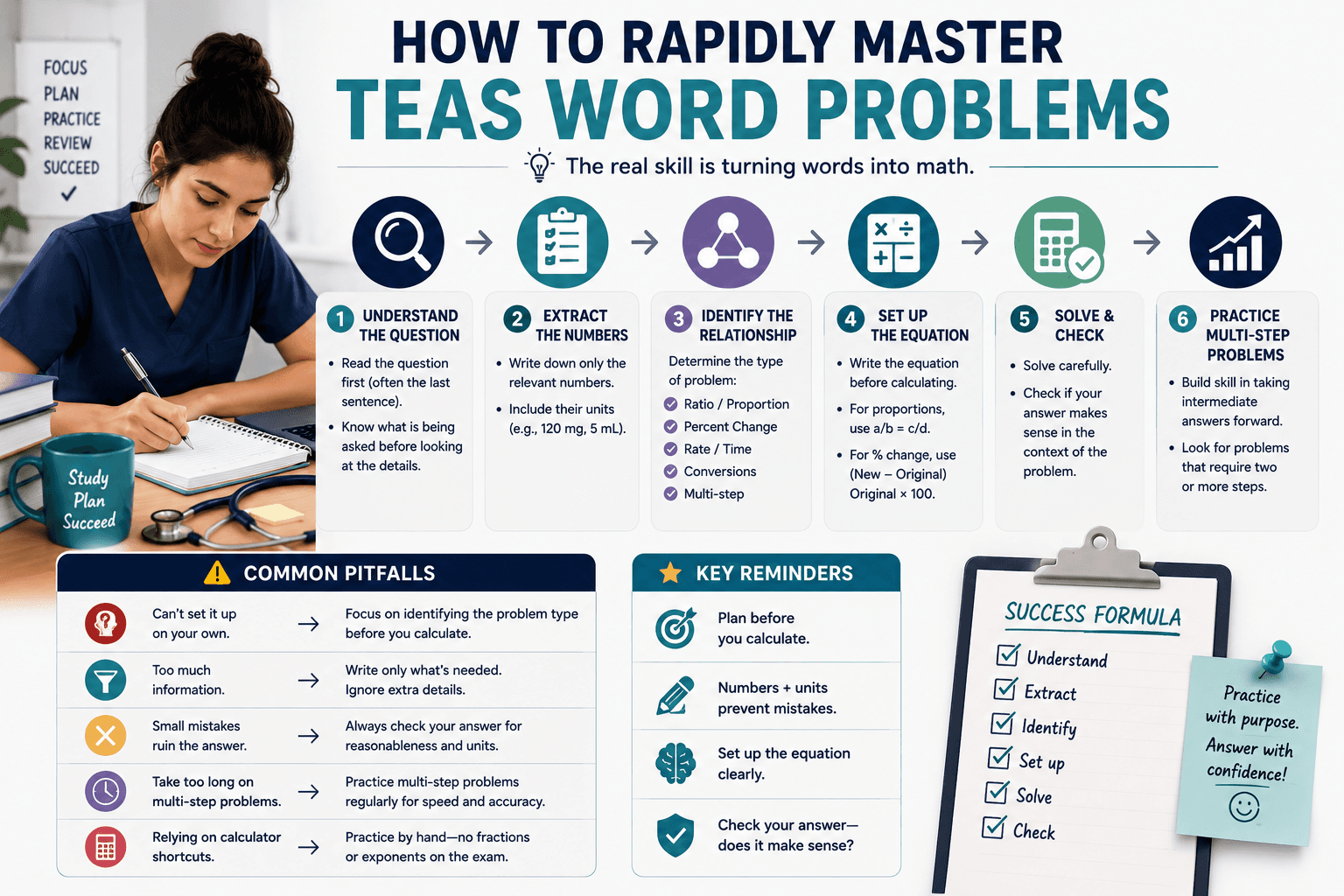
Step 1: Figure Out What the Question Really Is Before You Do Any Math
Read the question itself, i.e. what you are being asked – frequently the last sentence – and then work your way through the details of the problem. It’s one thing to read the stuff above if you know where you’re going with it.
Fix: Before retrieving figures from the section, underline or mentally flag the precise question being posed. This avoids the typical mistake of doing something correctly that was not what the inquiry asked.
Step 2: Extract just the relevant numbers and units
Word puzzles typically have more information than you need, partially to see whether you can figure out what is relevant. Write down each number with its unit (not simply the number). Keeping unit’s explicit helps to avoid a large proportion of typical errors.
Fix: As you read, write down each amount with its label immediately (e.g. "120 mg" not just "120"). One practice that avoids unit-conversion errors before they happen is that when you write out a mismatched unit, it is visually clear.
Step 3: Describe the Relationship You Are Explaining
Once you know what the question is asking for and what numbers you have, figure out what relationship there is between them. Common TEAS patterns are:
- Ratio and percentage ("if X per Y, how much for Z?")
- Percentage change ("How much did it increase?")
- "How long will it take if...(" rate issues”)
- Multi-step conversions (“take this measurement and convert it, then calculate…”)
Fix: Try to determine the sort of problem before you try to solve it. Many students start calculating immediately without checking what formula or relation is really relevant, leading them to apply the wrong method altogether.
Step 4: Prepare the Equation Before Calculation
Before you do any arithmetic, write the relationship down as an actual equation. In proportion issues, this is equivalent to writing out a/b = c/d rather than trying to do it in your brain. [(new - original) / original] x 100 with your real numbers supplied in before simplifying.
Fix: This phase can seem slower at first, but it avoids errors that happen when you jump straight to mental math, especially when you’re under the gun and your working memory is already taxed.
Step 5: Solve and then check your work
Once you get a quantitative solution, take a moment to ask yourself if it makes sense, given the context of the situation. If you are calculating a dose and you get a number of 5,000 mg when it should be a modest, conventional quantity, then that is a warning sign that something went wrong in your setup, not a green light to carry on.
Fix: This sanity-checking habit should be built in practice, not simply on test day. It also catches problems such as missed decimal points, or mismatched units, that a purely mechanical computation wouldn’t catch itself.
Practice Specifically with Multi-Step Problems
Single-step calculations in isolation do not practice the special skill of multi-step word problems: correctly taking an intermediate answer forward into a second calculation. A lot of TEAS math questions today are just like this – you need to convert a unit, and use that transformed number in another calculation.
Fix: Look for practice problems that specifically say multi-step, rather than expecting normal math practice would cover this skill automatically.
Recall the Limits of Calculator
The on-screen calculator given for the Math part is a basic four-function calculator, hence no fractions, no exponents. If your word-problem method depends on calculator capabilities absent on the real exam interface, you’ll run up against a roadblock in the middle of a problem on test day.
Fix: Make sure you practice each conversion and calculation by hand long before your exam, so you don’t learn about this constraint when you’re under the pressure of a deadline.
Common Issues and Solutions
Problem: “I understand the math when I see the equation but can’t set it up on my own.” Solution: This is a translation gap, not math deficit. Instead of getting into calculations straight away, practice recognizing the problem type first (ratio, % change, rate, conversion).
Problem: "I get confused with too much information in word problems." Solution: Train yourself to write just those figures that are important to the question being asked. Ignore details that are not relevant to the calculation being performed.
Problem: "I make tiny blunders that mess up my whole answer. Make it a practice to review your answer after every calculation to ensure it makes logical sense in context. This will catch misplaced decimals and unit issues before you submit your solution.
Problem: "I take too long on multi-step problems. Solution: Instead of doing drills with single steps, practice explicitly with multi-step problems, because the ability to take an intermediate result forward correctly is a specific talent that won't be developed by isolated practice.
Problem: "Using calculator shortcuts that don't work on the real test." Solution: Get used to doing fraction conversions and multi-step calculations by hand now, as the calculator given won’t do it for you during the real test.
Concluding Thoughts
It’s not about being better at math to solve TEAS word problems, it’s about getting faster and more dependable at translating a text into the right equation before you even do any math. First, determine what the real question is. Keep track of your numbers with units. Identify the type of relationship you are dealing with. Set up the equation explicitly. Check your final solution. That sequence, practiced regularly, converts word problems from the most difficult part of the exam into one of the most bearable.