Why TEAS Prep Is So Susceptible to Burnout
There are a several reasons that this exam is particularly burnout prone as opposed to studying for an exam for a single class. You’re juggling four different disciplines at the same time, often with employment, family or other courses. There is also considerable pressure on the result, as your score has a direct impact on your application to nursing school. And because the exam draws from knowledge across several distinct disciplines at once, it might feel like there’s always something more to review, with no natural ending point – a prescription for treating every evening as a study duty with no built-in finish.
Watch for Early Warning Signs
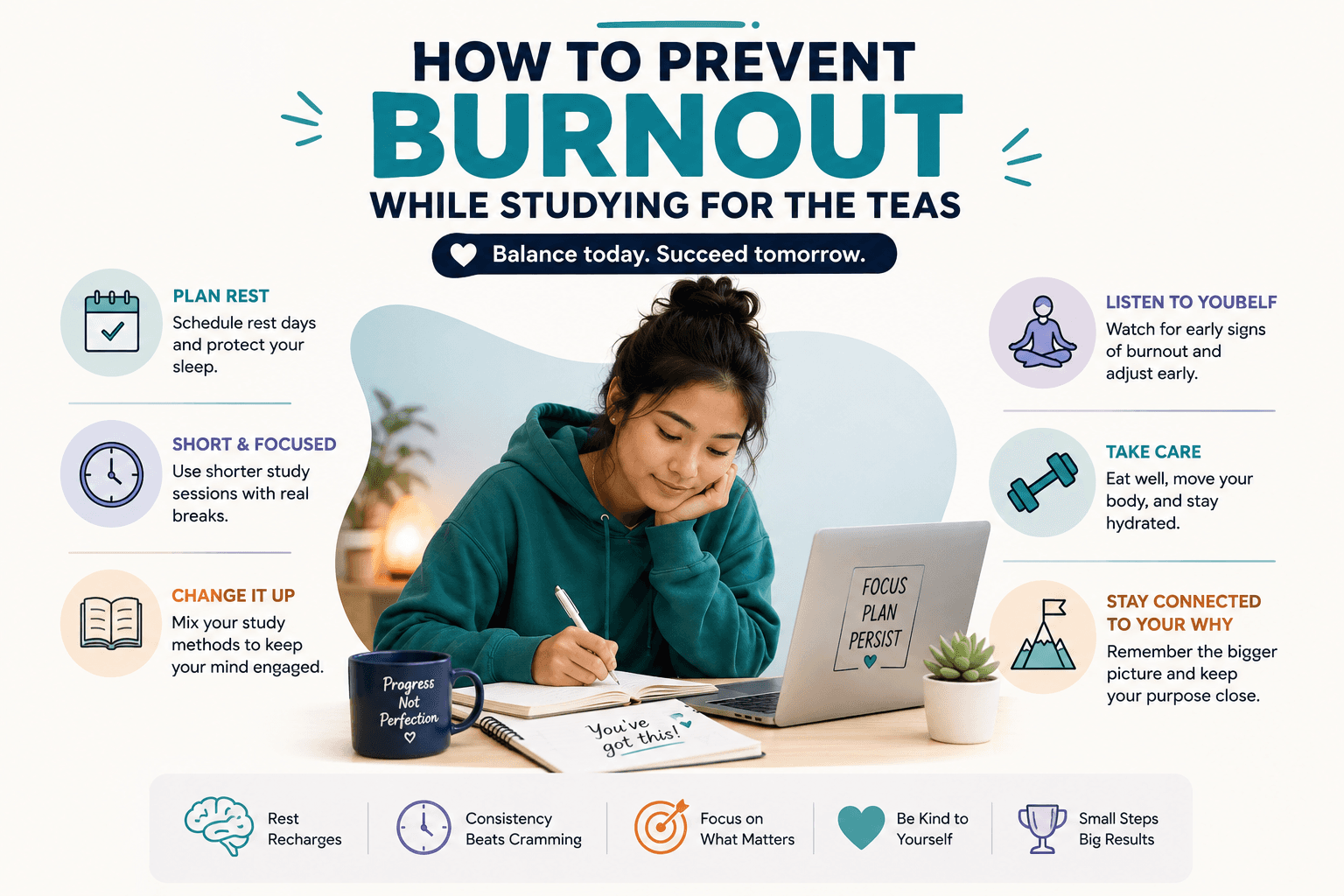
Burnout doesn’t happen overnight. It builds up over time. The sooner you catch it, the easier it will be to deal with. Common signs are:
- • Are your study sessions less fruitful than they used to be, even though you are spending the same amount of time or more.
- • Growing anxiety or avoidance of opening your study materials.
- • Finding it hard to focus even in sessions you’ve purposely shielded from distraction.
- • Physical tiredness that doesn't get better after a good night's sleep.
- • A shorter fuse than normal or irritability in other portions of your day.
Problem solving tip: If there are multiple of these indications at once, consider it good data, not a personal shortcoming. It's a cue to change your study structure, not to work harder in the same pattern that caused the fatigue in the first place.
Schedule Rest, Not Just Around It
The biggest mistake people make is thinking of rest as the time that’s left over after studying, instead of a planned and safeguarded part of the calendar. During your most intense study session, be sure to include at least one complete rest day in your week, and don’t cut back on sleep for extra review, instead keeping a constant sleep routine.
Problem-solving tip: Sleep deprivation directly affects memory consolidation and reasoning – just the skills the TEAS evaluates. Cramming late into the night usually yields worse outcomes than reviewing the same material after a good night's sleep.
Emphasize Sessions Over Marathon Study Periods
Inevitably, after the first hour or so attention wanes throughout long unstructured blocks of study and the returns drop. Retention is generally better with shorter, more targeted sessions, say, a 45- or 60-minute period of intense work with a real break, than with a single, undivided three-hour block.
Problem-solving tip: If you find your attention wandering a lot halfway through a session, it's a cue to take a real break, not to keep going in a weakened condition, because you often get very little more learning out of it compared to the time spent.
Change Your Study Method, Not Just the Subject
Doing the same thing for weeks on end, such just passively reading review material, could be more tiring over time than taking a different strategy. Mixing up your review material, practice questions, flashcards for memorization-heavy information, and the occasional full-length practice exam helps to break up your prep so that it doesn’t feel like the same repetitious chore every day.
Tip: Mental tiredness is caused by monotony as much as by the sheer number of hours you study. Mixing things around can improve your ability to study well without putting in more effort.
Rediscover Your Motivation for Learning:
When you’re deep in grammar rules or dose calculations it’s easy to lose perspective of why you are doing this. A quick reminder of your true motivation—the nursing job you’re striving for, the people you’ll one-day help—can turn a study session that feels like an obligation into one that feels purposeful.
Problem solving tip: This isn’t about faking positivity when you’re actually exhausted, it’s about knowing that burnout often multiplies when a task becomes pointless, and reconnecting with purpose is a legitimate method to fight that, with true rest.
Common problems and solutions
Problem: “I feel guilty about taking a rest day when my test date is coming up”. Solution: Think of rest as part of your preparation, not a break from it. A relaxed mind will remember and use facts better than a tired one that spends another hour on the same subject.
Problem: “I study for hours a day, but I feel like I’m not learning anything. Solution: It is a classic symptom of exhaustion producing declining returns, not a hint that you should add additional hours. Make your sessions shorter, include some meaningful breaks, and make sure your overall hours for the week are realistic with everything else in your life.
Problem: I keep putting off studying even though I know my test date is very near. Solution: Increased avoidance is often an early symptom of burnout, not a motivation problem. Evaluate whether your current schedule is sustainable, and if it is not, change it before you force yourself into an unsustainable schedule.
Problem: “I don’t have time to add rest days in with my job and other commitments.” Solution: A shorter, lighter day, such as 20-30 minutes of easy study instead of your typical session, might be meaningful rest in comparison to your normal pace, and you don’t need to take a whole day off if your schedule really doesn’t allow it.
Closing Thoughts
It’s not about studying less to avoid burnout; it’s about studying in a method that is genuinely sustainable for the entire weeks coming up to your exam. Plan for true rest, do targeted sessions instead of marathon blocks, change your study methods, and learn the early danger flags before they compound. A well-rested, consistently prepared test-taker beats a fatigued one who just put in more hours.