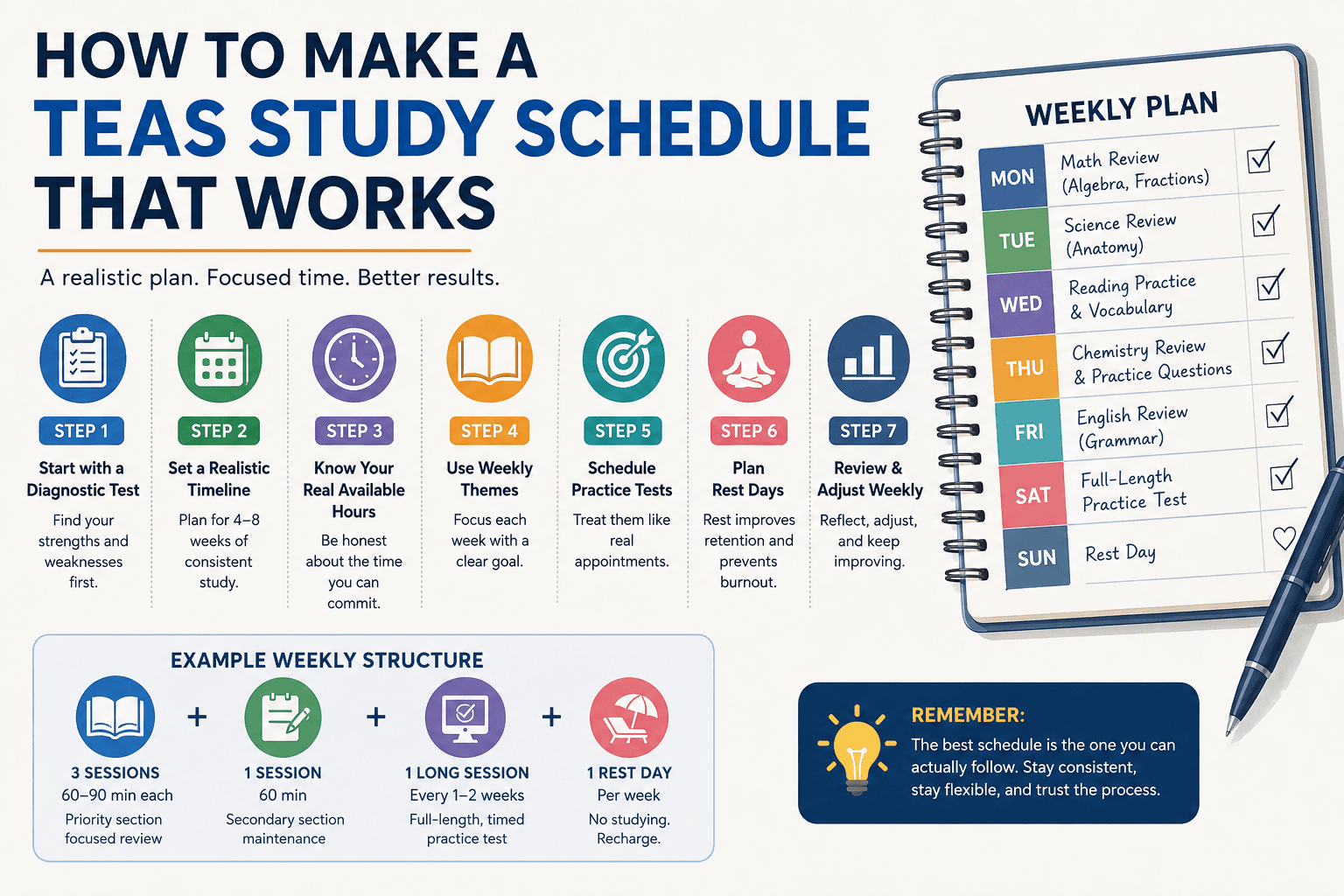
Step 1: Begin With a Diagnostic Test, Not a Calendar
Do one full-length, timed practice test to find out where you really stand in Reading, Math, Science and English before you decide how to split up your time. When you build a plan before you know your weak areas, you’re guessing at priorities – and most students guess wrong, over-preparing for a part they’re already strong in or under-preparing for one they’ve misjudged.
Problem it solves: A schedule that divides time evenly across the four portions, regardless of need, spending hours on things you already know.
Step 2. Develop a Realistic Overall Timeline
Most exam takers find that a steady, disciplined study plan of 4 to 8 weeks is helpful. If it’s been years since you’ve done math or scientific coursework, or your diagnostic findings show deficits in several sections rather of just one, lean toward the lengthier end.
Problem it solves: A timeline that is either unrealistically short (cramming) or unnecessarily protracted (motivation wanes before test day).
Step 3: Count Your Real Available Hours, Not Your Ideal Hours
This is where most study schedules fail even before they start. Instead of jotting down hours you’d like to study, find out how many hours you can actually fit in with work, school, or family commitments. Be honest – a timetable based on three hours of studying a day when you can only realistically manage an hour is a schedule you’ll drop after a week.
The problem it solves is a timetable that appears good on paper but falls apart the moment a real-life responsibility gets in its way.
Step 4: Weekly Themes Instead of Daily Randomness
Rather than trying to decide what you are going to study each day as you go along, give each week a general theme (modified according to your diagnostics results):
- Early weeks: Your weakest subject(s) + light review of the rest.
- Middle weeks: Expand to sub-areas that are often overlooked – chemistry and biology if Science is a focus, data interpretation if Math is a focus, vocabulary if English is a focus.
- Later weeks: Full-length timed practice tests; familiarity with the question types across all five formats (multiple choice, multiple choose, fill-in-the-blank, hot spot, ordered response).
- Last few days: light review only — no new material, no cramming, focus on rest and confidence.
- What problem it solves: Directionless daily studying that does whatever is comfy that day instead of developing progressively toward exam readiness.
Step 5: Schedule Your Practice Tests as Fixed Appointments
Don’t put full-length practice tests in the “I’ll get to it eventually” category. Include at least two or three full-length timed practice examinations in your study calendar and treat them with the same respect you would an actual visit.
Problem it solves: Never having trained under real timed conditions during the final week of preparation, which leads to pacing problems on the actual exam despite having great topic understanding.
Step 6: Schedule Intentional Rest Days
A schedule that has no break days is not more effective—it is more likely to be abandoned. Even during your most intensive weeks of study, try to build in at least one lighter day every week to prevent burnout and to enhance true retention, rather than just time invested.
The problem it solves is the diminishing returns of mental weariness and the higher likelihood of dropping the schedule altogether halfway through.
Step 7: Weekly re-assessment and adjustment
At the conclusion of each week, take a moment to analyze what worked and what didn’t. If you notice that there is a plan on a particular day that you always skip then the problem is not your discipline, but the plan itself. Change the calendar instead of failing the same unrealistic goal over and over again.
The problem it solves: That of stubbornly clinging to an initial strategy that isn’t really working, rather than modifying based on real feedback about your own tendencies.
An Example Weekly Structure
For a student with about 8 - 10 hours per week available:
- 3 sessions per week, 60–90 minutes each: focused content review on your priority section(s), rotating specific sub-topics rather than repeating the same material.
- 1 session per week, 60 minutes: review of a secondary section to prevent complete neglect of areas you're not actively prioritizing.
- 1 longer session every 1–2 weeks: a full-length, timed practice test as your date approaches.
- 1 rest day per week: no studying at all.
Adjust the exact hours up or down to fit your real availability and complete timeframe, but preserve the basic structure - priority-based sessions, secondary maintenance, periodic full-length practice, and built-in rest.
Common Problems and Solutions
Problem: “I have a detailed schedule, but I keep falling behind in the first week.” Solution: Your schedule probably lists your ideal availability, not your actual availability. Try to schedule it based on the hours you can reliably devote, even if that amount is less than you want.
Problem: "I don't know how to equitably divvy up time between portions." Solution: “Fair” is not equal. It is proportional to need. No need to evenly treat everything. Let your results in the diagnostics dictate the actual time you spend.
“I keep putting off my scheduled practice tests because they feel scary.” Solution: Make them permanent, non-negotiable appointments rather than discretionary add-ons. Practice exams are generally the most painful aspect of preparation, but they’re also the part that most directly promotes genuine exam-day readiness.
Problem: “I had a schedule that worked at first, but I lost motivation halfway through.” Solution: See if you built in rest days. A schedule without any down time tends to lead to burn out half way through, even if the content plan itself was adequate.
Last Thoughts
The hardest study schedule to follow is not the most ambitious one; it’s the one that starts with an honest diagnostic assessment, a realistic amount of available hours, and a framework that includes flexibility and rest. Focus on real deficiencies. Treat full length practice tests as static obligations. Adjust weekly based on what you’re actually doing, not what you expected to do. That combination is what takes a study program from something you typed out once, to something you actually follow through with on exam day.