Solving the Problem Before Understanding It
Test anxiety is not a character fault or an indication of poor preparation. It is a physiological and/or psychological response to a perceived high risks situation - racing thoughts, tightness in the chest, difficulty concentrating, or a mind that suddenly goes blank on subject you knew cold the night before. For many, this is an expected response to an exam like the TEAS, where the result might directly influence your entrance into a competitive nursing or health program.
The biggest error test-takers make is to think of nervousness as something to just push through on exam day, rather than something to actively manage in the weeks preceding up to it. Just like reviewing content, managing anxiety takes a plan.
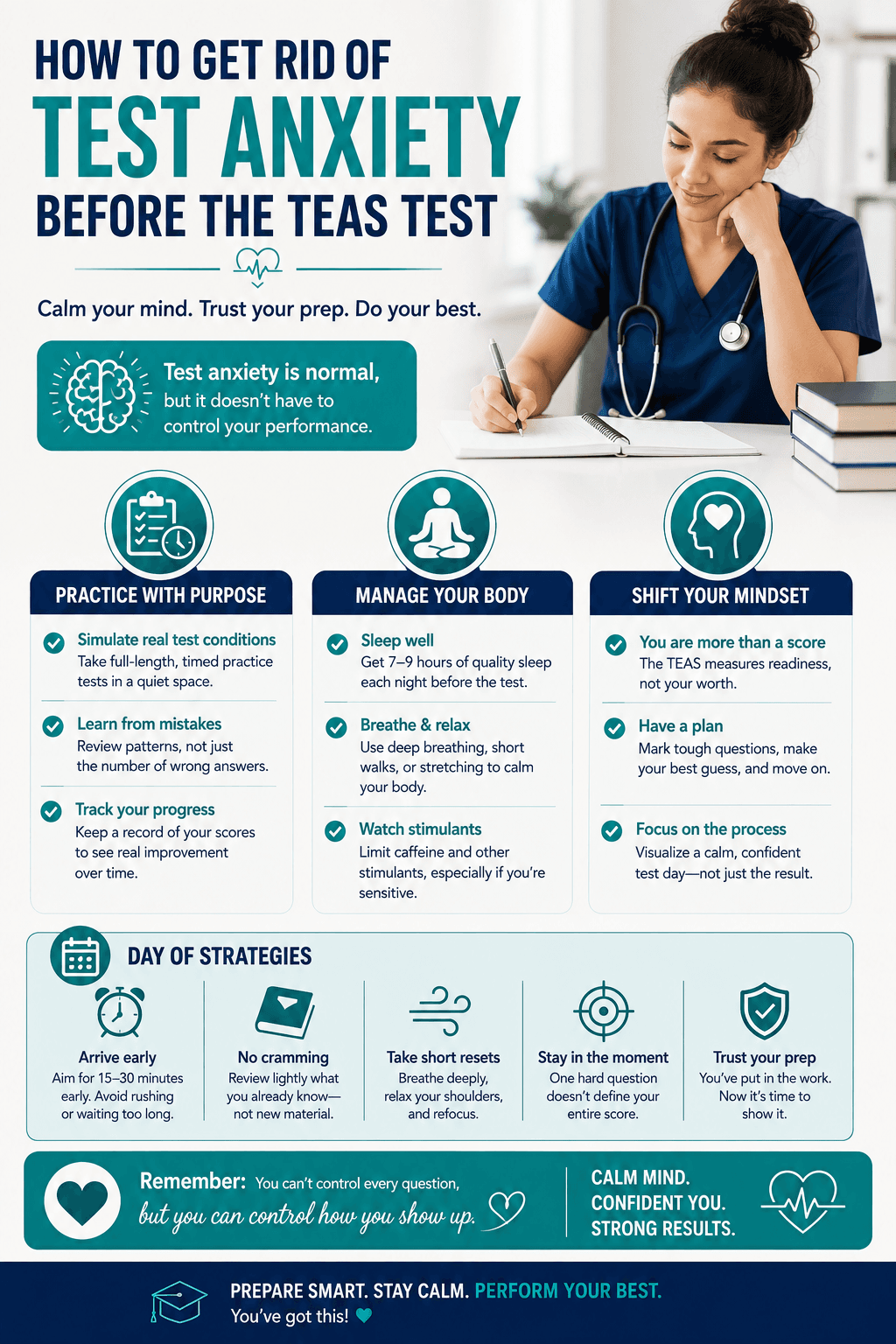
Confidence grows with structured practice, not volume alone
Get into genuine exam mode. Often the anxiety increases if the testing situation is novel. A good strategy is to complete full-length, timed practice tests in a quiet location without notes or interruptions. This educates your brain to link the test structure with familiarity, not uncertainty. Do it several times throughout the weeks leading up to your test, not just once.
Review mistakes without self-attack. Instead of the amount of bad answers, after every practice exam, focus on patterns in what you got wrong. We prevent practice sessions from becoming anxiety-affirming by treating errors as data not as failure.
Make tangible progress. Often, anxiety is caused by not knowing if you’re ready or not. A simple diary of your practice scores over time will provide you with real evidence of development, which can combat catastrophic thinking in the closing days before the exam.
Handling the physical side of anxiety
Get lots of sleep the week before. Lack of sleep makes you more anxious and worse at remembering things. Both of these are especially important for exam success. Rather of trying to squeeze in one decent night of sleep before the test, try to get consistent, adequate sleep in the days leading up to the test.
Calm your thoughts using your body. In the days leading up to the exam, and even in the moments leading up to the exam, you can utilize simple tactics to activate the body’s relaxation response. This could be steady diaphragmatic breathing, short walks, or light stretching.
Reduce your intake of caffeine and other stimulants. A moderate, familiar quantity of caffeine can help with focus, but a substantially greater dose than your body is used to on exam day might amplify physical symptoms of worry, like a racing heart or jitteriness, that can easily be mistaken for panic.
Change your relationship with the exam
Don’t equate score with your self-worth. Understandably, any test that is part of the admissions process for your program will feel like a referendum on your ability. Remember that the TEAS is a test of how ready you are for a certain curriculum, not a test of your intelligence or value as a person. This can help you relieve some pressure on any particular question or subject.
Consider a game plan rather than an all-or-nothing approach. The anxiety grows when test-takers consider the worst-case scenario associated with one difficult question. Instead, walk into the exam with a plan: if a question is hard, mark it, make your best estimate and move on. Pre-planned approach cuts down on decision fatigue in the moment.
It’s about the process, not simply the end. Instead of picturing a passing grade, mentally run through the physical procedures of exam day - getting there, checking in, sitting down, calmly working through the first part. This visualizing approach has been demonstrated to be more successful in reducing anxiety than worry over the outcome.
DAY OF STRATEGIES
Get there early, but not too early. Arriving with a comfortable buffer prevents the anxiety of rushing but too much additional time hanging around can also allow nervous energy to accumulate. Get to the exam facility in the recommended window (usually 15-30 minutes early) and use your time to take a short walk or participate in a calming routine instead of cramming last-minute.
No cramming. In the last hour, reviewing new information almost never enhances your performance and usually creates anxiety by reminding you of what you haven't learned. Instead, examine what you’re already sure about in a light way to promote a sense of preparedness.
Perform short resets during the test. If you feel anxiety rising throughout an exam, taking a few seconds to breathe slowly or to consciously relax your shoulders can break the physical anxiety reaction without sacrificing valuable time.
See setbacks as part of the journey. If a portion proves more difficult than you thought, don’t be tempted to try to work out your score on the run. One difficult portion does not determine your entire result, and concentrating on it in the middle of the exam simply makes it worse.
When Your Test Seems Larger Than Your Anxiety
The preceding tactics will be enough for most test takers to handle the pressure of exam day. However, if anxiety seems chronic, overwhelming, or out of proportion to the situation — stretching well beyond test prep and into daily functioning — it may be worth speaking with a counselor, campus advisor or healthcare provider who can offer additional help.
From Preparation to Performance
Content mastery and anxiety control are not two different jobs. They are interconnected. Even a well-prepared test-taker who walks in overwhelmed by fear might still underperform, but a calm, deliberate mindset can enable even a somewhat less polished knowledge base shine through into a greater score. If you can see worry as something you can manage as part of your preparation, not an inescapable by-product, you offer yourself the best chance to perform at the level your studying has earned you.