Why HESI Was Created With NCLEX Prediction in Mind
The HESI Exit Exam is designed specifically to be similar to the NCLEX in content areas, style of questions, and critical-thinking demands. Now, the NCLEX is designed to assess your ability to apply nursing knowledge in real clinical situations. You are not asked to test isolated facts in scenario-based questions
Because of its overlap, Exit Exam scores tend to be very closely correlated with students’ subsequent NCLEX performance, which is why the NCLEX is such a strong predictor of readiness.
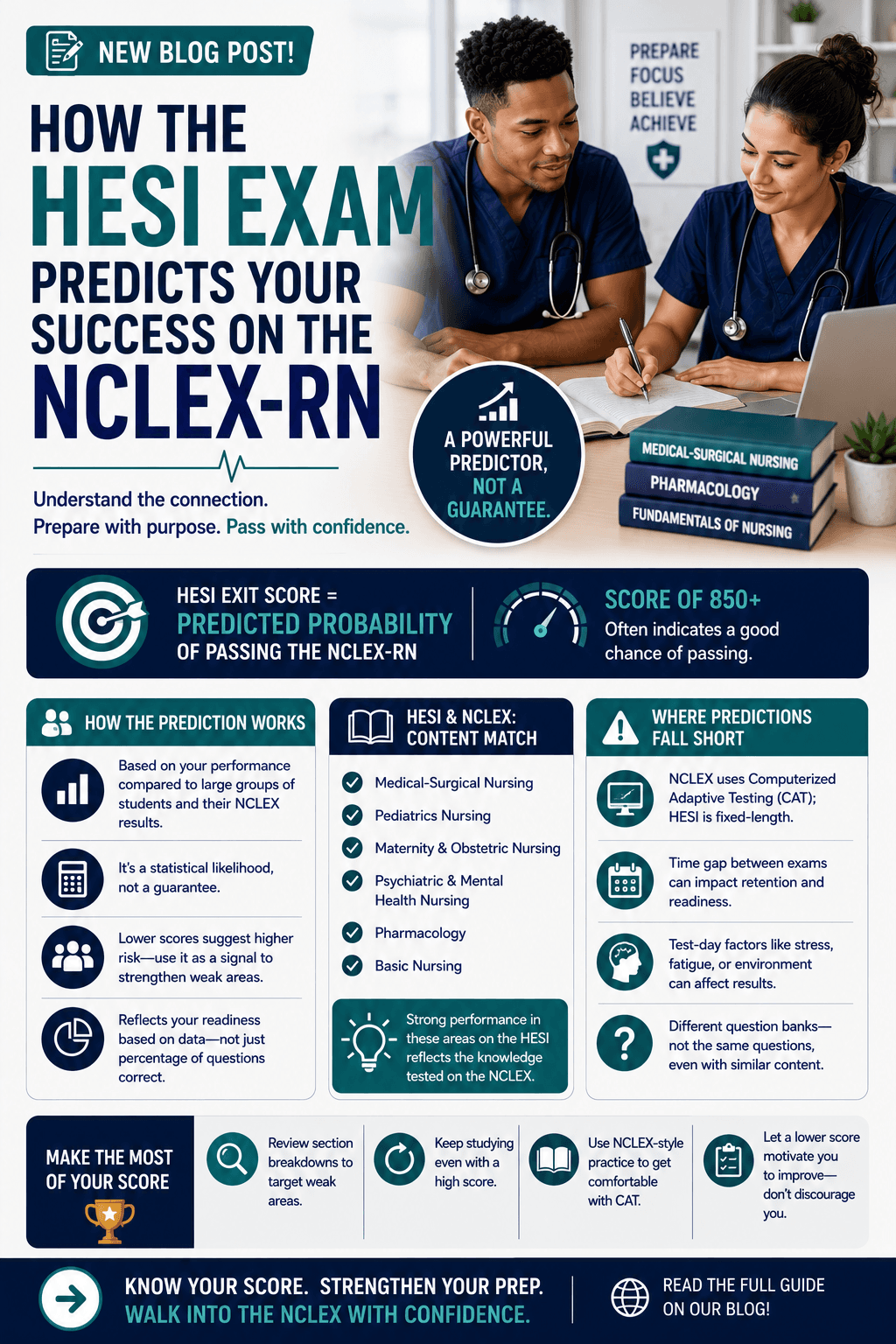
How the prediction score works
- The HESI Exit Exam does not give you a raw percentage, but rather it calculates a predicted probability of passing the NCLEX based on your performance.
- This is an educated prediction based on large data sets of students with similar HESI scores and their performance on the NCLEX historically.
- A common benchmark score of 850 or higher is often considered a good chance to pass the NCLEX on the first try.
- If a score is lower, that does not mean you will fail. However, statistically, a lower score is more likely to mean you will fail. That is why you should do more studying.
- Therefore, your score is not simply a count of how many questions you got right; it’s a data-driven prediction of your readiness compared to a large pool of previous test takers.
HESI/NCLEX Content Match
One of the big reasons HESI can predict how someone will do on the NCLEX is that there is a lot of overlap in the content that is tested.
- Medical-surgical nursing
- Nursing, Pediatric
- Midwifery and obstetric nursing
- Psychiatric and mental health nursing Pharmacology
- Basic nursing
Both exams are based on these core specialties. Performance on these core specialties on the HESI Exit Exam is a true representation of the type of knowledge base that the NCLEX tests.
Where the Prediction Falls Short
- In other words, there is a good correlation between HESI and NCLEX performance, but it is not a perfect 100% guarantee.
- The NCLEX is a Computerized Adaptive Testing format, which adjusts the difficulty of questions dynamically. The HESI Exit Exam is not of fixed length and so does not fully simulate this.
- The time between the two exams means that a student may continue to study or, conversely, may forget the material and change his/her actual readiness after taking the Exit Exam.
- In addition, factors on the day of the test (stress, fatigue) can affect performance on one exam regardless of how well you prepared overall.
Getting the Most Out of Your Predictive Score
Understanding that your HESI score is a statistical prediction rather than a guaranteed outcome can help you to leverage your results more strategically.
- Look at your section-by-section breakdown, not just your overall predicted score, for specific areas that still need reinforcement.
- A high predictive score is positive but not definite. Keep up with regular review rather than assume preparation is finished.
- Use a lower predictive score as a trigger to take action, not as a reason to get discouraged. Use it to guide you to study more in the areas that will be most helpful before you take the NCLEX.
- NCLEX specific practice resources are helpful as they help you get comfortable with the adaptive testing format that the HESI does not replicate.
Closing Thoughts
The predictive ability of the HESI Exit Exam for NCLEX success is predicated upon the intentional overlap of content, style of questions, critical-thinking demands as well as historical data correlating HESI scores to NCLEX outcomes. It is a useful, data-driven prediction, but not an absolute guarantee in either direction. Therefore, the best way to use your HESI results is as a genuine guide for further preparation, allowing you to walk into your NCLEX with a stronger knowledge base and a clearer understanding of precisely where your remaining study time will make the most impactful difference.