Does every HESI A2 version have a critical thinking section?
Not really. Like many other parts of the HESI A2, whether or not there is a critical thinking section and how heavily it weighs into your results will depend on which specific version your nursing program has chosen. Some programs have a critical thinking component as a separate scored section. Some may not have a critical thinking section at all, or may have similar reasoning-based questions as part of other sections such as reading comprehension.
The first and most important thing to do is to check with your own nursing program directly to find out if critical thinking is included in your required exam version. So based on what you read online, you cannot assume that the test you take will include critical thinking.
So what does the critical thinking section really test you on?
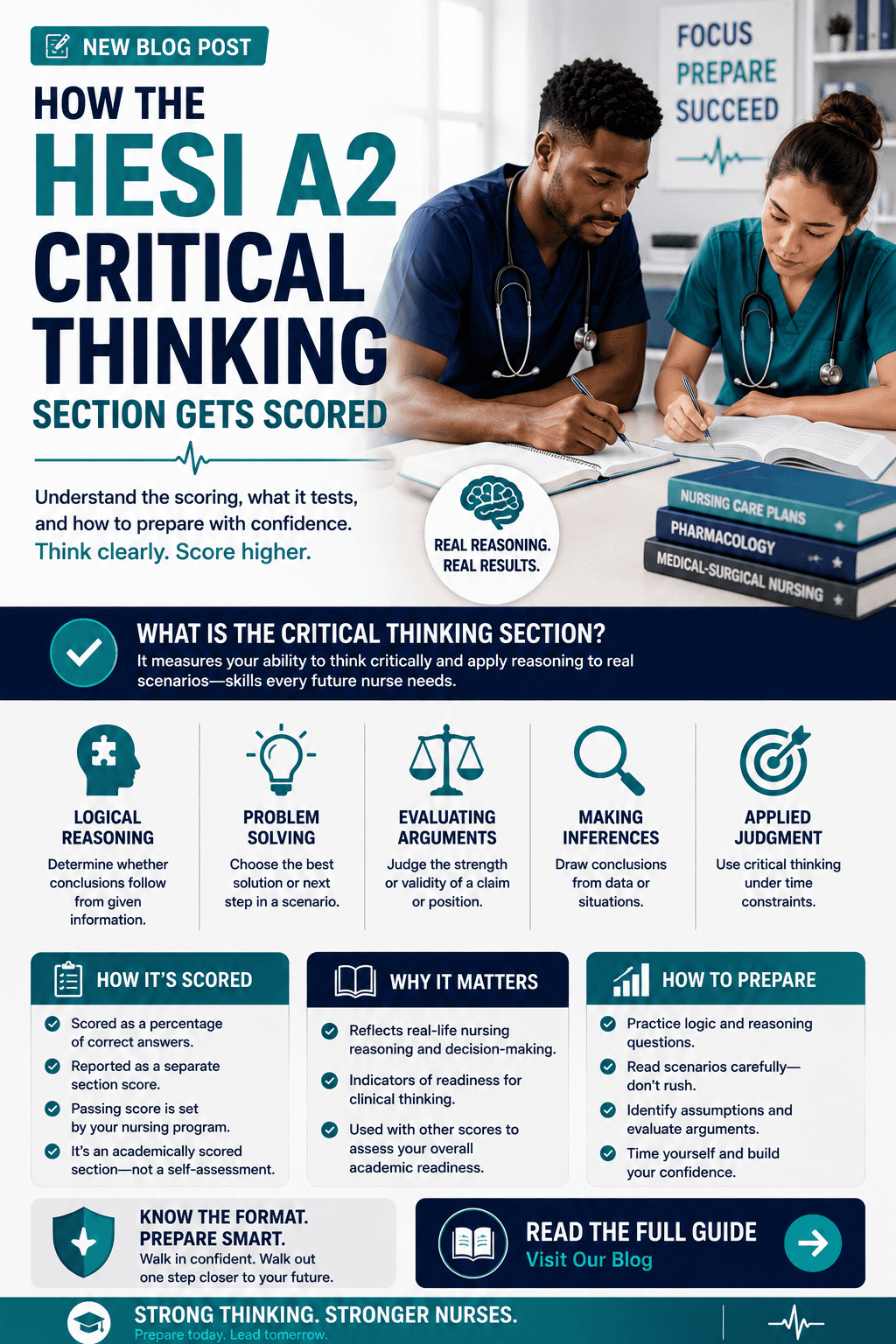
This section, where provided, is primarily designed to measure reasoning skills that go beyond basic factual recall – that is, the type of applied judgment that is relevant to nursing practice, even at the pre-nursing admission level.
- Logical reasoning — the ability to determine if the conclusion is a logical consequence of a set of information.
- Problem solving—coming up with a good next step or solution from a given scenario.
- Evaluation of arguments — judging the strength or validity of a position or claim.
- Making inferences from data or situations — like inference questions, but they are frequently used with more analytical or situation-based material rather than a simple reading passage.
How Do They Usually Grade This Section?
As with other academic parts of the HESI A2, the critical thinking part is usually scored as a percentage, which is the percentage of questions you answered correctly in that section. Instead of being blended into an overall composite number, it is usually reported as its own separate score, separate from other sections like math, reading or science.
Like the other sections of the HESI A2, your nursing program sets the passing score, so there is no one passing score that applies to all schools. The critical thinking section, in contrast, is usually treated as an academically scored subsection, because it is designed to measure a specific reasoning skill, rather than merely to gather self-reported data, like the personality profile or the learning style assessment.
Why This Section is So Important to Some Programs
Programs that incorporate a scored critical thinking component do so because this type of reasoning is highly reflective of skills that nursing students will need to develop throughout their education and future clinical practice—skills such as evaluating patient scenarios, weighing multiple pieces of information, and drawing appropriate conclusions under time constraints. This section can serve as an early indicator of a student’s preparedness for the type of applied clinical reasoning that is tested more extensively later, particularly on the HESI Exit Exam and ultimately the NCLEX. This score can be used in combination with other sections to provide a more complete picture of a student’s overall academic readiness, rather than relying solely on content-based knowledge sections.
How to Get Ready for This Section
- The critical thinking questions test applied reasoning, not memorized facts, so studying with traditional flashcards is not very useful preparation for this section.
- Practice with sample critical thinking or logic based questions, as exposure to this particular question type builds comfort with the reasoning patterns involved.
- With critical thinking questions, read the scenarios carefully and do not jump to conclusions – many errors can be avoided by spending a few extra seconds reading the setup.
- Practice identifying assumptions in an argument or scenario. Spotting unstated assumptions is often key to evaluating logical soundness.
- Practice timing yourself, as critical thinking questions may require more time to read and reason thru than simple fact recall questions.
Misinformation about This Section
- Myth: This section is the same as the personality profile or learning style assessment. Reality: The critical thinking section is typically an academically scored section, meaning there are right and wrong answers, unlike the self-assessment sections.
- Myth: Meaningful preparation for critical thinking questions is not possible. Reality: This section is more about reasoning than rote memorization, but practicing similar question types really does help you get comfortable and improve your scores over time.
- Myth: All of the HESI A2 exams are the same on this section. Reality: Inclusion and weighting may differ from program to program, so it is important to check the structure of your specific exam version directly with your school.
How to Tell If This Section Is on Your Exam
Often the registration information for your specific HESI A2 program will be listed with the other required sections. If this is not obvious in your registration materials, you can always ask your admissions office directly. Check out any HESI A2 study guide your program recommends specifically. Guides provided by your program are often reflective of the exact sections you will encounter.
Summary
If the critical thinking section is a part of the HESI A2, it is usually scored in the same way as other academic sections (i.e. a percentage based on how many questions you answer correctly). Your nursing program determines the minimum passing score. Knowing that this section is meant to test your reasoning skills and not your memorization ability can help you prepare differently. Instead of using traditional flashcards, you should practice working thru similar question types. As always, your best bet for knowing exactly what you will be in store for on test day is to check with your program to confirm your exact exam requirements.