The Problems with One-Size-Fits-All Assumption
A typical misconception is to assume that a “good score” is the same for every nursing program. In practice, a score that easily clears the threshold at one institution may not do so at a more competitive program, or may not carry the same weight as GPA and needed coursework at another. Applicants who do not research the unique methodology of their intended program run the danger of being under-prepared for a difficult admissions process or over-prepared for a program that weighs the TEAS lightly. Getting to the bottom of this begins with understanding the many models schools use.
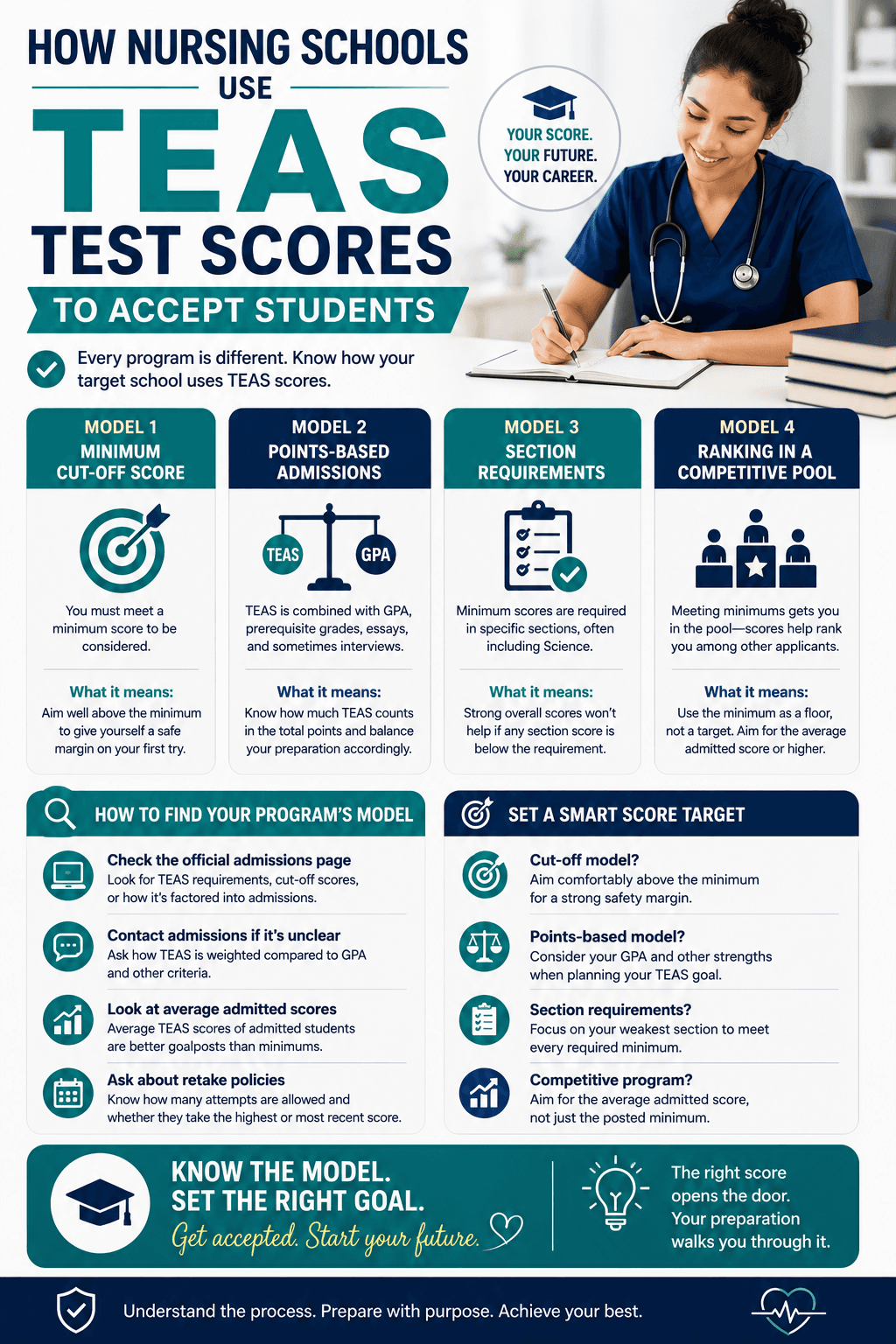
Model 1: Minimum Cut-off Score
How does it function. Many programs have a minimum score on the composite or one of the sections to even look at your application. If you fall below this criterion, even slightly, you are frequently automatically disqualified, no matter how strong the rest of your application is.
Implication to your plan. If your target program is a cutoff model, your goal is not to score as high as possible, but to score high enough to beat the cutoff comfortably. There are often waiting periods for retests, so you want to score well above the minimum on your first attempt, not just scrape by.
Model 2: Points-Based Admissions (Holistic Admissions)
How it Works Other programs have a larger point system that combines TEAS scores with GPA, prerequisite grades, personal statements and sometimes interviews. In this concept, a somewhat lower TEAS score can be made up for by great academic performance elsewhere, and a high TEAS score can help make up for a less competitive GPA.
What this means for your strategy If you are applying to a points-based program you might want to know roughly how much the TEAS carries compared to other considerations. A program that weighs GPA and TEAS equally demands a different preparation method than one where the TEAS is a tiny portion of the overall result.
Model 3: Requirements by Section
How it works. Some programs do not just examine at your composite score, but have minimum scores for each section, especially Science, because it is directly related to the nursing education. A good composite score does not mean you meet the programs’ requirements if you do not meet the requirements in one area. For example, if you get a good overall score, but do not have the required score in the Science portion or Math section.
What this implications for your approach. If your target program has minimums for sections, don’t expect good overall performance to compensate for a weak sector. Practice testing to find your weakest area early and have more study time in that area even if your expected composite score looks competitive.
Model 4: Ranking applicants in a competitive pool
How it works Meeting basic standards in very competitive schools does not ensure admission, it just qualifies you to be rated with other applicants. When this happens, TEAS results may matter less as a pass/fail checkpoint and more as a way to separate otherwise comparable applicants.
What it means for your plan. For competitive programs, use the minimum published as a floor not a target. If available, research the average or desired score range of admitted students, which is often substantially beyond the stated minimum.
How to Tell What Model Your Program Is
- First, check the official admissions page of the program. Most nursing programs will have their own TEAS criteria listed. This may be a cutoff score, a points system, or minimums on specific sections. It's typically more dependable than general forums or hearing it second-hand.
- For unclear policy, please contact admissions directly. If the public data doesn’t tell you how much the TEAS counts in the admission decision compared to GPA or other considerations, a direct question to an admissions counselor might clarify your real target and prevent you from wasting study time on the wrong benchmark.
- Don't simply look at the minimums -- look at average admission scores. Some programs announce the average TEAS score for their latest admitted cohort. For competitive programs this number is frequently much more beneficial for goal-setting than the basic minimal requirement.
- Ask about retake policies pertaining to the admissions cycle. Knowing how many attempts you can take in an application cycle and if a program takes your greatest or most recent score helps guide your retake strategy if your initial attempt doesn’t go as well as you hoped.
Set a realistic score target for a certain program
Once you understand the model of your program, set your target like this:
- If a program has cutoffs, aim well above the minimum to give yourself a safety margin.
- If you are on a points system for your program, consider your TEAS study time in light of your existing GPA and other qualities in your application.
- If your program has minimums for each area, don’t look only at your composite score, but your poorest section score.
- For programs with very strong competition, find out what the average accepted scores are and aim for that number, not the declared minimum.
From Insight to Strategy
The TEAS important. But how much , and in what way is totally dependent on the program you are applying to . Don’t try to prepare for some generic, one-size-fits-all target, but make sure you understand the admissions model for your specific program before you lock down your study plan. A little research up front can dramatically alter how you use your study time, how you interpret a practice score, and finally, how confidently you can walk into the exam knowing just what you need to get.