Core Fact: There is no universal limit on ATI
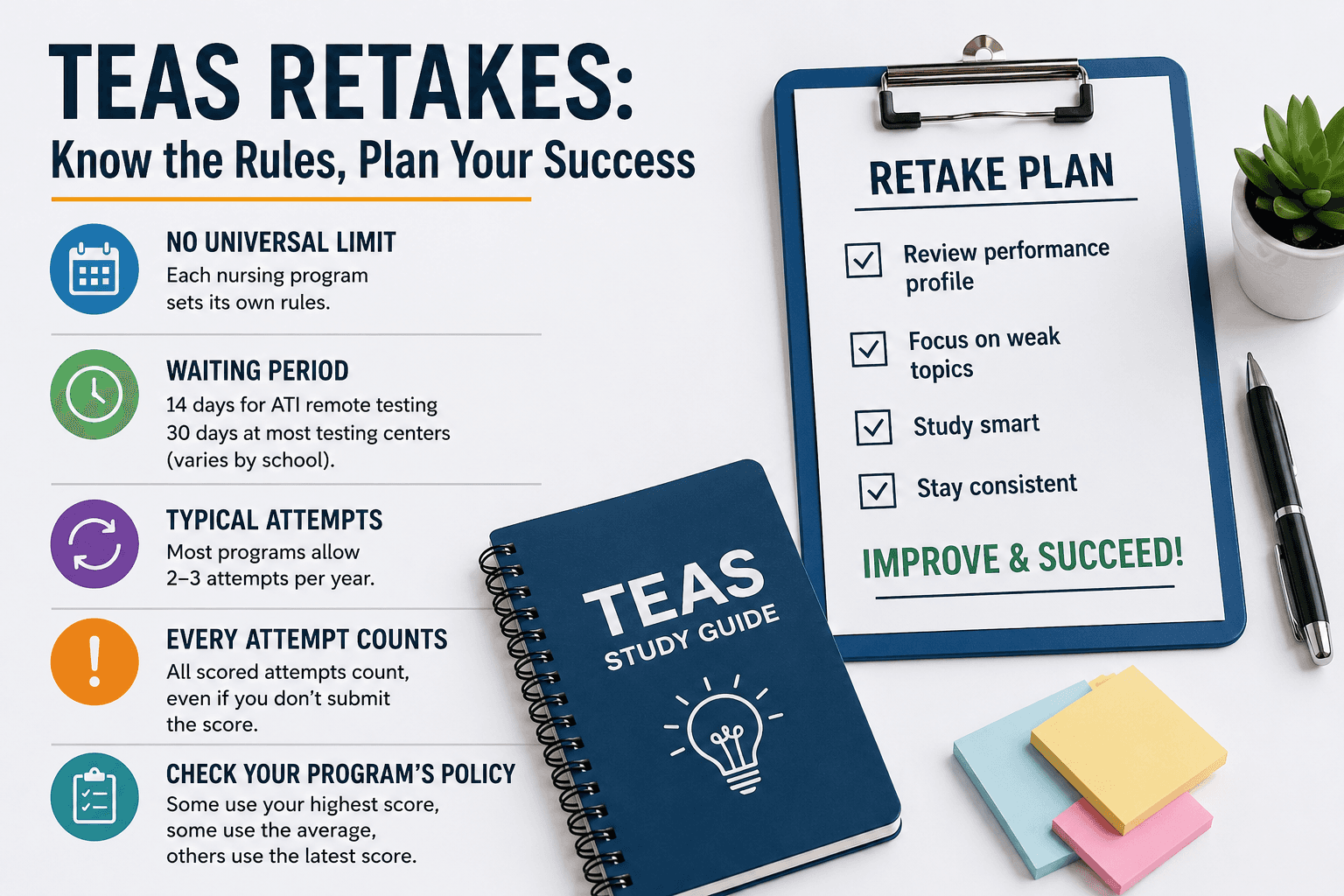
ATI, the agency that oversees the TEAS, doesn't have a single limit on retakes for everyone, everywhere. Rather, individual nursing and health science programs will establish their own guidelines for the number of attempts they will accept and the frequency of testing. That's why you'll see various numbers referenced in different locations; it is not necessarily a general rule of ATI.
The waiting periods for taking the test again
The rules differ, but two waiting times appear frequently:
- TEAS at ATI (remote, proctored directly by ATI): 14-day interval between attempts.
- A wide variety of testing centers – 30 days is the more frequently referenced time, frequently defined by the individual program rather than ATI.
- Take a good tip from the problem solving side: Do not take average data as an indicator for your waiting period. If you are taking the exam through ATI or your school, be sure to check with them as they may have different waiting periods.
How Many Attempts Are Typically Allowed?
The number differs from school to school but examples of this are:
- The most common range of attempts across nursing programs is 2-3 in 12 months.
- Others adjust your total to a lower amount for each application process within the year if it has been set at a higher one.
- If a program's number of attempts is reached in a 12-month period, it might require an entire year from the last attempt before re-taking the test.
Problem solving Tip: Three attempts per year is a general rule, but don't assume this will be the case for your program, unless it is. Always refer to the published admissions policy of the school you want to attend.
A Detail That Surprises Many Test-Takers: Every Scored Attempt Counts
All exams scored, even if you do not submit that exam to your program, count as an official attempt. This is important because some test takers think that only those scores that they intentionally sent towards the total count, but that's not the case. Institutions will see your entire testing history (including not submitted attempts).
Various approaches to dealing with multiple scores in Programs
This is a key factor to consider in determining whether or not a retake is worthwhile and will differ depending on the program:
- Some programs will only take the best score from any attempt.
- Some take the average of several tries.
- Some have been only considering your latest score, not earlier scores.
Problem-solving Tip: You should always check this particular policy with your program prior to scheduling a retake. An average is calculated from your scores, not the highest score — if you aren't sure you'll score much better, retaking it isn't a good idea because you might still come up short of your target.
No Discount for Repeat Attempts
There is no discounted fee for those who retake the tests. You should consider this when deciding on the financial and time commitments of adding more than one additional time, particularly.
Common Problems and Solutions
Problem: If I need to take the TEAS more than once, it is okay? Solution: Please consult the stated policy of your specific program (don't assume a general number). There is no limit to the number of attempts you can make with ATI, however, your program is likely to have a limit.
Problem: “I have taken the TEAS at an ATI testing center and I am not sure about the next time that I would be able to retest.” Solution: Be sure you're using the 14-day ATI-specific waiting period, as opposed to the 30-day period that many schools use.
Problem: "Yes, even if you don't turn in the score. Solution: Yes. Whether or not you submit the score to a program, an attempt that scores is included in your total and will be included on your official transcript.
The question: "Will repeating the process improve my chances of getting in? Solution: Ask your program if they'll take the best score, average or last effort. The one thing that will make the difference between a retake being a risk free chance to make better and a strategy that will need a greater level of certainty before entering.
Often, people have already been tested three times this year and require further testing. Solution: If you reached the number of attempts you are allowed for each period, then you might have to wait until the next period of time that you are allowed to use the program — usually a full year after your last use, depending on the program. Test again immediately if you are not certain.
I want to retest in order to be able to get a better score on a test that I have passed. Solution: If your program has a specific policy on this scenario, it may require a longer waiting period (possibly citing a multi-year gap) for candidates retesting only to increase an already passing score but not to obtain a minimum score for the first time.
Effective strategies for approaching a retake
- Double check waiting period: 14 days for ATI-testing, typically 30 days for school-administered testing.
- Review the number of times you can try your program in the application cycle and over the entire 12-month period.
- Before deciding whether to retake a score, learn how to interpret multiple scores (highest score, average score, or most recent score).
- Budget for the full fee once again, as there's no repeat-tester discount.
- Make use of the wait time, studying specifically the sub-topics that you lost points for on your last attempt.
Final Thoughts
The number of times you can take the TEAS varies on the policies of your particular program, which are piled on top of a general waiting period between tries. There isn't a single, uniform answer. The most dependable course of action is always the same: instead of depending on a generic figure you saw elsewhere, find out your program's precise guidelines regarding try limitations, waiting times, and how multiple scores are assessed. A retake is no longer a guessing game but rather a simple, strategic choice if you are aware of the actual regulations that apply to you.