Total TEAS Exam Time
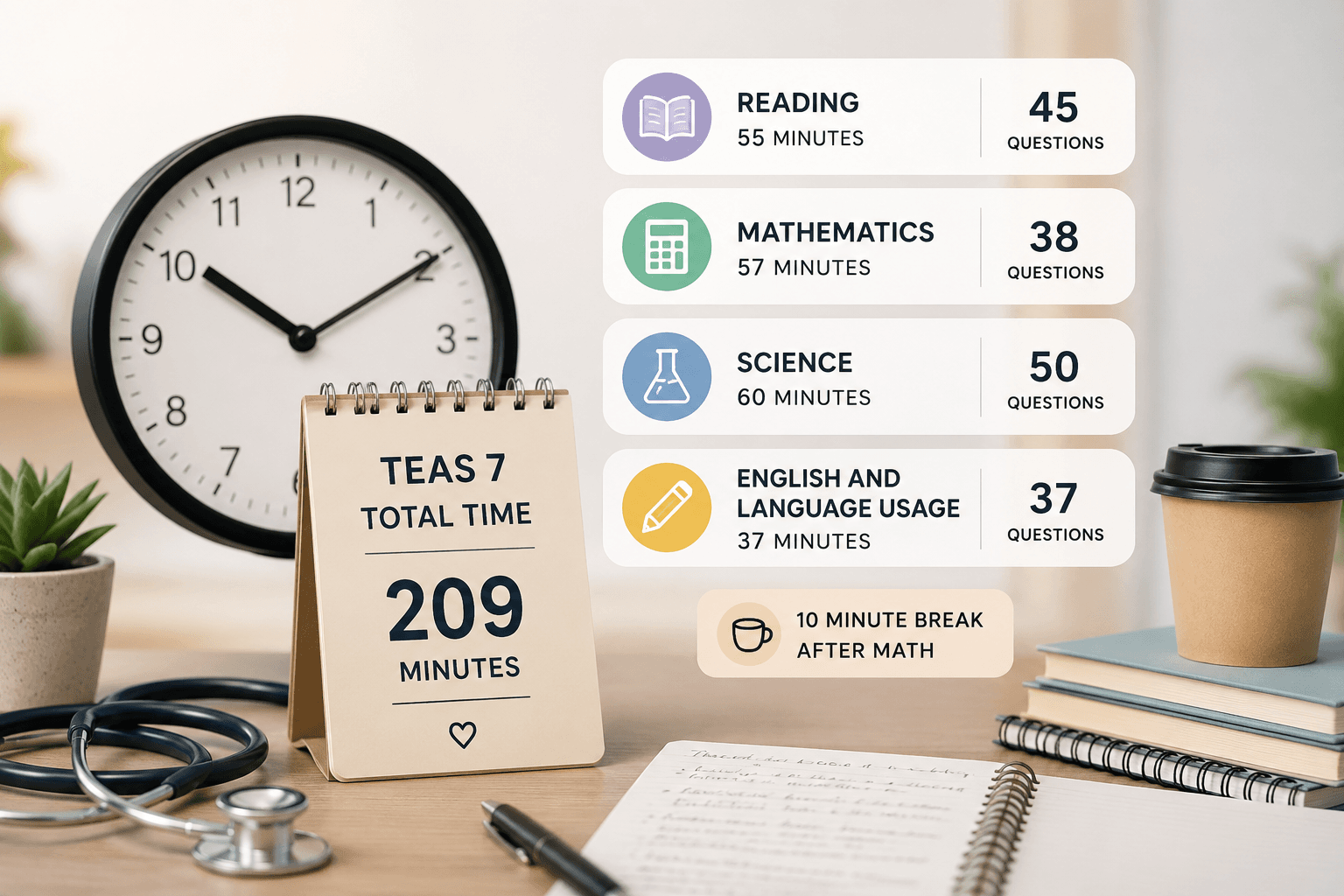
The TEAS 7 has a total testing time of 209 minutes — 3 hours and 29 minutes. This is the time when they are active testing, and does not include check-in, instructions, or built-in break between testing sections. This is the minimum you should do, not the maximum. The actual appointment (check-in to walking out the door) is generally about 4 hours, including check-in and identity verification and pre-exam instructions.
After the Mathematics section (whether administered in person or remotely) there is a 10-minute break, during which your clock does not run, so there is no loss of working time during the break. The real test isn't the average reading speed of the test, it is the range of reading speed; some questions are based on short passages, while others are based on comparison between two longer passages or interpretation of a chart. When a longer section of passage comes later in the book, having distributed your budget evenly over all 45 can end up leaving you low. Multi-step calculations: Mathematics (57 min, 38 questions): The most generous number of minutes per question on the exam. Nevertheless, students who are not at ease with manually converting fractions to decimals will not find the on-screen calculator as tight as desired, as it is only a basic four function. Science (60 min, 50 questions): This section has the most questions and is the longest but doesn't go through questions as fast as Reading. It feels more pressured because content density – anatomy and physiology, biology, chemistry, and scientific reasoning are separate recall, not one connected. English and Language Usage (37 min, 37 questions): The shortest time on the exam with approximately 1 minute per question. The majority of items are brief direct grammar or vocabulary questions which do not involve multi-step reasoning, but only if you don't over-think the individual items which is the most common pitfall here.
The time needed for your appointment or exam
The 209 minutes is the total active testing time only. Factor in:
- Arrival and check-in: Be prepared and arrive 15-30 minutes early. Check-in is ID verification, checking registration and security checks (such as locking items in a locker), which can take as long as 30 minutes during rush hours.
- Remote exams: Log in 15-30 minutes prior to check in with staff and the examiner; this may include checking in the testing environment or having it scanned.
- Pre-exam instructions: A brief period of time for reading rules before timed sections start.
- 10-minute break: This is only after Math and not between any sections.
All told, you'll need about 4 hours, although you're spending 3 hours 29 minutes answering questions.
Common Problems and Their Solutions
- My schedule for the day was too filled with 209 minutes. Schedule an entire 4-hour period with a bit of leeway at the end in case of check-in or delays (which can occur during busy deadline time periods).
- I am constantly having to keep up the pace in one section but not in another. Tape measures the timing of each part of the track, rather than the whole track, to determine the specific slowdown.
- “Will I be able to double check answers before a section closes?” No — the pacing doesn't leave time to review in every section and it is not really feasible in English. Develop the habit of making confident and grounded decisions along the way.
- Is there a difference in timing with remote testing? The testing time is the same for both, 209 minutes. The difference is the pre-exam process: budget time for equipment/environment check prior to the clock.
- Will using the calculator on the computer be a hindrance to Math? Work on converting fractions to decimals and algebraic work in advance of the test to become familiar with the basic four function calculator.
- How can I make use of the break effectively? Take it as a real reset and get up, get water, take a few breaths. Ten minutes is not sufficient for adequate review and the clock stops anyway.
Is Extra Time with Accommodations available?
The ADA may provide extended time as an accommodation for students who have documented disabilities. These usually need to be applied for and confirmed prior to your appointment and will often require evidence to be provided 30 days or further in advance. Make your testing center or program early (it's much more difficult to make up last minute appointments).
This is compared to other entrance exams
Overall testing time is in a fairly comparable testing window (multi-hour) across different standardized tests such as the HESI A2. You are encouraged to review the format carefully before choosing which to prepare as they are not all interchangeable.
Create a Time Based Study Plan
- Use full length and timed practice tests that use real section limits, not shortened versions.
- Time yourself by section and not just the whole activity to find out your actual bottleneck.
- Work on that specific skill that you find you are slower at — scanning rather than re-reading for Reading, manual conversions for Math.
- Make the appointment appear as it will be on the day, including a mock check-in and the entire 209-minute appointment block and break, to make the day feel familiar.
- Organize trips and/or schedule with a 4-hour time commitment, not just the 209 minutes.
Final Thoughts
The TEAS exam's overall testing duration, which is 209 minutes spread over four sections, is predetermined and well-documented; the difficult part of preparation is getting that into practice on test day. The entire visit should take about four hours, including check-in, instructions, and the built-in break. The greatest preparation is to practice under these precise conditions, section by section, until pacing becomes second nature rather than a countdown you're battling against. This is better than remembering these figures. under these exact conditions, section by section, until pacing feels like second nature rather than a countdown you're fighting against.