The General Guideline: Two Years
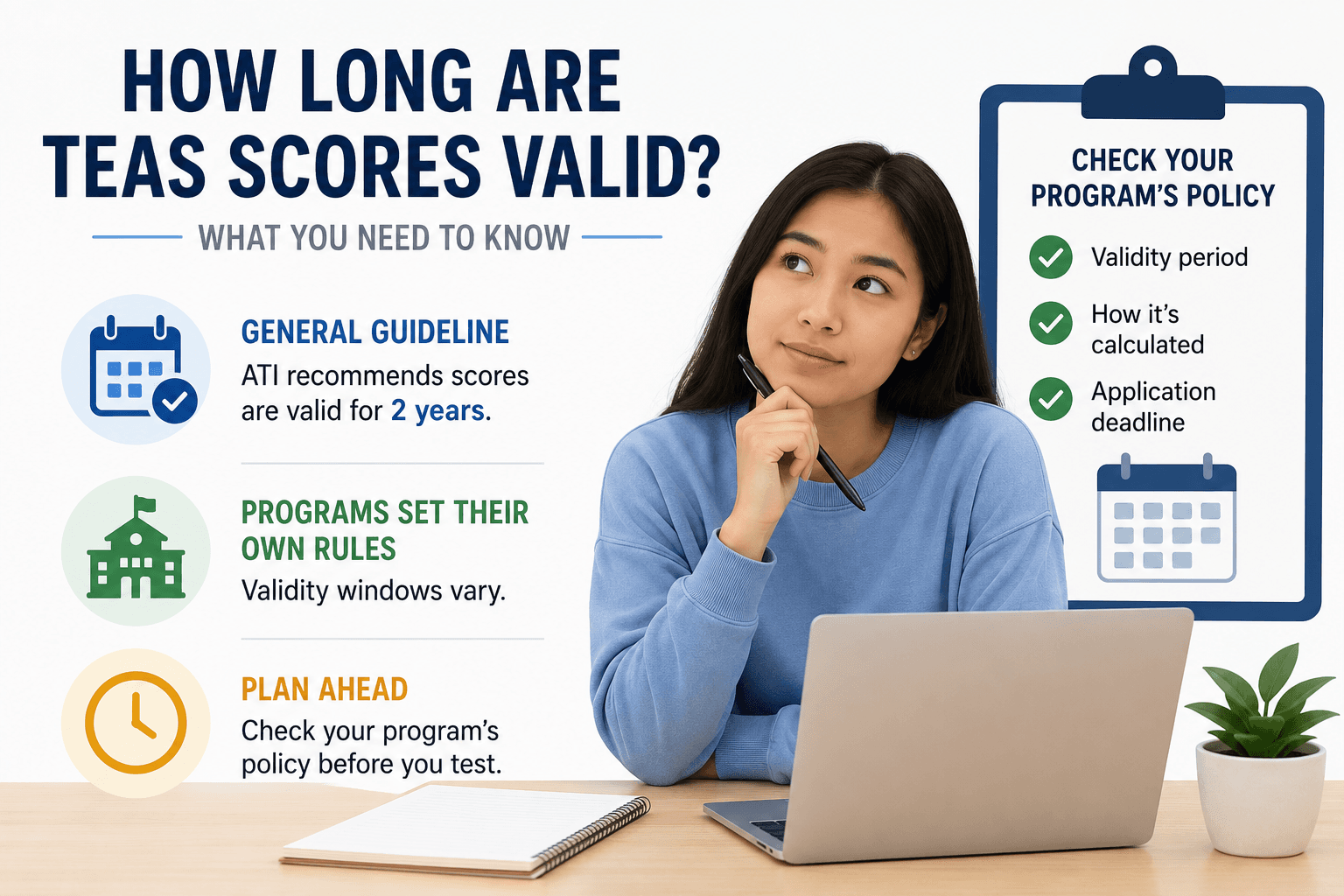
ATI recommends that a TEAS score be valid for 2 years from the date of the test. This is the number you will hear most frequently used as a reference point. But, and this is the crucial point, ATI's general advice is not considered the law. Each nursing and health science program has different validity windows, which can vary significantly from the two-year baseline.
Why Validity Windows Vary So Much by Program
Each nursing program's admissions committee determines the “recency” of a score to demonstrate a candidate's present academic preparation. That's not a coincidence, but rather a justification that academic proficiency in math, science, reading and English changes over time, and that programs need to be assured your score remains a true reflection of your skills at the time you would be expected to be taking the program. This translates to a variety of real-world policies in practice:
- A few programs use a 2-year window, which is in line with ATI's guidance.
- Others have a 1-year period that your score must be within 12 months of your application date.
- Some programs may require two years of scores before the academic year they are being used for (a slightly different calculation than two years from the date of your application).
- Fewer programs have extended their validity even further, allowing for up to three years of scores, especially where face-to-face testing requirements were put in place relatively recently along with revised validity policies at the school.
This implies that the same TEAS score that is accepted for a program's application cycle may be perfectly fine for one application window but be disqualified for another because it is now outdated.
Real Examples of How Different This Can Look
Let's make this clear: some programs expect that your score be in a very narrow range, right from your application date, for 12 months. Others determine the validity based on the beginning of the school year instead of the date of the application, which means that your effective date may be earlier (or later) than what you would calculate if you simply assumed a "two years from test date. Others use the "two years from the start of the school year", which means that if you used a simple "two years from test date" assumption, your effective date would be earlier or later than it really is. Some schools also want to know if you have taken more than one test, that both tests must be within the same application window for your test to count. That's why being guided by a general rule of thumb is a real risk, as opposed to the stated policy of your program.
Common Problems When Applying
"I tested more than a year ago, I thought I could have plenty of time until my score ran out. The solution: A 2-year guideline is not enough. Be sure to verify the validity period of your specific program right away; some programs have a 12-month window, which may mean your score has expired or is rapidly coming up on expiration.
If you are applying to several programs and they seem to be using different methods to count your validity, then the problem is: "I'm applying to multiple programs and they seem to be counting my validity differently. Solution: Develop a basic tracking document that specifies the validity periods for each program and the method used to determine the periods (from test date, application deadline, or relative to start of academic year). Assume that the shortest window of any of the programs you are targeting is your actual deadline for achieving that score.
"I don't know if my score is still valid for the semester I'm applying to." Solution: Number of programs calculate validity two years from test date, not necessarily the beginning of the academic year you are entering. Check directly with admissions which method they use to calculate, because you can find yourself up to months off by a different program using a different method of calculation.
“The test was taken some time ago and I am concerned about the test score not lasting until I get the rest of my application materials.” Solution: If your validity window is approaching your realistic application timeline, it might be better to test proactively, instead of waiting and hoping to get an application that has expired because the date of the first test is near the expiration date and you have enough time to retest and wait for the next test.
"No, you'll still get a good score if you wait a year to apply. Solution: Be sure to agree to this clearly, or don't delay. Genuine acrobatics today won't matter if it's outside your program's window when you submit, so check the specific expiration instead of the date of today's class — it's more about your actual realistic application date.
How to avoid being taken aback by an expiration surprise
- Look for the stated validity policy for your individual program; do not assume it is simply the 2-year rule.
- Make sure to record precisely the method used to determine validity: from test date, from application date, from academic year start date.
- If applying to multiple programs, monitor each program's window and apply to the earliest one that you have and treat this as the final deadline.
- If you need to delay your test or retake, plan your original test date accordingly, rather than just your last minute deadline.
- If you are unsure, contact admissions directly and ask specifically: “As of [when you plan to submit this application is the TEAS score from [test date] still valid?”
Conclusion
Not every program will have a fixed, universal TEAS score for validity; because there are no universal standards, the common guideline of 2 years is a good starting point, but not a promise. Always remember that the safest way to do it is to check the exact validity period and calculation method for your program; the general rule may not apply to your specific program. These few minutes of confirmation now can spare you from realizing too late that a perfect score just came out of the window and out of your reach.