Building Blocks: Raw Scores by Section
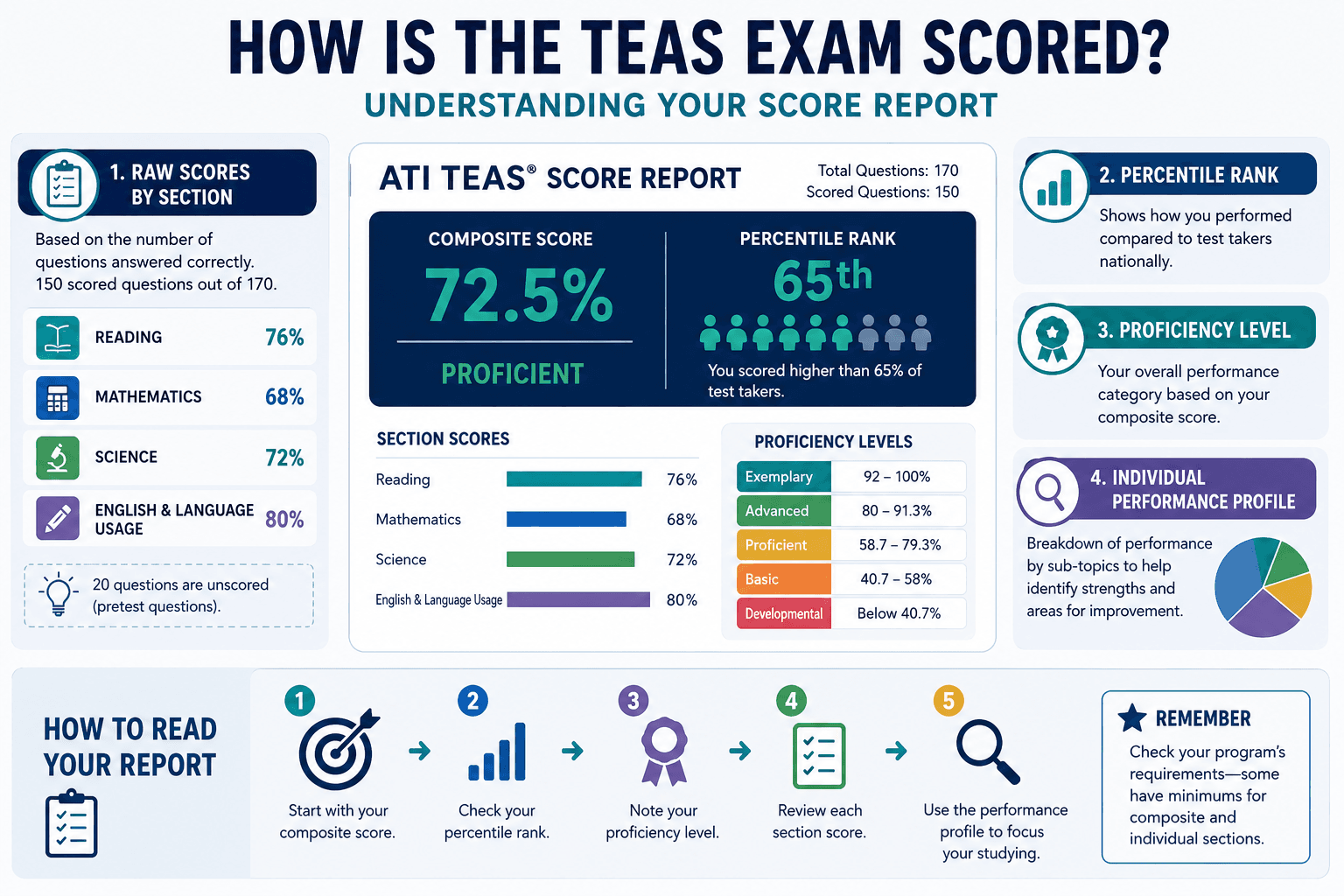
The Reading, Mathematics, Science, and English and Language Usage scores you receive for your TEAS are based on a raw score that is a percentage of all the questions in that section that you answered correctly.
A surprising tidbit for many test takers: Not all questions are equal. Out of 170 questions, only 150 are scored and the remaining 20 questions are unscored "pretest" questions ATI uses to assess future content. You will not be able to determine which questions will be which, so all questions will be considered to be worth the same.
Composite Score: Your Overall Number
Your composite score is an average of the four sections, with weighted scores. It's the one number that is most likely to be cited when you are asked about admissions requirements by nursing programs, and also the one number that is most likely to be a minimum requirement. Importantly, ATI employs the technique of score equating, that is, a statistical process that allows for slight difficulty differences between various exam forms. In practice, this means that if a student achieves 70% on one test date, this is the same as having achieved 70% on another test date, so there is no need to worry that a student will have a “easier version” which would affect their comparability with other applicants.
Percentile Rank: How You Compare Nationally
Your report also contains a percentile rank, which indicates how well you performed compared to other students taking the test nationally. One thing a percentile rank can tell you that a raw score cannot is whether a 65% composite is above average, below average, or average in comparison with all those who took the exam. This context is used in conjunction with your raw score, especially when applying to competitive, limited-enrollment programs.
Proficiency Levels: The Category Labels
ATI also gives your overall score a proficiency level rating in the following ranges:
- Exemplary: 92–100%
- Advanced: 80–91.3%
- Proficient: 58.7–79.3%
- Basic: 40.7–58%
- Developmental: Below 40.7%
These labels provide you with a general overview of where you stand, but they are general categories: between 70 and 80 percent is Proficient, and there could be a wide variety of competitive positions within that range. Even though the label provides the information, always verify the exact composite with your program's required composite.
Individual Performance Profile: Your Diagnostic Tool
In addition to your composite, percentile and section scores, your score report also contains an Individual Performance Profile — a breakdown of your performance on specific sub-topics within each section (e.g., in the Science section, it may have a breakdown of your performance on anatomy & physiology, biology, chemistry and scientific reasoning).
If you will be retaking the exam, this is the section you will want for the greatest benefit since it will let you know exactly where you were scoring points instead of leaving you in the dark.
Typical Score Report Issues Faced by Test Takers
- "I don't see how my composite score could be different from the simple average of my 4 section scores. Solution: This is a weighted average – it is not a simple average – so sections are not necessarily going to contribute the same. Pay attention to your composite score as the most important number for admissions, and analyze your section scores to see where your composite score is coming from.
- I'm not sure if that would be competitive since my composite meets my program's minimum. Solution: Use your percentile rank for additional context. Your application will be considered if it meets the minimum; your percentile will give you an idea of how well your application stacks up against other applications a program might be considering.
- If you're taking the exam again, you might have the problem of not knowing which sections to concentrate on. Solution: Skip the Individual Performance Profile and proceed directly to your individual level. It highlights specific sub-topics that you missed marks for them, giving you the ability to study just those topics for your retake as opposed to studying the whole topic.
- I'm not certain whether a program is considering my composite or individual section scores. Solution: Check with your program directly. Some (especially Science) have minimum section requirements in addition to the composite, and many consider these minimum requirements to be the only ones that matter.
- If you received a lower grade than expected, and you are not sure if this is your level of ability, then this is a problem. Solution: Keep in mind that there are 20 questions that you don't score on your pretest that can sometimes seem more difficult or different, but aren't actually affecting your score. The one shot is one attempt; a lot of successful nursing students didn't make it on the first go round and when they retake, they study with a plan in mind.
How to Read Your Report Step by Step
- The first of the questions you should look at is your composite score.
- Determine your percentile rank to see how competitive that score is in relation to other students.
- Record your proficiency level label, but also, see what percentage you are at within that proficiency level.
- Check each 4 section scores independently, particularly if there are specific minimum requirements for sections.
- Dig into your Individual Performance Profile for sub-topic detail, particularly if you're considering a retake.
Final Thoughts
Your TEAS score report provides much more information than just the pass/fail score — a composite score, percentile rank, etc., proficiency category, section score breakdowns and detailed sub-topic score breakdowns. Knowing all of this, not just the composite, will help you determine where you're going right and wrong and what you need to improve on if you're thinking about a retake.