Important Update: PAX is being phased out
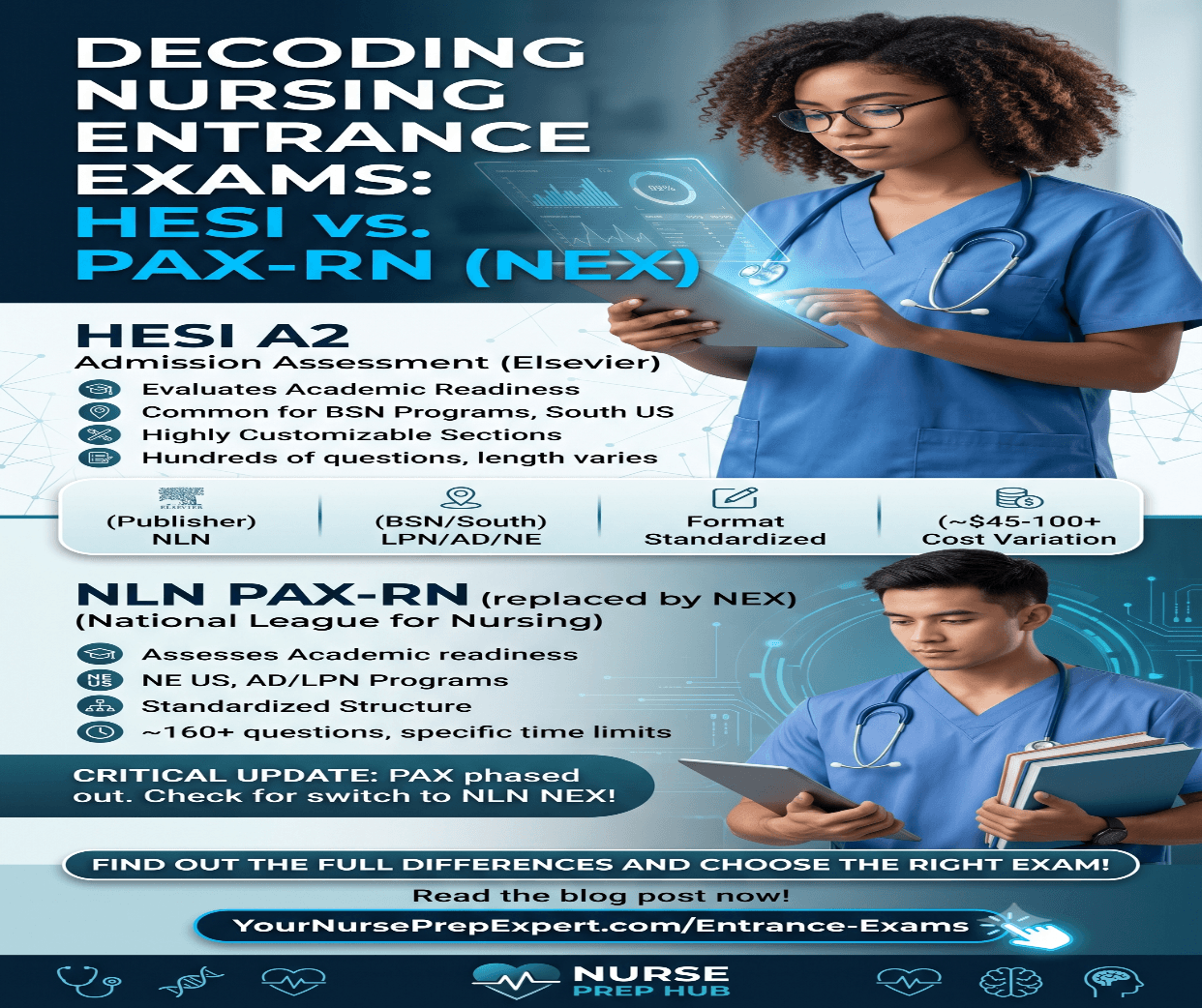
Before comparing the details, let us mention a big change that just happened. The National League for Nursing has been replacing the NLN PAX-RN with a newer test called the NEX (Nursing Entrance Exam), which is now the National League for Nursing's current test. If your target school still mentions the PAX-RN in its materials, it is worth checking directly to see if they have made the switch to the NEX, as the older program materials may not have been updated to reflect the change.
That said, many students would still find themselves coming across references to the PAX-RN. The NEX is similar in general structure and purpose, so this comparison includes both, with notes on where the newer NEX differs.
The HESI A2 is a nursing school entrance exam that evaluates your readiness for the program.
The HESI A2 is an admission exam developed by Health Education Systems, Inc. University based BSN programs, with a notable concentration in southern states, heavily use it. The HESI is customizable. Applicants to nursing programs will only be required to take the sections that apply to them. This may include math, reading comprehension, vocabulary, grammar, anatomy and physiology, biology, chemistry and sometimes physics. Optional personality and learning style assessments are also available and are not scored. A complete HESI A2 battery may contain hundreds of questions and last several hours, but most programs only require a few of these sections rather than the entire exam.
What was the PAX-RN (now NEX)?
The PAX-RN was formerly published by the National League for Nursing and was created for students studying to obtain an LPN, associate degree, or bachelor’s degree in nursing. Traditionally, it consisted of about 160 multiple-choice questions in three subject areas – reading comprehension and word knowledge, math and science – to be answered in about two hours. It is replaced by the NEX, which has a similar three-part format with around 163 questions in Verbal, Mathematics and Science. Each section of the NEX is timed separately and takes around 60 minutes.
Structural Differences
- Number of sections – The HESI A2 has eight or nine possible sections depending on what your program needs, while the PAX-RN/NEX has a more consistent three-part structure that is used across almost every program that uses it.
- Customization — individual nursing programs can customize the HESI A2, so your particular exam experience is very dependent on your school’s requirements. The PAX-RN/NEX has a more standardized format regardless of what school you are applying to.
- Content breadth — The HESI A2 goes into more granular subject-specific content, including dedicated sections for anatomy and physiology, biology, and chemistry. The PAX/NEX condenses science content into one combined section.
- The National League publishes publisher— Health Education Systems, Inc. (a division of Elsevier), the PAX-RN, and its successor, the NEX, publish The HESI A2 for Nursing.
What Tests Are Schools Usually Looking for?
Historically, the PAX-RN has been most used by nursing programs in the Northeastern United States, but its use has declined over time as more schools are switching to the TEAS or HESI A2. The HESI A2 is still geared more towards university-based BSN programs and is more common in southern states. Exam requirements are completely decided by the school. The only way to know for sure what exam applies to you is to check with each school you are applying to.
Cost Variation
The cost of both exams depends on the testing center or program that administers the exam, but the HESI A2 is generally estimated to cost between $35 and $75, while the cost of PAX-RN exams has historically been higher, often ranging from $45 to $100. Costs can vary a lot depending on the school and the type of testing, so the best way to get details is to contact your program directly.
What is more difficult?
As if most comparisons of entrance exams there can be no single answer – difficulty depends a lot on the strengths and weaknesses of individual students. Some students find the HESI A2 more difficult just because it is longer and has more sections you can possibly take. Others find the PAX-RN more difficult because it has more emphasis on general reading and science reasoning in a shorter amount of time. One or the other is never necessarily more difficult.
How to Choose Which to Prepare For
- NEX, HESI A2, and PAX-RN, and other exams like the TEAS or Kaplan are not interchangeable as far as study materials go, so be sure to get the exact requirement from your target school.
- Be sure to double check if your school has changed from the PAX-RN to the NEX, as older admissions materials may not reflect this recent change.
- Use exam-specific prep materials since each exam has enough different structure and content emphasis that generic “nursing entrance exam” study guides may not prepare you adequately for the specific test you are taking.
- In addition, if you are applying to multiple schools that require different exams, plan for extra time to prep for multiple exam types.
Conclusion
The HESI A2 and the PAX-RN (now largely replaced by the NEX) serve the same general purpose, but are meaningfully different in terms of structure, breadth of content, and the organizations publishing them. Since each nursing program has its own exam requirements and the PAX-RN is being phased out for the newer NEX, the most important first step is to confirm the exact, current requirement of your target school. From there, exam-specific preparation will serve you best in meeting your program’s admission requirements rather than generic entrance exam study habits.