Why Reading Comprehension Is More Important Than You Realize
You will be reading and interpreting information correctly on every section of the HESI exam. This will be a math word problem, a science-based scenario, or a simple reading passage. Poor reading comprehension will not just cost you points on the reading section alone — it can quietly sabotage your performance everywhere else on the exam.
This makes reading comprehension one of the highest advantage areas to strengthen, since improvement in reading comprehension tends to pay dividends in multiple sections at once.
Typical Questions Asked in HESI Reading Section
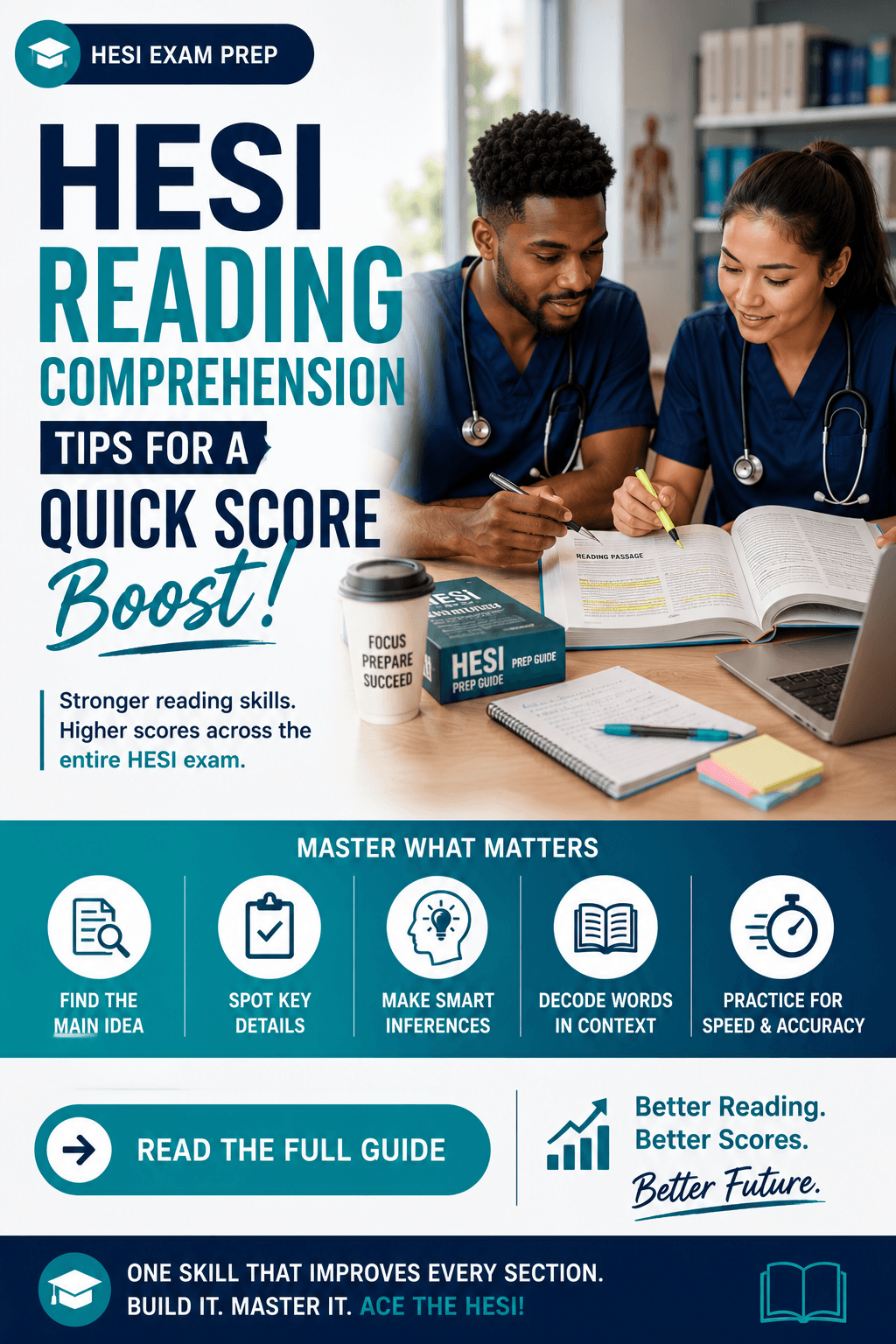
The HESI reading comprehension section generally has a few repeating types of questions:
- Main idea questions - locating the central idea of a passage.
- Detail questions — finding facts or information given directly in the text.
- Inference questions: What a passage implies but does not directly state.
- Vocabulary-in-context questions: determine the meaning of a word according to how it is used in the passage.
- Author’s purpose questions—figuring out why the passage was written or what tone it conveys.
How to Improve Your Reading Comprehension Score – Tips
- Read the questions before you read the passage. Knowing what you are looking for helps you read with purpose, not absorbing every detail equally.
- Get the main idea early. Most passages have a clear main point, generally in the first or last few sentences — learn to spot it quickly.
- Do not worry if you come across words you do not know. Instead of wasting, time or getting stuck on one term, use context clues to make a reasonable guess.
- Read actively. You are trained to mentally summarize each paragraph as you go instead of passively skimming through the entire passage at once.
- Be on the lookout for absolute language. Passages that use words like “always,” “never,” or “all” are often wrong because it is unlikely that a passage would make such a blanket statement.
- Start with the painfully wrong answers and weed them out. Your accuracy will improve, especially on inference questions, if you cut down on your options before you choose your final answer.
- Practice with time pressures. Timed practice builds comfort with realistic pacing because reading comprehension requires both speed and accuracy.
How to Practice Good
- It is not just reading more, but reading strategically and reviewing your mistakes carefully that will improve your reading comprehension.
- Use practice passages that are similar in style to the HESI exam, not casual reading materials. Test passages tend to follow a specific structure and tone.
- Review wrong answers thoroughly, determine if the mistake was from misreading, misunderstanding, or rushing.
- Look for patterns in your mistakes (e.g., you always struggle with inference questions), and focus on that skill in future practice.
- Establish a regular practice schedule. Comprehension is built over time and with repetition, not in a one-time cram session.
Common Mistakes to Watch Out For
- Reading passages several times instead of reading actively and efficiently the first time.
- Second-guessing an answer that was correct on first read, overanalyzing simple questions.
- Misses important qualifiers that change the correct answer and ignores the specific language of questions.
- Not going to timed practice, which means you, will not be used to the pacing you need on exam day.
Conclusion
If you want one of the best returns for your study time on the HESI, work on improving your reading comprehension skills because it will help you do better on just about every other area of the exam. You can improve this score quickly by practicing strategic reading techniques, reviewing your mistakes carefully, and becoming comfortable with timed conditions versus content-heavy sections that require an enormous amount of memorization. A little focused practice here goes a long way—not only for the HESI exam, but also for the reading-intensive coursework you will encounter throughout nursing school.