Why is Leadership Material on a Nursing Test?
Nursing work involves much more than the care of patients. Nurses routinely delegate tasks, prioritize care for multiple patients and communicate within interdisciplinary teams, all requiring specific professional judgment and leadership skills. Those responsibilities are part of the daily practice of nursing. The HESI exam will test those responsibilities as a content area, not expecting them to be picked up incidentally.
Commonly Covered Key Content Areas
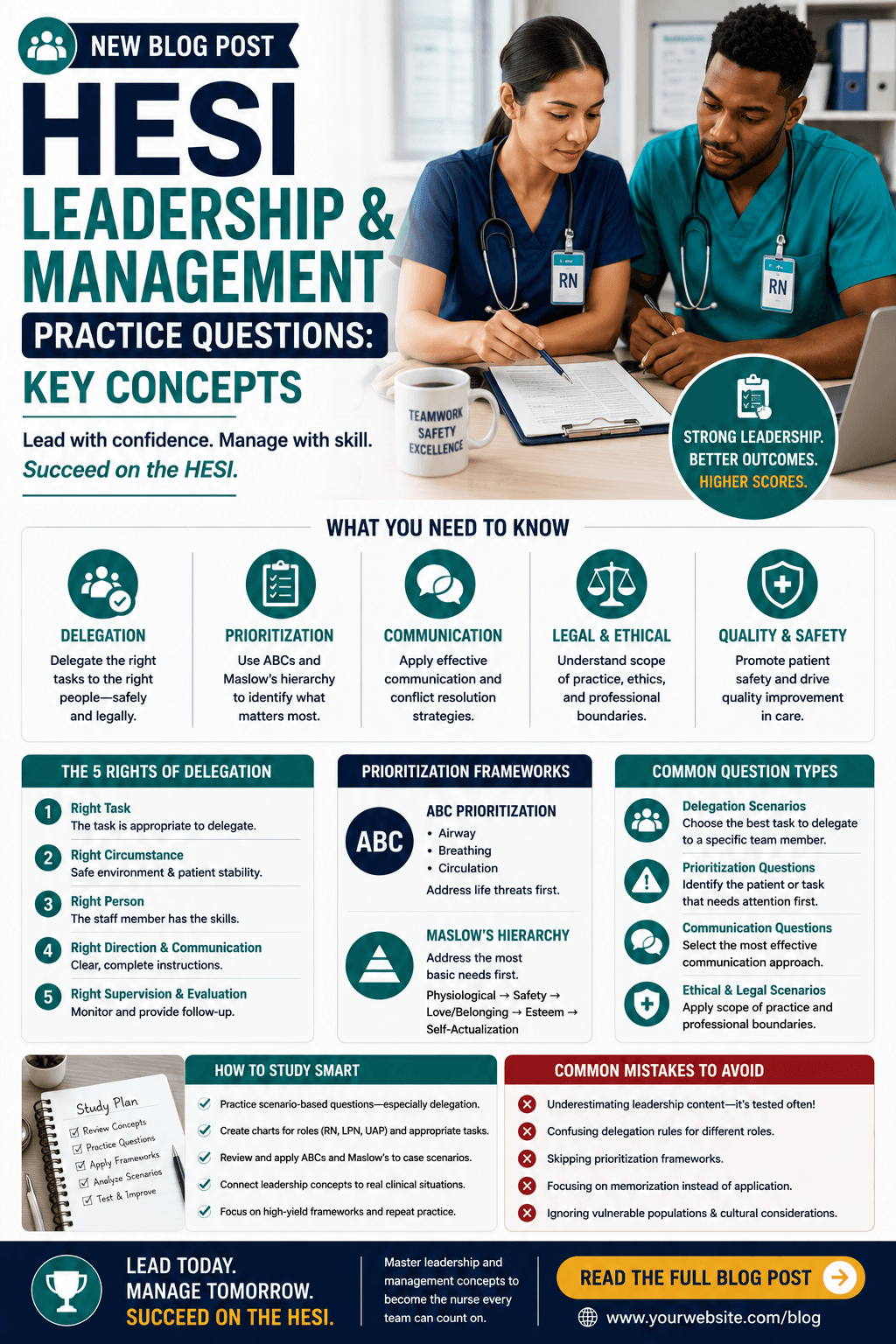
Delegation principles—knowing which tasks can be appropriately delegated to various members of the health care team, such as licensed practical nurses or unlicensed assistive personnel.
- Prioritization and triage: deciding which patient or task needs the most urgent attention when there are several competing demands.
- Communication and conflict resolution – identifying good communication practices on interdisciplinary teams and effective approaches to conflict in the workplace.
- Legal and Ethical Considerations – including scope of practice boundaries and basic ethical principles related to nursing leadership decisions.
- Quality improvement and patient safety — understanding key principles of avoiding errors and continuously improving care in a health care environment.
Delegation principles
Delegation questions are some of the most consistently tested leadership topics, largely because proper delegation has a direct impact on both patient safety and legal accountability.
- The "Five Rights of Delegation" framework is often cited and includes the right task, right circumstance, right person, right direction and communication, and right supervision.
- Fundamental to what can be safely delegated to registered nurses, licensed practical nurses, and unlicensed assistive personnel are the differences in their scope of practice.
- Tasks that cannot generally be delegated – assessment, evaluation and nursing judgment based decisions – are often presented in contrast to tasks that can be appropriately delegated.
Prioritization Frameworks to Consider
- The ABC prioritization (airway, breathing, circulation) is still a basic framework to decide which patient needs to be seen first.
- In nursing, Maslow’s hierarchy of needs is frequently used to prioritize which patient needs are of the highest importance when there are multiple concerns.
- Acute vs. chronic conditions, understanding that an acute condition that changes suddenly generally requires more immediate attention than a chronic concern that is stable.
Typical Types of Questions You Will See
- Delegation scenario questions – these ask you to select the specific task that can be appropriately assigned to a specific team member.
- Prioritization questions, asking which patient/task should be attended to first out of several presented options.
- Communication questions, which assess your understanding of effective, professional communication within a healthcare team.
- Ethical and legal scenario questions to test your understanding of scope of practice and appropriate professional boundaries.
High-Yield Topics for Additional Review
- The Five Rights of Delegation, as this framework keeps coming up throughout leadership content.
- ABC and Maslow’s-based prioritization frameworks due to their wide use across almost any prioritization-style question.
- Key differences in the basic scope of practice for RNs, LPNs, and unlicensed assistive personnel.
- Common examples of appropriate versus inappropriate delegation, as this is a frequently tested skill.
How to Effectively Study Leadership Content
- Practice delegation-specific scenario questions — delegation is one of those skills that is suited to applied practice, not just memorization.
- You can create a simple chart, for reference, of which tasks are appropriate for each member of the health care team.
- Actively review prioritization frameworks, practicing applying ABC and Maslow’s principles to specific patient scenarios.
- Connect leadership ideas to particular clinical scenarios, as it is often easier to understand abstract management ideas when they are linked to known clinical situations.
Common Errors to Avoid
- Underestimating this content area, thinking it is less important than clinical topics, even though it is present throughout the exam.
- Confusing delegation rules for different roles, no clear organized system to differentiate what is appropriate for each team member to do.
- Trying to memorize the structures but not practicing how to respond to specific scenario-based questions.
- Ethical and legal content, often paired with more simple questions about delegation and prioritization, is often ignored.
Concluding Remarks
Leadership and management questions on the HESI exam represent truly important professional responsibilities that go well beyond direct clinical care — delegation, prioritization, and effective team communication all play a vital role in safe, competent nursing practice. This section requires focused confidence, which you can achieve by reviewing high-yield frameworks like the Five Rights of Delegation and ABC prioritization, and by practicing scenario-based questions instead of passive memorization. No matter the clinical specialty that you eventually pursue, these principles of leadership will also continue to be directly relevant for the entirety of your nursing careers.