Why are there so many nursing entrance exams?
There is no national entrance exam to nursing school. Instead, a number of major tests vie to be adopted by different programs, and schools pick which test they will require. The ATI TEAS, HESI A2 and Kaplan Nursing Admission Test are three of the most common tests used. A smaller number of programs use the NLN PAX, primarily in the Northeast.
Well, each school chooses which exam it wants . So the “best “exam for you is not really a choice, it depends on your program’s requirements.
Summary: Each test includes
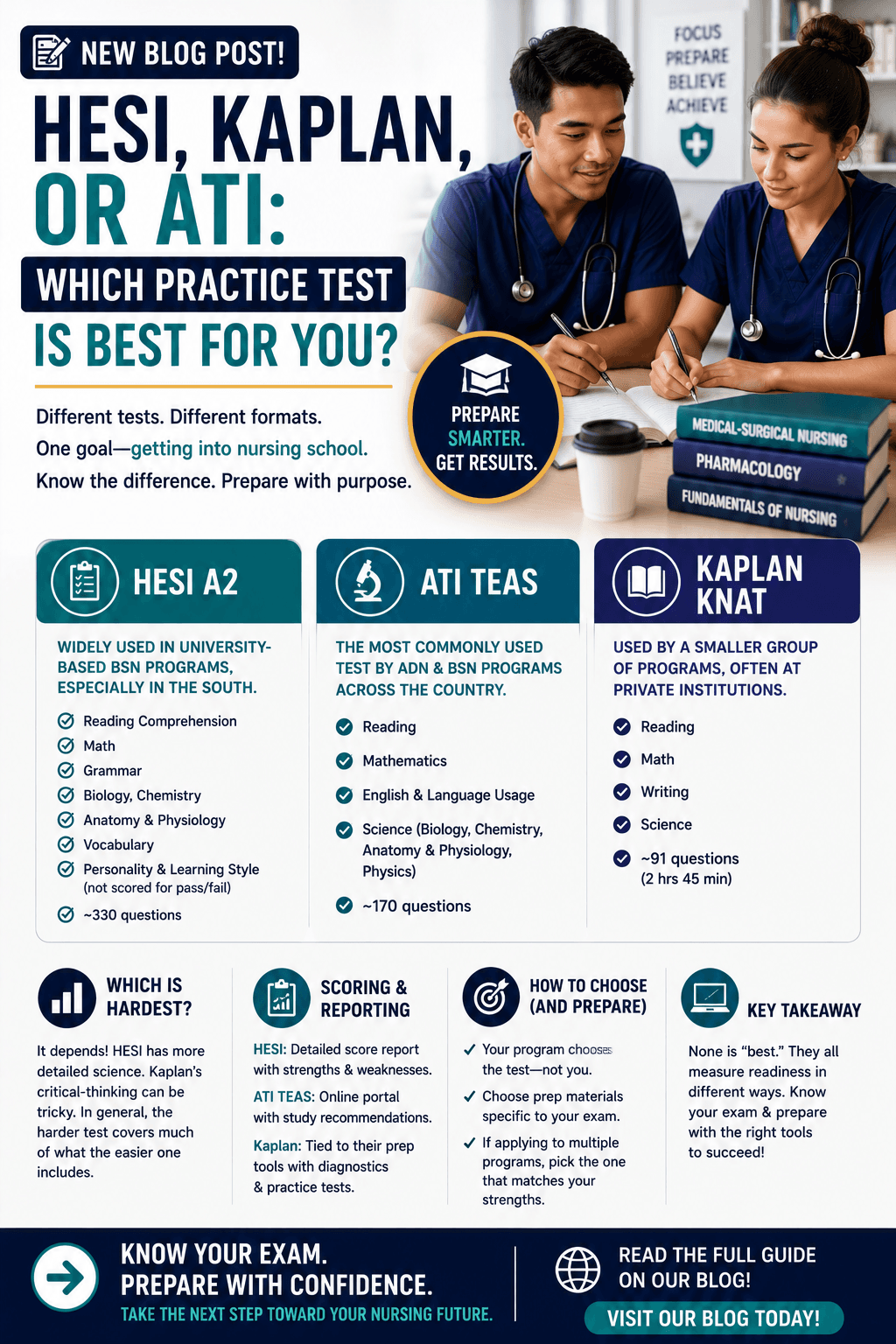
ATI TEAS is the most commonly used of the three and is required or accepted by the vast majority of ADN and BSN programs across the country. It is divided into four main sections: reading, mathematics, English and language usage, and science. It usually has about 170 multiple-choice questions.
The HESI A2 is the second most common exam and is heavily used at university-based BSN programs and in the southern states. The TEAS is more focused on science subjects, including grammar, biology, chemistry, reading comprehension, and math, whereas the TEAS also has sections on anatomy and physiology and vocabulary. It also has a personality and learning style component that generally is not scored for pass/fail purposes, unlike the other exams.
A smaller, but consistent group of programs, often at private institutions, utilize the Kaplan Nursing Admission Test (KNAT). It is generally shorter than the other two, with about 91 multiple-choice questions in four sections – reading, math, writing and science – that are completed in about two hours and forty-five minutes.
What is the Most Difficult Test?
Difficulty is subjective and depends on individual strengths, but a few general patterns are commonly observed. The HESI science section tends to be more detailed than TEAS, and the critical-thinking sections of Kaplan are often viewed as more difficult than either of the other two tests. Typically the harder exam will include much of what the easier exam includes. If you are aiming for a job that requires multiple of these exams, studying for the harder exam will usually prepare you for the easier exam too.
Differences in Scoring and Reporting
The scoring and post-test reporting are slightly different for each exam. Usually, HESI will give you a detailed report of your score compared to the passing scores and give you an idea of what areas of the nursing related content you missed questions in. ATI TEAS scores are usually available through an online student portal and include study recommendations in specific subject areas based on your results. Kaplan’s results are very much tied to its own prep materials, and it offers practice tests and diagnostic tools to help you identify specific areas to review before retaking the test.
How to Decide Which One to Prepare For
You do not really have a choice of which exam to take (your nursing program makes that choice for you), so it is not so much a question of which exam is “best” in a general sense, but how to study for the one your program requires.
- Study resources are often exam specific, so double check exactly which exam your program requires before you purchase any prep materials.
- If you are applying to programs with multiple exams, consider which exam matches your personal strengths better — for example, if you have a stronger science background you may find HESI’s heavier science emphasis more manageable.
- HESI, Kaplan and TEAS prep books and question banks are specific to the format and content focus of each exam so be sure to use practice materials specific to the exam you will be taking.
- Experience with one exam will not necessarily prepare you fully for another. The format, number of questions and timing are very different between exams.
Conclusion
None of the exams, HESI, Kaplan or ATI’s TEAS, is the “best.” They all test the same general areas to see if you are academically ready for nursing school, but they do it in slightly different ways with different content emphasis, formats, and scoring. The most important step is to find out exactly what examination your specific nursing program requires and then focus your preparation on exam-specific materials rather than generic, one-size-fits-all study resources. In addition, once you know what test you are taking, you can study with confidence, knowing that your study time is being spent studying what you are actually going to see on test day.