The Importance of Grammar on the HESI Exam
Given the importance of clear and accurate writing in health care settings, whether writing documentation or patient education materials, the nursing programs include a section on grammar. Solid grammar skills also help your reading comprehension performance since knowing how a sentence is structured will help you better understand complex passages.
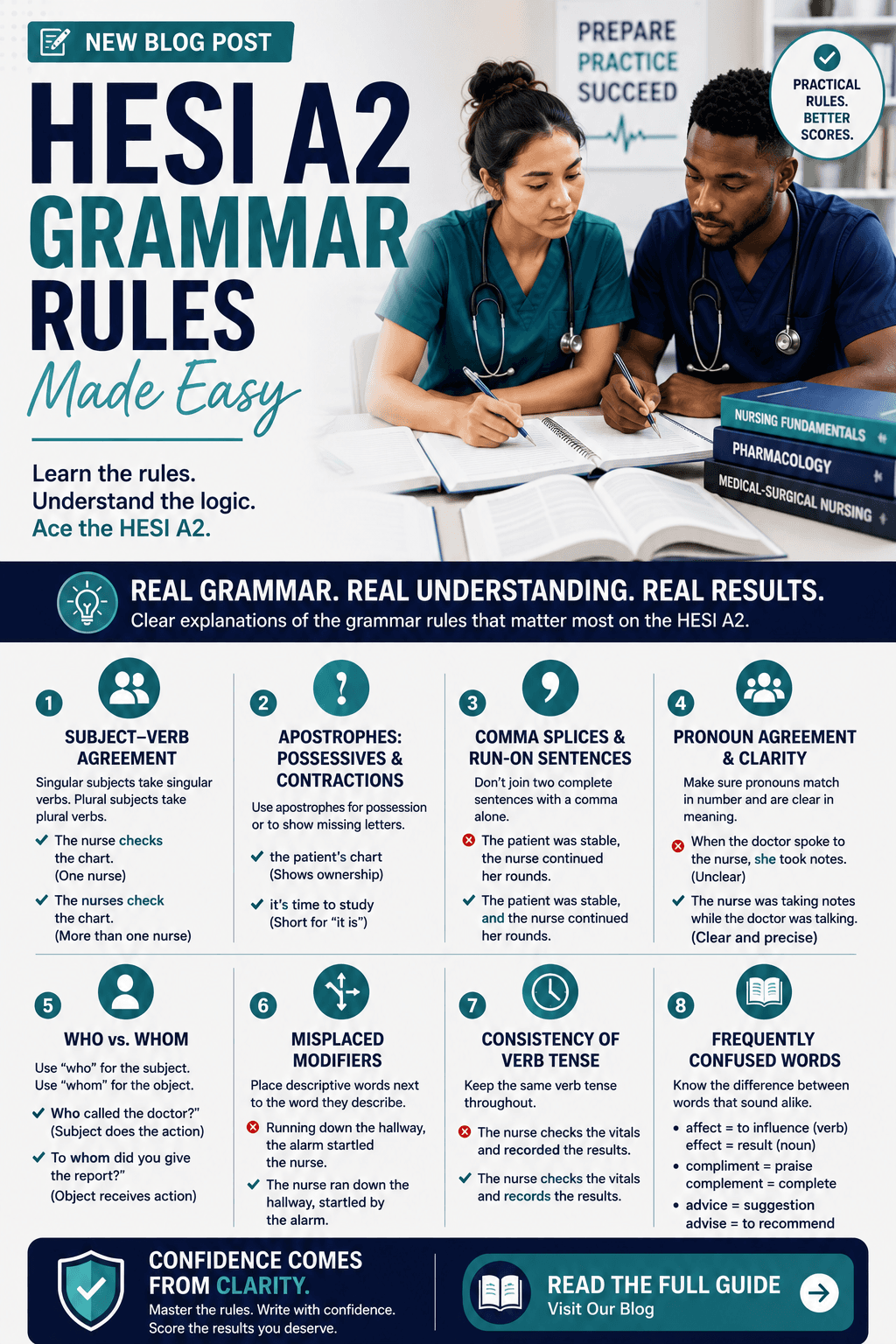
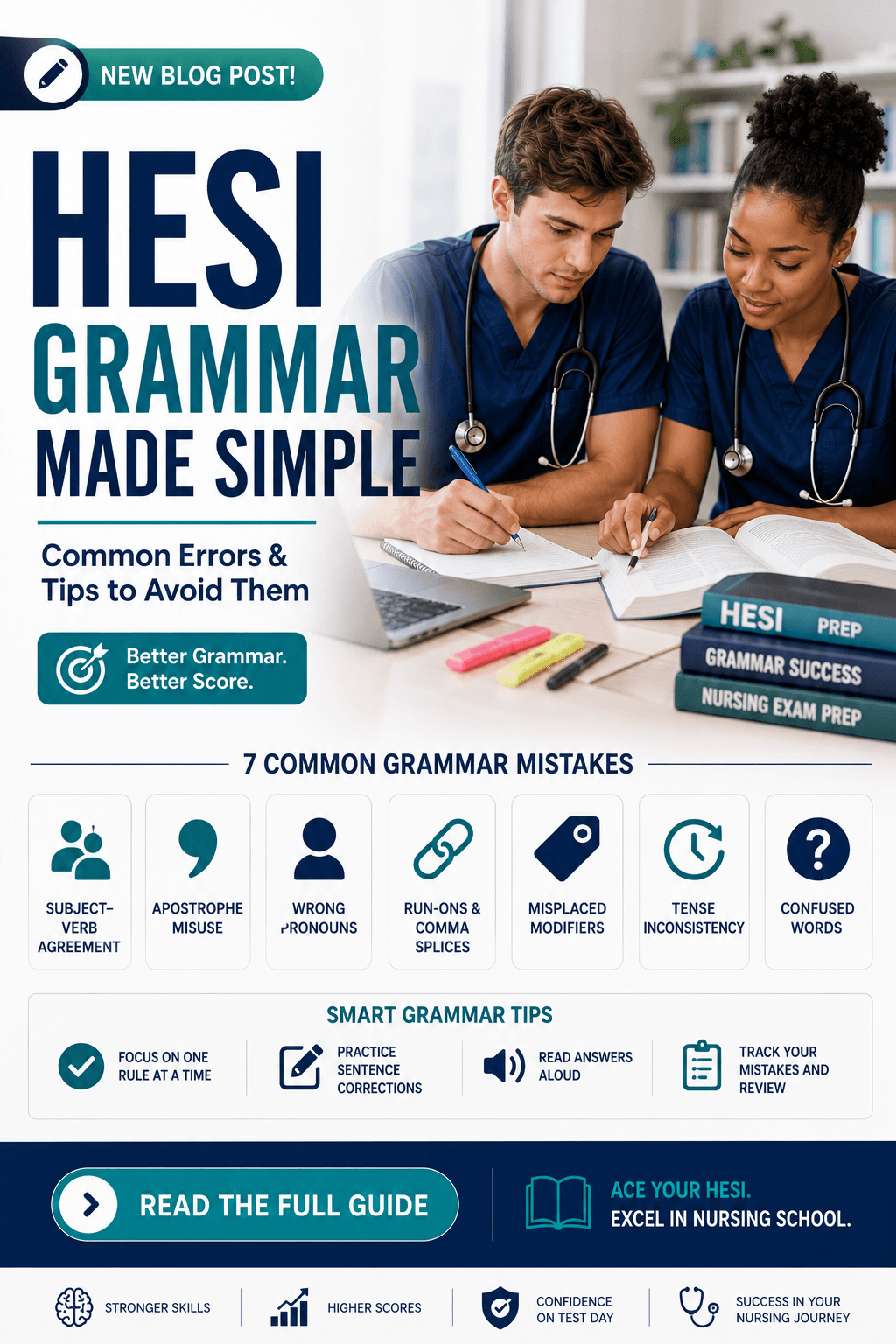
Common Mistake #1: Incorrect Subject-Verb Agreement
One of the most common errors in grammar involves subjects and verbs that do not agree, especially in sentences with compound subjects or phrases placed between them.
The error: Using the wrong form of a verb (singular or plural) with the sentence’s subject, especially when the subject is far from the verb.
How to stop it: Find the real subject of the sentence, ignoring descriptive words in between, and then match the verb to it.
Common Mistake #2: Apostrophes Misused
Apostrophes are often used in the wrong place, especially for possessives and contractions.
The error: Confusing “its” (possessive) with “it’s” (contraction for “it is”) or inserting apostrophes where none are needed for plural nouns that are just plural.
How to prevent it: Try replacing the word with “it is.” If you can, use “it’s.” If you are just showing possession, use “its” without the apostrophe.
Common Mistake #3: Using the Wrong Pronoun
Pronoun mistakes often occur when the reference is unclear or the case is incorrect.
The mistake: Using “who” when “whom” is correct, or making ambiguous pronoun references where it is unclear to what noun a pronoun refers.
How to prevent it: For who/whom questions, put “he” or “him” in the sentence — if “he” works, use “who”; if “him” works, use “whom.” Make sure each pronoun clearly refers to a particular noun. If you have ambiguous references.
Common Mistake #4: Run-ons and Comma Splices
Incorrect combinations of independent clauses are a common structural error.
Error: Joining two complete sentences with only a comma (no proper punctuation or conjunction).
How to escape it: Is each part of the sentence a complete thought? Be sure to join complete thoughts with a period, semicolon, or coordinating conjunction.
Common Mistake #5: Misplaced, Dangling Modifiers
Confusing or unintentionally funny sentences can be produced by misplaced modifiers.
The mistake: Putting a descriptive phrase too far away from the word it is supposed to describe, so that it is unclear what it is actually describing.
How to prevent it: 2. Place descriptive phrases next to the word or subject they describe.
Common Error #6: Improper Verb Tense Consistency
One of the most common errors is to change verb tenses within the same sentence or passage.
The error: Switching from past tense to present tense to future tense without any reason in the same sentence or paragraph.
How to prevent it: Early, determine the overall tense of the sentence or passage, and make sure that all the verbs are consistent consciously.
Common Mistake #7: Misusing Commonly Confused Words
Some words are always confused with another because they are spelled the same or sound the same.
The error: Mixing up words like "affect" and "effect," "than" and "then," or "your" and "you're."
How to prevent it: Learn a simple rule of thumb for each pair, for example, "affect" is usually a verb and "effect" is usually a noun.
How to Get Good at Grammar
- Fix one kind of error at a time, instead of trying to fix all the grammar rules at once.
- Do sentence correction style practice questions, since this is a format very similar to how grammar is tested on the HESI exam.
- Read your answers aloud. Awkward or incorrect grammar frequently “sounds wrong” even when the specific rule is not immediately obvious.
- Write down a list of your own mistakes that you repeat and keep it around. Review the list frequently until you stop making those particular errors in your practice sessions.
Closing Thoughts
The HESI exam is prone to the same old, predictable grammar mistakes, which means that this section is highly improbable with focused practice. By knowing these common mistakes and practicing specific correction exercises, you can improve your grammar score comparatively fast, compared to those content sections that require a lot of memorization. Good grammar skills will help you on the exam as well as throughout nursing school and into your professional documentation and communication as a nurse.